Glossary term: 소행성
Description: 소행성은 태양이나 다른 별, 또는 항성의 잔해 주위를 공전하는 작은 천체입니다. 소행성은 여러 가지 구성 물질로 이루어져 있습니다. 어떤 것은 탄소가 풍부하고, 어떤 것은 암석 물질(규산염)이 많으며, 또 어떤 것은 주로 금속으로 이루어져 있습니다.
대부분의 소행성은 중력에 의해 뭉쳐진 잔해 더미로, 표면이 울퉁불퉁하고 모양이 고르지 않습니다. 일부 소행성은 작은 위성을 가지고 있거나, 다른 소행성이 그 주위를 돌고 있기도 합니다.
소행성은 왜소행성보다 작습니다. 왜소행성은 중력이 충분히 강해 거의 둥근 형태를 유지할 수 있지만, 소행성은 그렇지 않습니다. 소행성의 크기는 보통 가로 1미터에서 10미터 사이부터 시작합니다. 태양이나 별의 열을 받아 가스와 먼지를 방출하는 작은 천체는 소행성이 아니라 혜성이라고 부르지만, 두 천체의 구분이 항상 명확한 것은 아닙니다.
‘소행성’이라는 이름은 역사적으로 태양을 도는 작은 천체들 중, 망원경으로 보기엔 너무 작아서 별처럼 보이는 천체에 붙여졌습니다. 그래서 ‘별’을 뜻하는 그리스어에서 유래해 소행성(asteroid)이라는 이름이 붙었습니다.
Related Terms:
See this term in other languages
Term and definition status: The original definition of this term in English have been approved by a research astronomer and a teacher The translation of this term and its definition is still awaiting approval
The OAE Multilingual Glossary is a project of the IAU Office of Astronomy for Education (OAE) in collaboration with the IAU Office of Astronomy Outreach (OAO). The terms and definitions were chosen, written and reviewed by a collective effort from the OAE, the OAE Centers and Nodes, the OAE National Astronomy Education Coordinators (NAECs) and other volunteers. You can find a full list of credits here. All glossary terms and their definitions are released under a Creative Commons CC BY-4.0 license and should be credited to "IAU OAE".
If you notice a factual or translation error in this glossary term or definition then please get in touch.
Related Media
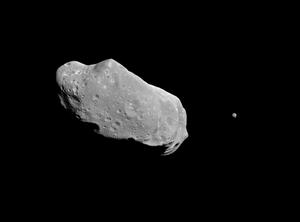
Ida and Dactyl
Caption: This picture of the asteroid Ida with its satellite Dactyl was taken by the Galileo space probe in August 1993 from a range of 10,870 kilometers (6,755 miles). Ida is a heavily cratered, irregularly shaped asteroid in the main asteroid belt between Mars and Jupiter. This image is proof that asteroids like the 56 km large Ida can possess their own moons.
Credit: NASA/JPL
credit link
License: PD Public Domain icons
Related Activities
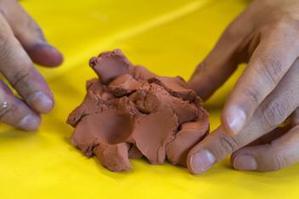
Creating Asteroids
astroEDU educational activity (links to astroEDU website) Description: Have fun, building asteroids using clay!
License: CC-BY-4.0 Creative Commons 저작자표시 4.0 국제 (CC BY 4.0) icons
Tags:
Hands-on
, Model
Age Ranges:
4-6
, 6-8
, 8-10
Education Level:
Pre-school
, Primary
Areas of Learning:
Modelling
, Structured-inquiry learning
Costs:
Medium Cost
Duration:
1 hour 30 mins
Group Size:
Group
Skills:
Communicating information
, Developing and using models
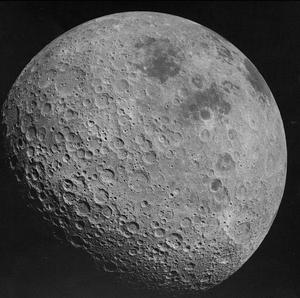
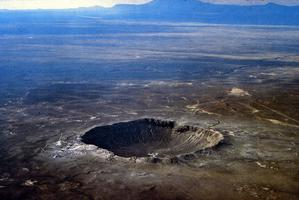
Impact Craters
astroEDU educational activity (links to astroEDU website) Description: A literal Earth-Shattering experiment
License: CC-BY-4.0 Creative Commons 저작자표시 4.0 국제 (CC BY 4.0) icons
Tags:
History
, Impact
, Experiment
Age Ranges:
10-12
, 12-14
, 14-16
Education Level:
Middle School
, Primary
, Secondary
Areas of Learning:
Guided-discovery learning
, Modelling
, Traditional Science Experiment
Costs:
Low Cost
Duration:
1 hour
Group Size:
Group
Skills:
Analysing and interpreting data
, Asking questions
, Constructing explanations
, Engaging in argument from evidence
, Using mathematics and computational thinking
Meteoroids, Meteors and Meteorites
astroEDU educational activity (links to astroEDU website) Description: Unveiling the mystery of "shooting stars": meteors, meteorites and meteroids
License: CC-BY-4.0 Creative Commons 저작자표시 4.0 국제 (CC BY 4.0) icons
Tags:
Geology
Age Ranges:
6-8
, 8-10
, 10-12
, 12-14
Education Level:
Middle School
, Primary
Areas of Learning:
Interactive Lecture
Costs:
Low Cost
Duration:
1 hour 30 mins
Group Size:
Group
Skills:
Analysing and interpreting data
, Asking questions
, Communicating information
, Engaging in argument from evidence

Asteroid miners
astroEDU educational activity (links to astroEDU website) Description: Develop a scientific plan for mining asteroids and extracting space resources!
License: CC-BY-4.0 Creative Commons 저작자표시 4.0 국제 (CC BY 4.0) icons
Age Ranges:
14-16
, 16-19
Education Level:
Secondary
Areas of Learning:
Guided-discovery learning
, Observation based
, Problem-solving
, Project-based learning
, Structured-inquiry learning
, Technology-based
Costs:
Free
Duration:
3-6 hours
Skills:
Analysing and interpreting data
, Asking questions
, Engaging in argument from evidence
, Planning and carrying out investigations