Glossary term: 내행성
Description: 태양계에서 내행성은 수성, 금성, 지구, 화성입니다. 이들 행성의 궤도는 소행성대 안쪽에 있으며, 모두 소위 말하는 지구형 또는 암석형 행성으로서, 두꺼운 수소와 헬륨 대기를 가진 거대행성들에 비해 상대적으로 희박한 대기를 갖고 있습니다.
Related Terms:
See this term in other languages
Term and definition status: The original definition of this term in English have been approved by a research astronomer and a teacher The translation of this term and its definition is still awaiting approval
The OAE Multilingual Glossary is a project of the IAU Office of Astronomy for Education (OAE) in collaboration with the IAU Office of Astronomy Outreach (OAO). The terms and definitions were chosen, written and reviewed by a collective effort from the OAE, the OAE Centers and Nodes, the OAE National Astronomy Education Coordinators (NAECs) and other volunteers. You can find a full list of credits here. All glossary terms and their definitions are released under a Creative Commons CC BY-4.0 license and should be credited to "IAU OAE".
If you notice a factual or translation error in this glossary term or definition then please get in touch.
In Other Languages
- 아랍어: الكوكب الداخلي
- 독일어: Innerer Planet
- 영어: Inner Planet
- 스페인어: Planeta interior
- 페르시아어: سیارات درونی
- 프랑스어: Planète intérieure
- 이탈리아어: pianeta interno
- 브라질 포르투갈어: Planeta Internos
- 중국어 간체: 内行星
- 중국어 번체: 內行星
Related Media
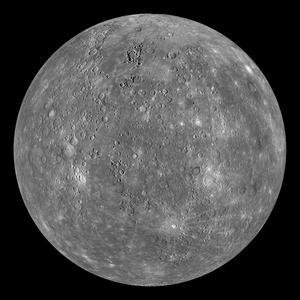
Mercury
Caption: This image is a composite of a picture mosaic of the planet Mercury's surface obtained by the MESSENGER (Mercury Surface, Space Environment, Geochemistry and Ranging) space probe. MESSENGER was launched by NASA in 2004 and explored Mercury from 2011 to 2015.
Credit: NASA/Johns Hopkins University Applied Physics Laboratory/Carnegie Institution of Washington
credit link
License: PD Public Domain icons
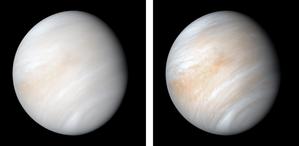
Venus in visible light
Caption: This picture taken by NASA's Mariner 10 probe shows what the planet Venus looks like when looking at it with naked eyes. Venus is enshrouded inside a thick cloudy atmosphere dominated by carbon dioxide, never revealing its hot surface.
Credit: NASA/JPL-Caltech
credit link
License: PD Public Domain icons
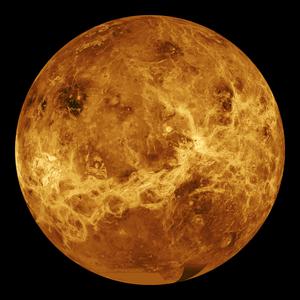
Venus' surface
Caption: This image is a computer-aided rendering of the surface of the planet Venus. Since visual light cannot penetrate the thick clouds in Venus' atmosphere, the image was obtained with radio waves. NASA's space probe Megallan, launched in 1989 mapped Venus' surface between 1990 and 1994.
Credit: NASA/JPL
credit link
License: PD Public Domain icons
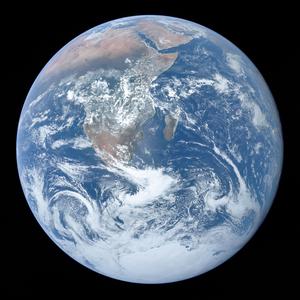
Earth as observed from Apollo 17
Caption: Full disk view of the Earth taken on 7 December 1972, by the crew of the Apollo 17 spacecraft en route to the Moon at a distance of about 29,000 kilometres (18,000 mi). It shows Africa, Antarctica, and the Arabian Peninsula.
Credit: NASA/Apollo 17 crew/Project Apollo Archive
License: PD Public Domain icons
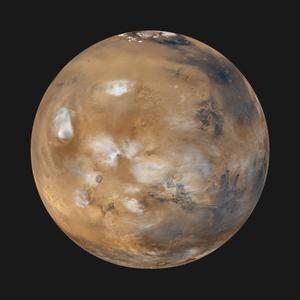
Mars
Caption: This image of the planet Mars taken by NASA's Mars Global Surveyor Orbiter in 1999 shows its dry surface. The picture features the most spectacular geological regions on Mars. Besides the deep Valles Marineris valley we see four volcanoes. While three of them form the Tharsis ridge, the Olympus Mons is largest volcano we have so far discovered in the Solar System. Ice clouds cover parts of the Martian surface.
Credit: NASA/JPL/MSSS
credit link
License: PD Public Domain icons