Termo do glossário: Desvio para o vermelho
Descrição: Este termo pode se referir a três efeitos diferentes: desvio para o vermelho Doppler, cosmológico ou gravitacional. O desvio para o vermelho Doppler é o oposto do desvio para o azul; no caso do desvio para o vermelho, a fonte que emite a radiação eletromagnética está se afastando do observador, e assim o comprimento de onda da radiação eletromagnética é esticado para comprimentos de onda mais longos (mais avermelhados). Isso é semelhante ao efeito Doppler no contexto das ondas sonoras. O redshift ou desvio para o vermelho cosmológico é o resultado do alongamento para comprimentos de onda mais longos da radiação eletromagnética emitida por uma fonte devido à expansão física do espaço, ao contrário do redshift Doppler, que se deve ao movimento relativo. O redshift ou desvio para o vermelho gravitacional refere-se ao efeito em que o comprimento de onda da radiação eletromagnética emitida por uma fonte é alongado para comprimentos de onda maiores, ou seja, os fótons associados perdem energia ao tentarem sair de uma região (poço gravitacional) onde a gravidade é mais intensa.
Termos relacionados:
Ver este termo em outros idiomas
Status do termo e da definição: A definição original deste termo em inglês foi aprovada por um astrônomo(a) pesquisador(a) e um(a) professor(a) A tradução deste termo e de sua definição ainda aguarda aprovação
O Glossário Multilíngue da OAE é um projeto do Escritório da IAU de Astronomia para a Educação (OAE) em colaboração com o Escritório da IAU para Divulgação da Astronomia (OAO). Os termos e definições foram selecionados, escritos e revisados por meio de um esforço coletivo da OAE, dos Centros e Nós da OAE, dos Coordenadores Nacionais de Educação em Astronomia (NAECs) da OAE e de outros voluntários. Você pode encontrar uma lista completa dos créditos aqui. Todos os termos do glossário e suas definições são disponibilizados sob uma licença Creative Commons CC BY-4.0 e devem ser creditados à "IAU OAE".
Se você notar algum erro factual ou de tradução neste termo do glossário ou em sua definição, por favor entre em contato.
Em outros idiomas
- Árabe: الانزياح الأحمر
- Alemão: Rotverschiebung
- Inglês: Redshift
- Espanhol: Desplazamiento al rojo
- Francês: Décalage vers le rouge
- Italiano: redshift
- Japonês: 赤方偏移 (link externo)
- Chinês Simplificado: 红移
- Chinês Tradicional: 紅移
Mídia relacionada
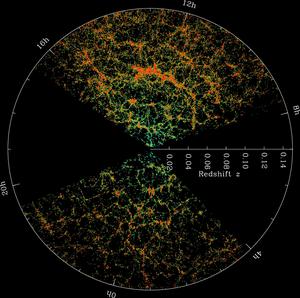
SDSS Redshift Map
Legenda: This image shows a map of the distribution of galaxies and is based on redshift data from the Sloan Digital Sky Survey (SDSS). Redshift measurements provides information on the distances, positions and motions of the galaxies.
The Earth is located at the center of the image, and each dot represents a galaxy. The outer circle represents a ""distance"" of about 2 billion light years. The idea of distance in cosmology is complex because the usual measurement of distance is the separation between two points in space at the same time. However, because of the speed of light, the further a distance, the farther back in time we are observing. The numbers on the outer circle are Right Ascension coordinates mapped onto a flat circle, and provides information on the position of the galaxies on the sky. The colours used represent the ages of the stars in the galaxies, the redder, more strongly clustered points represent galaxies comprising of older stars. The dark wedges that do not contain any dots are regions that were not mapped by the SDSS due to dust from the Milky Way galaxy obscuring the view.
Crédito: M. Blanton and Sloan Digital Sky Survey
link do crédito
License: CC-BY-4.0 Creative Commons Attribution 4.0 International (CC BY 4.0) ícones