This page describes an image Pan-STARRS Survey: Mosaic of the Northern Sky
Baixar arquivo ( imagem 6.63 MB)
Legenda da imagem:
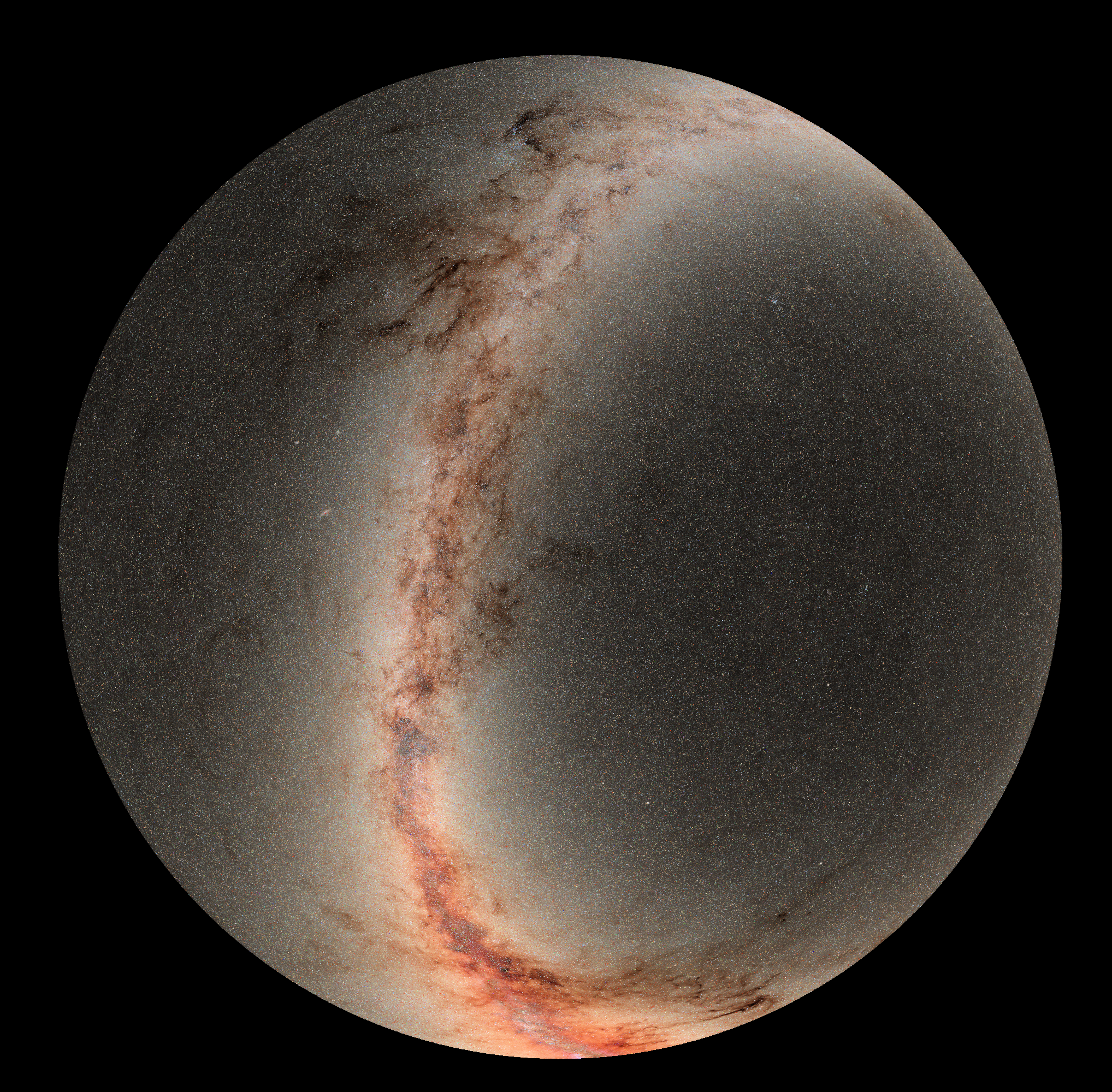
This circular mosaic was created from thousands of sky images taken by the Pan-STARRS Observatory, a 1.8-meter telescope located on the volcano Haleakalā on Maui, Hawai`i. The centre of the circle marks the north celestial pole, while the outer boundary corresponds to a declination of −30 degrees — the southern limit of the survey from that location. Each part of this image was visited multiple times during the survey with each location imaged in five different colors with multiple images per color to catch objects changing in brightness and to find moving objects such as asteroids. This dataset is a powerful example of an astronomical survey, in which the sky is systematically photographed to build large, uniform catalogs of celestial objects.
The wide, bright band running roughly from top to bottom is the Milky Way, with the Galactic centre appearing near the lower edge where the glow is strongest. Across the image are hundreds of millions of detected sources, most of them stars within our own galaxy, along with many distant galaxies in the background. Surveys like Pan-STARRS are essential for studying the structure of the Milky Way and for discovering new objects across vast areas of the sky.
Role até as legendas em outros idiomas
Crédito da imagem: Richard White (STScI), Pan-STARRS1 Science Consortium Link do crédito
Termos relacionados do glossário:
Levantamento Astronômico
Licença da imagem: Public Domain Public Domain ícones
As legendas dos arquivos de mídia apresentadas no site da OAE foram escritas, traduzidas e revisadas por meio de um esforço coletivo da OAE, dos Centros e Nós da OAE, dos Coordenadores Nacionais de Educação em Astronomia (NAECs) da OAE e de outros voluntários. Você pode encontrar uma lista completa dos créditos do nosso projeto de tradução aqui. Todas as legendas dos arquivos de mídia são disponibilizadas sob uma licença Creative Commons CC BY-4.0 e devem ser creditadas à "IAU OAE". Os próprios arquivos de mídia podem ter licenças diferentes (veja acima) e devem ser creditados conforme indicado acima em "crédito".
Se você notar algum erro factual nesta legenda ou algum erro em qualquer uma de suas traduções, por favor entre em contato.
Legendas em diferentes idiomas:
Legenda da imagem: Dieses kreisförmige Mosaik wurde aus Tausenden von Himmelsaufnahmen erstellt, die vom Pan-STARRS-Observatorium aufgenommen wurden, einem 1,8-Meter-Teleskop auf dem Vulkan Haleakalā auf Maui, Hawaii. Der Mittelpunkt des Kreises markiert den nördlichen Himmelspol, während der äußere Rand einer Deklination von −30 Grad entspricht – der südlichen Grenze der Durchmusterung von diesem Standort aus. Jeder Teil dieses Bildes wurde während der Durchmusterung mehrfach erfasst, wobei jeder Ort in fünf verschiedenen Farben und mit mehreren Bildern pro Farbe aufgenommen wurde, um Helligkeitsänderungen zu erfassen und sich bewegende Objekte wie Asteroiden zu finden. Dieser Datensatz ist ein eindrucksvolles Beispiel für eine astronomische Durchmusterung, bei der der Himmel systematisch fotografiert wird, um große, einheitliche Kataloge von Himmelsobjekten zu erstellen.
Das breite, helle Band, das sich grob von oben nach unten erstreckt, ist die Milchstraße, wobei das galaktische Zentrum nahe dem unteren Rand zu sehen ist, wo das Leuchten am stärksten ist. Auf dem Bild sind Hunderte Millionen erfasster Quellen zu sehen. Bei den meisten davon handelt es sich um Sterne innerhalb unserer eigenen Galaxie, zusammen mit vielen weit entfernten Galaxien im Hintergrund. Durchmusterungen wie Pan-STARRS sind unerlässlich für die Erforschung der Struktur der Milchstraße und für die Entdeckung neuer Objekte über riesige Himmelsareale hinweg.
Crédito da imagem: Richard White (STScI), Pan-STARRS1-Wissenschaftskonsortium
Termos relacionados do glossário: Durchmusterung Status da tradução da legenda: Ainda não aprovado por um revisor
Tradutores da legenda: Simon Kraus
Legenda da imagem: This circular mosaic was created from thousands of sky images taken by the Pan-STARRS Observatory, a 1.8-meter telescope located on the volcano Haleakalā on Maui, Hawai`i. The centre of the circle marks the north celestial pole, while the outer boundary corresponds to a declination of −30 degrees — the southern limit of the survey from that location. Each part of this image was visited multiple times during the survey with each location imaged in five different colors with multiple images per color to catch objects changing in brightness and to find moving objects such as asteroids. This dataset is a powerful example of an astronomical survey, in which the sky is systematically photographed to build large, uniform catalogs of celestial objects.
The wide, bright band running roughly from top to bottom is the Milky Way, with the Galactic centre appearing near the lower edge where the glow is strongest. Across the image are hundreds of millions of detected sources, most of them stars within our own galaxy, along with many distant galaxies in the background. Surveys like Pan-STARRS are essential for studying the structure of the Milky Way and for discovering new objects across vast areas of the sky.
Crédito da imagem: Richard White (STScI), Pan-STARRS1 Science Consortium
Termos relacionados do glossário: Astronomical Survey
Legenda da imagem: Questo mosaico circolare è stato realizzato a partire da migliaia di immagini del cielo acquisite dall’Osservatorio Pan-STARRS, un telescopio da 1,8 metri situato sul vulcano Haleakalā a Maui, nelle Hawaii. Il centro del cerchio indica il polo nord celeste, mentre il bordo esterno corrisponde a una declinazione di −30 gradi — il limite meridionale dell’osservazione da quella posizione. Ogni parte di questa immagine è stata visitata più volte durante l'indagine, con ogni posizione ripresa in cinque colori diversi e più immagini per colore, al fine di catturare oggetti che cambiano di luminosità e individuare oggetti in movimento come gli asteroidi. Questo set di dati è un potente esempio di indagine astronomica, in cui il cielo viene fotografato sistematicamente per costruire cataloghi ampi e uniformi di oggetti celesti.
L'ampia fascia luminosa che si estende approssimativamente dall'alto verso il basso è la Via Lattea, con il centro galattico che appare vicino al bordo inferiore, dove il bagliore è più intenso. Nell'immagine sono presenti centinaia di milioni di sorgenti rilevate, la maggior parte delle quali sono stelle all'interno della nostra galassia, insieme a molte galassie lontane sullo sfondo. Rilevamenti come Pan-STARRS sono essenziali per studiare la struttura della Via Lattea e per scoprire nuovi oggetti in vaste aree del cielo.
Crédito da imagem: Richard White (STScI), Consorzio scientifico Pan-STARRS1
Termos relacionados do glossário: indagine astronomica Status da tradução da legenda: Ainda não aprovado por um revisor
Tradutores da legenda: Giuliana Giobbi