Termo do glossário: Levantamento Astronômico
Descrição: Um levantamento astronômico é um conjunto de dados astronômicos obtidos por meio de observações de todo o céu ou de uma região dele. Esses levantamentos geralmente contêm informações sobre as posições dos objetos astronômicos que catalogam em um determinado momento, bem como sobre seus brilhos, cores e outras propriedades. Grandes levantamentos astronômicos mapeiam o céu tanto para fornecer dados para pesquisas astronômicas quanto para ajudar na seleção de alvos para grandes telescópios.
O projeto de um levantamento astronômico dependerá de seus objetivos científicos; por exemplo, se visa o céu inteiro, grandes partes do céu ou apenas áreas menores. Levantamentos que cobrem áreas menores do céu, conhecidos como levantamentos de feixe estreito, podem dedicar mais tempo à observação de uma mesma região e, por isso, são capazes de detectar objetos mais tênues do que alguns levantamentos de maior abrangência.
Os levantamentos astronômicos podem abranger partes específicas do espectro eletromagnético, como ondas de rádio ou o infravermelho, ou podem combinar dados de diferentes faixas de comprimento de onda.
Alguns levantamentos astronômicos realizam observações repetidas da mesma parte do céu, permitindo o estudo científico do movimento dos objetos pelo céu e da variação no brilho dos objetos astronômicos ou do surgimento de objetos transitórios, como supernovas. Ao medir a variação anual nas posições, os astrônomos também podem calcular a distância dos objetos usando o paralaxe. Outro tipo de levantamento astronômico é o levantamento espectroscópico, que mede os espectros de milhares (ou milhões) de estrelas, galáxias e outros objetos astronômicos.
Termos relacionados:
- Brilho
- Cor
- Astronomia infravermelha
- Astronomia Óptica
- Paralaxe
- Radioastronomia
- Mapa Celeste
- Espectro
- Supernova
Ver este termo em outros idiomas
Status do termo e da definição: A definição original deste termo em inglês foi aprovada por um astrônomo(a) pesquisador(a) e um(a) professor(a) A tradução deste termo e de sua definição ainda aguarda aprovação
O Glossário Multilíngue da OAE é um projeto do Escritório da IAU de Astronomia para a Educação (OAE) em colaboração com o Escritório da IAU para Divulgação da Astronomia (OAO). Os termos e definições foram selecionados, escritos e revisados por meio de um esforço coletivo da OAE, dos Centros e Nós da OAE, dos Coordenadores Nacionais de Educação em Astronomia (NAECs) da OAE e de outros voluntários. Você pode encontrar uma lista completa dos créditos aqui. Todos os termos do glossário e suas definições são disponibilizados sob uma licença Creative Commons CC BY-4.0 e devem ser creditados à "IAU OAE".
Se você notar algum erro factual ou de tradução neste termo do glossário ou em sua definição, por favor entre em contato.
Em outros idiomas
- Árabe: المسح الفلكي
- Alemão: Durchmusterung
- Inglês: Astronomical Survey
- Espanhol: Estudio Astronómico
- Francês: Relevé astronomique
- Italiano: indagine astronomica
- Japonês: サーベイ観測 (link externo)
- Chinês Simplificado: 天文巡天
- Chinês Tradicional: 天文巡天
Mídia relacionada
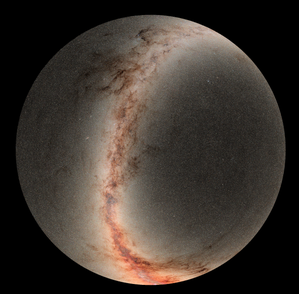
Pan-STARRS Survey: Mosaic of the Northern Sky
Legenda: This circular mosaic was created from thousands of sky images taken by the Pan-STARRS Observatory, a 1.8-meter telescope located on the volcano Haleakalā on Maui, Hawai`i. The centre of the circle marks the north celestial pole, while the outer boundary corresponds to a declination of −30 degrees — the southern limit of the survey from that location. Each part of this image was visited multiple times during the survey with each location imaged in five different colors with multiple images per color to catch objects changing in brightness and to find moving objects such as asteroids. This dataset is a powerful example of an astronomical survey, in which the sky is systematically photographed to build large, uniform catalogs of celestial objects.
The wide, bright band running roughly from top to bottom is the Milky Way, with the Galactic centre appearing near the lower edge where the glow is strongest. Across the image are hundreds of millions of detected sources, most of them stars within our own galaxy, along with many distant galaxies in the background. Surveys like Pan-STARRS are essential for studying the structure of the Milky Way and for discovering new objects across vast areas of the sky.
Crédito: Richard White (STScI), Pan-STARRS1 Science Consortium
link do crédito
License: PD Domínio Público ícones
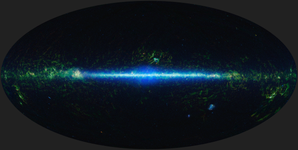
WISE Survey Capturing the Whole Sky in Infrared Light
Legenda: This image presents the entire sky mapped in infrared light from space by the WISE satellite. While dust in the plane of the Milky Way blocks visible light, obscuring the heart of our Galaxy, infrared light passes through the dust. The most prominent feature is the broad, bright band running horizontally through the centre — this is the plane of our Milky Way galaxy. Numerous brighter knots and patches appear above and below the band, marking regions of active star formation and nearby galaxies.
Such a dataset is a classic example of an astronomical survey, in which large portions of the sky is scanned to build a comprehensive catalogue of cosmic sources. The WISE satellite operated in space, allowing it to study parts of the infrared spectrum blocked by Earth's atmosphere.
Crédito: NASA/JPL-Caltech
link do crédito
License: PD Domínio Público ícones