词条 红外天文学
描述: 红外天文学是观测红外光的天文学分支。与可见光观测相比,红外天文学对温度较低的天体更为敏感,也可以观测到红移较大的遥远星系。红外观测受星际消光的影响较小,因此可以看到深空的星际气体云和尘埃云。
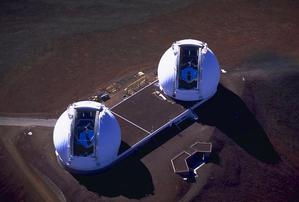
地球大气层中的分子会吸收大量来自太空的红外光,因此地面上的红外天文观测主要是在吸收率较低的波长范围内进行。地球及其大气层都会辐射红外线,因此需要特殊的技术来消除这种本底辐射。对于波长较长的红外辐射,这种本底辐射加上大气吸收使得地面观测几乎不可能。因此,许多红外观测都是利用太空望远镜进行的。不过,对于波长最长的红外线,可以在非常干燥的地方进行地面观测。这通常被称为亚毫米波天文学。
相关词条
用其他语言查看该词条
词条和定义状态: 该术语的英文原始定义已通过天文研究人员和教师的审核 该术语及其定义的译文仍待审核
OAE多语言词汇表是由国际天文学联合会(IAU) 天文教育办公室(OAE) 和 国际天文学联合会(IAU) 天文推广办公室(OAO)合作的项目。. 术语和定义由 OAE中心, OAE 国家天文教育协调员(NAECs) 以及其他志愿者共同选择、撰写和审阅。您可以在 找到完整的致谢列表。所有词汇表术语及其定义均根据 Creative Commons CC BY-4.0许可证发布 且版权归属于 “IAU OAE”。
如果您发现此词汇术语或定义中的事实或翻译错误, 请向 发邮件 联系.
其他语言版本
- 阿拉伯语: علم فلك الأشعة تحت الحمراء
- 德语: Infrarotastronomie
- 英语: Infrared Astronomy
- 西班牙语: Astronomía infrarroja
- 法语: Astronomie infrarouge
- 意大利语: Astronomia all'infrarosso
- 尼泊尔语: इन्फ्रारेड खगोल विज्ञान
- 巴西葡萄牙语: Astronomia infravermelha
- 繁体中文: 紅外天文學
相关媒体
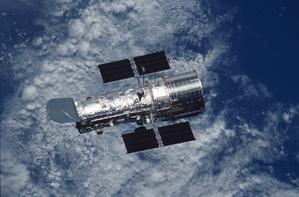
哈勃太空望远镜俯瞰地球
图注: 环绕地球运行的 NASA/ESA 哈勃太空望远镜。这张照片是哥伦比亚号航天飞机上的宇航员在对太空望远镜本身执行完 3B 号维修任务后拍摄的。望远镜有一个开口,允许光线进入(在望远镜的左侧)。光线穿过望远镜的光学系统,到达位于望远镜另一端凸起处的照相机和摄谱仪(右侧)。这些仪器的数据随后通过天线传回地球。望远镜两侧的黑色矩形是为天文台供电的太阳能电池板。
来源: 美国宇航局/欧空局
来源链接

The Pillars of Creation in comparison
图注: The 'Pillars of Creation' are a renowned astronomical feature situated within the Eagle Nebula in the Serpens constellation. The illustration provides a direct comparison between images captured by the Hubble Space Telescope (HST) and the James Webb Space Telescope (JWST), showcasing the pillars, which span several light years in diameter, in both visible light (also known as optical light) and infrared light. On the left are the pillars as seen by Hubble in visual light, taken in 2014. It displays dark pillars against an opaque background, with only a handful of visible stars. Conversely, the counterpart on the right is Webb’s near-infrared view published in 2022, penetrating the dust and revealing numerous stars of varying sizes.
Their distance from Earth is approximately 6,500 to 7,000 light years. Within these pillars, new stars are constantly forming, making them a subject of extensive study by astronomers. Composed mostly of cool molecular hydrogen and small amounts of interstellar dust, they are subject to erosion by the intense ultraviolet radiation emitted by nearby massive and newborn stars, a process known as photoevaporation.
来源: NASA, ESA, CSA, STScI
来源链接

Herschel’s view of new stars and molecular clouds
图注: This image shows the Westerhout 3, 4 and 5 star formation regions. This area has huge amounts of gas and dust. This gas and dust hides the physical processes going on in this region from studies using visible light. This image was taken in infrared light by the Herschel Space Observatory. This infrared light allowed Herschel to see deep into these star forming regions.
In Westerhout 3, 4 and 5, huge, cold clouds of molecular hydrogen have collapsed into dense knots and filaments. Within these new structures the gas is dense and cold enough for it to collapse and form stars. These new stars give off powerful winds of charged particles, like stronger versions of the solar wind our sun gives off. These winds have combined to blow massive bubbles in the surrounding gas and dust. These are visible as the large darker voids in the image.
来源: ESA/Herschel/NASA/JPL-Caltech; acknowledgement: R. Hurt (JPL-Caltech)
来源链接
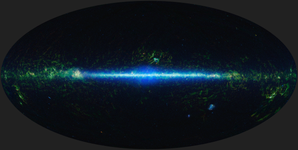
WISE Survey Capturing the Whole Sky in Infrared Light
图注: This image presents the entire sky mapped in infrared light from space by the WISE satellite. While dust in the plane of the Milky Way blocks visible light, obscuring the heart of our Galaxy, infrared light passes through the dust. The most prominent feature is the broad, bright band running horizontally through the centre — this is the plane of our Milky Way galaxy. Numerous brighter knots and patches appear above and below the band, marking regions of active star formation and nearby galaxies.
Such a dataset is a classic example of an astronomical survey, in which large portions of the sky is scanned to build a comprehensive catalogue of cosmic sources. The WISE satellite operated in space, allowing it to study parts of the infrared spectrum blocked by Earth's atmosphere.
来源: NASA/JPL-Caltech
来源链接
License: PD 公共领域 图标






.png)