词条 视差
描述: 视差是由于观察者视点的变化,导致天体在天空中位置的表观变化。天空中的位置变化,以角度表示,是相对于我们所知道的最远的物体来确定的——过去是使用遥远的恒星;是被称为类星体的极其遥远的物体,它们确定了所谓的国际天球参考框架。视位置变化的角度与天体离我们的距离成反比,因此视差测量是确定邻域天体距离的有力工具("视差法")。对于太阳系天体,从地球上不同位置同时进行观测可以得到有效的视差值。对于恒星来说,视差角是观测者位置与视线成直角移动一个天文单位(地球-太阳平均距离)时的偏移值。观测者的位置移动量可以通过相隔几个月的观测来实现,在这几个月之间,地球沿着围绕太阳的轨道移动。根据定义,在这种条件下视差角为 1 弧秒的天体与地球的距离为 1 秒差距(3.26 光年)。在一年中,恒星在天空中的视位置会划出一个椭圆,其半主轴就是视差角。迄今为止最精确的恒星视差是由欧空局的盖亚任务提供的,盖亚任务是专门为这项任务设计的太空望远镜。
相关词条
用其他语言查看该词条
词条和定义状态: 该术语的英文原始定义已通过天文研究人员和教师的审核 该术语及其定义的译文仍待审核
OAE 多语言词汇表是由国际天文学联合会(IAU) 天文教育办公室(OAE) 和 国际天文学联合会(IAU) 天文推广办公室(OAO)合作的项目。. 术语和定义由 OAE中心, OAE 国家天文教育协调员(NAECs) 以及其他志愿者共同选择、撰写和审阅。您可以在 找到完整的致谢列表。所有词汇表术语及其定义均根据 Creative Commons CC BY-4.0许可证发布 且版权归属于 "IAU OAE"。
如果您发现此词汇术语或定义中的事实或翻译错误, 请向 发邮件 联系.
其他语言版本
- 阿拉伯语: زاوية إختلاف المنظر
- 德语: Parallaxe
- 英语: Parallax
- 西班牙语: Paralaje
- 法语: Parallaxe
- 意大利语: Parallasse
- 日语: 視差 (外部链接)
- 巴西葡萄牙语: Paralaxe
- 繁体中文: 視差
相关图表

Annual Parallax
图注: Distance determination has historically been a challenge for astronomy. One of the primary ways to measure distance is to use annual parallax. The Earth orbits around the Sun over the course of a year meaning that it moves from one side of the Sun (shown here as position A) to the other side of the Sun (position B) over the course of six months. It then moves back to its original position over the remaining six months. This movement subtly changes the perspective an observer on Earth sees the night sky from. This is similar to the change in viewing perspective you may get when viewing a scene from your left eye and then your right eye. The change of viewing perspective causes nearby objects to shift in position in your vision. The annual motion of the Earth around the Sun changes the perspective of the observer enough to shift the observed positions of celestial objects. How big this effect is depends on the distance to the celestial object. Nearby stars will have bigger shifts in observed position than more distant stars.
The positional shift is known as the trigonometric or annual parallax (which we will call α here) and is defined as the shift in position of a star compared to what an observer at the center of the Solar System (the Sun) would see. In this diagram we see the star viewed from perspectives six months apart (positions A and B). When observed from position A the star’s shift in position will be α while when observed at position B it will be –α. Thus the relative difference in the stars position between being observed at position A and position B will be 2α.
The size of the trigonometric or annual parallax in arcseconds is approximately 1 divided by the distance in parsecs. An arcsecond (often represented by a ″ symbol) is the angular diameter a one-metre-long stick would have when viewed from 206 km away. A parsec (often abbreviated to pc) is 3.26 light years or 30.86 trillion kilometres. This is 206,265 astronomical units (the typical distance between the Earth and the Sun). No other star is closer than 1 pc to the Sun so all stars in the sky have trigonometric parallaxes less than one arcsecond.
While trigonometric parallaxes have long been used to measure the distances to objects in our Solar System or nearby stars, recent advances have pushed the boundaries of these distance measures further. The Gaia satellite has pushed the boundaries of parallax measurements to over a thousand parsecs. Arrays of radio telescopes can also very accurately measure the positions of very distant objects and thus their trigonometric parallax.
Note the Earth and Sun are not to scale here and the Earth’s axial tilt is not accurately represented.
来源: Aneta Margraf/IAU OAE
相关活动
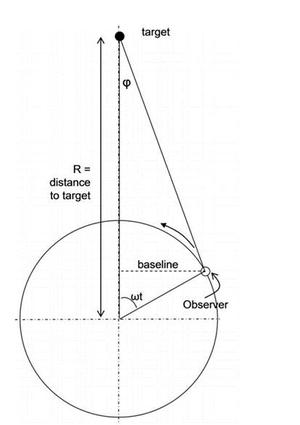
The 4-Point Backyard Diurnal Parallax Method
astroEDU educational activity (links to astroEDU website) Description: Measure the distance to an asteroid with a novel technique
License: CC-BY-4.0 知识共享许可协议 署名 4.0 国际 (CC BY 4.0) 图标
标签:
Hands-on
, Measurement
, Distances
, CCD imaging
, astrometry
年龄段:
16-19
, 19+
受教育等级:
非正式
, 中学
, 大学
学习领域:
引导式发现学习
, 项目式学习
费用:
高成本
时间跨度:
多天
组别大小:
小组
技能:
分析和解读数据
, 提出问题
, 传达信息
, 构建解释
, 规划并开展调查
, 使用数学和计算思维