Termo do glossário: Paralaxe
Descrição: A paralaxe é a mudança aparente na posição de um objeto celeste no céu devido a uma mudança no ponto de vista do observador. A mudança de posição no céu, expressa como um ângulo, é determinada em relação aos objetos mais distantes que conhecemos - historicamente, estrelas distantes; na astronomia moderna, objetos extremamente distantes chamados quasares, que determinam o que é chamado de Sistema Internacional de Referência Celeste. O ângulo da mudança de posição aparente é inversamente proporcional à distância do objeto em relação a nós, tornando as medições de paralaxe uma ferramenta poderosa para determinar distâncias em nossa vizinhança cósmica ("método de paralaxe"). Para objetos do Sistema Solar, observações simultâneas de diferentes locais na Terra podem gerar valores úteis de paralaxe. Para estrelas, os ângulos de paralaxe são dados para um deslocamento padrão da posição do observador em uma unidade astronômica (a distância média Terra-Sol) em ângulos retos em relação à linha de visão. Mudanças de posição do observador dessa magnitude podem ser obtidas fazendo-se observações com vários meses de intervalo, com a Terra se movendo ao longo de sua órbita ao redor do Sol nesse intervalo. Por definição, um objeto cujo ângulo de paralaxe nessas condições é de 1 segundo de arco está a uma distância de 1 parsec (3,26 anos-luz) da Terra. Em um ano, a posição aparente de uma estrela no céu traça uma elipse, cujo semi-eixo maior é o ângulo de paralaxe. As paralaxes estelares mais precisas até o momento são fornecidas pela missão Gaia da ESA, um telescópio espacial projetado especificamente para essa tarefa.
Termos relacionados:
Ver este termo em outros idiomas
Status do termo e da definição: A definição original deste termo em inglês foi aprovada por um astrônomo(a) pesquisador(a) e um(a) professor(a) A tradução deste termo e de sua definição ainda aguarda aprovação
O Glossário Multilíngue da OAE é um projeto do Escritório da IAU de Astronomia para a Educação (OAE) em colaboração com o Escritório da IAU para Divulgação da Astronomia (OAO). Os termos e definições foram selecionados, escritos e revisados por meio de um esforço coletivo da OAE, dos Centros e Nós da OAE, dos Coordenadores Nacionais de Educação em Astronomia (NAECs) da OAE e de outros voluntários. Você pode encontrar uma lista completa dos créditos aqui. Todos os termos do glossário e suas definições são disponibilizados sob uma licença Creative Commons CC BY-4.0 e devem ser creditados à "IAU OAE".
Se você notar algum erro factual ou de tradução neste termo do glossário ou em sua definição, por favor entre em contato.
Em outros idiomas
- Árabe: زاوية إختلاف المنظر
- Alemão: Parallaxe
- Inglês: Parallax
- Espanhol: Paralaje
- Francês: Parallaxe
- Italiano: Parallasse
- Japonês: 視差 (link externo)
- Chinês Simplificado: 视差
- Chinês Tradicional: 視差
Diagramas relacionados

Annual Parallax
Legenda: Distance determination has historically been a challenge for astronomy. One of the primary ways to measure distance is to use annual parallax. The Earth orbits around the Sun over the course of a year meaning that it moves from one side of the Sun (shown here as position A) to the other side of the Sun (position B) over the course of six months. It then moves back to its original position over the remaining six months. This movement subtly changes the perspective an observer on Earth sees the night sky from. This is similar to the change in viewing perspective you may get when viewing a scene from your left eye and then your right eye. The change of viewing perspective causes nearby objects to shift in position in your vision. The annual motion of the Earth around the Sun changes the perspective of the observer enough to shift the observed positions of celestial objects. How big this effect is depends on the distance to the celestial object. Nearby stars will have bigger shifts in observed position than more distant stars.
The positional shift is known as the trigonometric or annual parallax (which we will call α here) and is defined as the shift in position of a star compared to what an observer at the center of the Solar System (the Sun) would see. In this diagram we see the star viewed from perspectives six months apart (positions A and B). When observed from position A the star’s shift in position will be α while when observed at position B it will be –α. Thus the relative difference in the stars position between being observed at position A and position B will be 2α.
The size of the trigonometric or annual parallax in arcseconds is approximately 1 divided by the distance in parsecs. An arcsecond (often represented by a ″ symbol) is the angular diameter a one-metre-long stick would have when viewed from 206 km away. A parsec (often abbreviated to pc) is 3.26 light years or 30.86 trillion kilometres. This is 206,265 astronomical units (the typical distance between the Earth and the Sun). No other star is closer than 1 pc to the Sun so all stars in the sky have trigonometric parallaxes less than one arcsecond.
While trigonometric parallaxes have long been used to measure the distances to objects in our Solar System or nearby stars, recent advances have pushed the boundaries of these distance measures further. The Gaia satellite has pushed the boundaries of parallax measurements to over a thousand parsecs. Arrays of radio telescopes can also very accurately measure the positions of very distant objects and thus their trigonometric parallax.
Note the Earth and Sun are not to scale here and the Earth’s axial tilt is not accurately represented.
Crédito: Aneta Margraf/IAU OAE
License: CC-BY-4.0 Creative Commons Attribution 4.0 International (CC BY 4.0) ícones
Atividades relacionadas
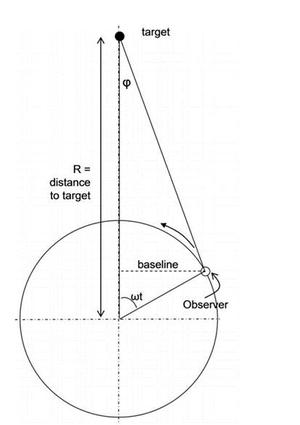
The 4-Point Backyard Diurnal Parallax Method
astroEDU educational activity (links to astroEDU website) Description: Measure the distance to an asteroid with a novel technique
License: CC-BY-4.0 Creative Commons Attribution 4.0 International (CC BY 4.0) ícones
Tags:
Hands-on
, Measurement
, Distances
, CCD imaging
, astrometry
Faixas etárias:
16-19
, 19+
Nível de ensino:
Informal
, Médio
, Universidade
Áreas de aprendizagem:
Aprendizagem por descoberta guiada
, Aprendizagem baseada em projetos
Custos:
Alto custo
Duração:
vários dias
Tamanho do grupo:
Grupo
Habilidades:
Analisar e interpretar dados
, Fazer perguntas
, Comunicar informações
, Construir explicações
, Planejar e realizar pesquisas
, Usar matemática e pensamento computacional








