词条 双星
描述: 双星是由两颗恒星组成的系统,它们在引力的作用下围绕共同的质心运行。它们的轨道遵循开普勒运动定律,呈椭圆形(形状像一个压扁的圆)或圆形。
银河系中一半以上的恒星要么属于双星系统,要么是有一颗以上伴星的系统(称为高阶多星系统)的一部分。由于与地球距离遥远,大多数双星和高阶多星系统在观测者看来都是单颗恒星。
根据发现双星所用的观测方法,双星可以分为如下几类,它们可能同时属于多个类别:
目视双星是直接观测即可分辨的两颗靠近的独立恒星。并不是所有看起来在天空中离得很近的两颗恒星都是受引力约束的双星,有些可能只是出于巧合在天空中看起来很近,但并不受引力约束。不受引力约束的双星可能相距数百光年。
光谱双星是由于恒星围绕它们共同的质心运行时,恒星光谱中的谱线发生了多普勒频移而被发现的。
食双星是其中一颗恒星从它的伴星和观测者之间穿过时,挡了住来自伴星的部分光线,使系统的组合光线看起来短暂变暗而被探测到的。
天体测量双星是指只能观测到一个恒星图像的系统——可能是由于其中一颗恒星太暗而无法观测到,也可能是由于两颗恒星的图像被混合在一起——但双星系统中恒星的轨道运动会导致恒星图像中最亮的点在天空中的位置发生周期性变化。
相关词条
用其他语言查看该词条
词条和定义状态: 该术语的英文原始定义已通过天文研究人员和教师的审核 该术语及其定义的译文仍待审核
OAE多语言词汇表是由国际天文学联合会(IAU) 天文教育办公室(OAE) 和 国际天文学联合会(IAU) 天文推广办公室(OAO)合作的项目。. 术语和定义由 OAE中心, OAE 国家天文教育协调员(NAECs) 以及其他志愿者共同选择、撰写和审阅。您可以在 找到完整的致谢列表。所有词汇表术语及其定义均根据 Creative Commons CC BY-4.0许可证发布 且版权归属于 “IAU OAE”。
如果您发现此词汇术语或定义中的事实或翻译错误, 请向 发邮件 联系.
其他语言版本
- 阿拉伯语: النجم المزدوج
- 德语: Doppelsternsystem
- 英语: Binary Star
- 西班牙语: Estrella binaria
- 法语: Étoile binaire
- 意大利语: Stella binaria
- 日语: 連星 (外部链接)
- 马拉地语: तारा युगल
- 巴西葡萄牙语: Estrela binária
- 繁体中文: 雙星
相关媒体

A binary brown dwarf system revealed
图注: This image presents a nearby system of brown dwarfs, objects that fall between planets and stars in mass and do not sustain long-term nuclear fusion in their cores. Located about 6.5 light-years from Earth, this system (known as Luhman 16) is the third closest system to the Solar System after the Alpha Centauri system and Barnard's Star. It was initially observed as what seemed to be a single faint source of infrared light. Brown dwarfs are often difficult to study because of their low brightness, especially in visible light. However they shine brighter in infrared light due to their cooler effective temperatures.
The comparison highlights the importance of observational resolution. The image at the center, taken by NASA’s Wide-field Infrared Survey Explorer (WISE), shows the system as a single blurred object due to its lower resolution (WISE has a resolution of roughly 6 arcseconds). A highlighted zoomed-in view from the Gemini South Observatory in Chile reveals that this “single” source is actually a binary system of two brown dwarfs. The improved angular resolution (roughly 0.6 arcseconds) allows astronomers to separate the two objects clearly, demonstrating how higher-resolution observations uncover hidden structures in the universe. While the Gemini telescope is situated on the Earth and thus is affected by the blurring effects of the Earth's atmosphere, it has a substantially larger mirror than the WISE telescope (8m wide vs. 40cm wide) meaning it can achieve much higher resolutions.
来源: NASA/JPL/Gemini Observatory/AURA/NSF
来源链接
License: PD 公共领域 图标
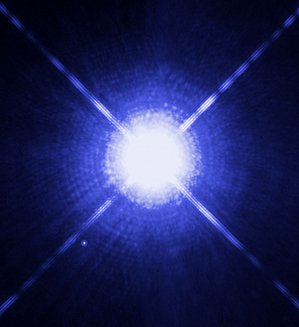
Sirius A with his faint white dwarf companion Sirius B
图注: This Hubble Space Telescope image highlights Sirius, the brightest star in Earth’s night sky, appearing as an intensely luminous object at the center with prominent cross-shaped diffraction spikes. These spikes, along with the saturated glow around the main star, are caused by the Sirius' light being spread out by the telescope and camera used to make this image. Slightly below and to the left of the main star, a tiny point of light marks Sirius B, a much dimmer object captured thanks to Hubble’s high sensitivity.
Sirius A is an A-type star, known for its high surface temperature and strong white-blue light, while Sirius B is a compact white dwarf, the dense remnant of a star that has exhausted its nuclear fuel. Together, they form a well-known Binary star system located about 8.6 light-years from Earth.
Sirius B was originally a higher mass and brighter star that burned through its hydrogen fuel more quickly than Sirius A. This led to Sirius B evolving into a red giant and eventually ending its life as a planetary nebula, leaving only the remains of its core as a white dwarf orbiting Sirius A.
来源: NASA, ESA, H. Bond (STScI), and M. Barstow (University of Leicester)
来源链接
相关图表
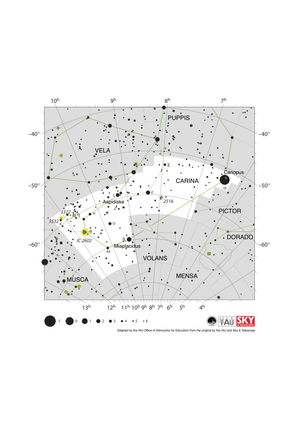
Carina Constellation Map
图注: The constellation Carina along with its bright stars and surrounding constellations. Carina is surrounded by (going clockwise from the top): Vela, Puppis, Pictor, Volans, Chamaeleon, Musca and Centaurus. Carina is notable for Canopus, the second brightest star in the night sky and for the famous variable star Eta Carinae. This latter object is a binary star system of two young very massive stars. Its brightness has varied greatly over the past few centuries. At one point it outshone Canopus before dimming by a factor of four thousand to become invisible to the naked eye. In recent years it has brightened enough to again be visible without the aid of a telescope.
Carina is a southern constellation and thus the whole constellation is visible at some point in the year to the entire southern hemisphere. The whole constellation is also visible from equatorial regions of the northern hemisphere with parts of the constellation visible from northern temperate regions.
The open clusters NGC 2516, NGC 3532 and IC 2602 lie in Carina. These are marked here by yellow circles. The Carina Nebula, also known as NGC 3372, lies in the constellation. This large nebula contains many massive young stars, including Eta Carinae.
This diagram maps an area around the south celestial pole. Here lines of constant right ascension converge. The right ascension values of these lines are marked on the x-axis above and below the diagram. Some of the lines of constant declination are marked on the y-axis. The sizes of the stars marked here relate to the star's apparent magnitude, a measure of its apparent brightness. The larger dots represent brighter stars. The Greek letters mark the brightest stars in the constellation. These are ranked by brightness with the brightest star being labeled alpha, the second brightest beta, etc., although this ordering is not always followed exactly. Carina was previously part of the larger Argo Navis constellation along with Vela and Puppis. As the letter designations for stars were created before this division took place, Greek letter designations are now divided between the three constellations with Carina having stars designated alpha and beta but no gamma or delta. The dotted boundary lines mark the IAU's boundaries of the constellations and the solid green lines mark one of the common forms used to represent the figures of the constellations. Neither the constellation boundaries, nor the lines joining the stars appear on the sky.
来源: Adapted by the IAU Office of Astronomy for Education from the original by the IAU and Sky & Telescope