Termo do glossário: Estrela binária
Descrição: Uma estrela binária é um sistema formado por duas estrelas que orbitam em torno de seu centro de massa comum, devido ao fato de estarem ligadas pela força da gravidade. Suas órbitas seguem as leis do movimento de Kepler e têm formato elíptico (semelhante a um círculo achatado) ou circular.
Mais da metade de todas as estrelas da Via Láctea estão em sistemas binários ou fazem parte de sistemas com mais de uma estrela companheira (conhecidos como sistemas estelares múltiplos). Devido às suas enormes distâncias da Terra, a maioria das estrelas binárias e dos sistemas estelares múltiplos de ordem superior aparecem ao observador como uma única estrela.
As estrelas binárias podem ser classificadas em várias categorias, de acordo com o método de observação pelo qual foram identificadas como estrelas binárias. Elas podem pertencer simultaneamente a mais de uma categoria:
As binárias visuais podem ser observadas como duas estrelas distintas, próximas uma da outra no céu. Nem todas as estrelas que parecem próximas no céu (estrelas duplas) são binárias ligadas pela gravidade; algumas podem estar próximas no céu por coincidência, mas não estão ligadas pela gravidade. Estrelas duplas que não são binárias ligadas pela gravidade podem estar separadas por centenas de anos-luz de distância.
As binárias espectroscópicas são identificadas devido ao desvio Doppler das linhas no espectro das estrelas, à medida que elas orbitam seu centro de massa comum.
As binárias eclipsantes podem ser detectadas quando uma das estrelas componentes passa entre sua estrela companheira e um observador, bloqueando parte da luz da estrela companheira e fazendo com que a luz combinada do sistema pareça, por um breve instante, mais fraca.
As binárias astrométricas são sistemas nos quais apenas uma imagem estelar é observada — seja porque uma das estrelas é muito fraca para ser observada, seja porque as imagens das duas estrelas se misturam — mas nos quais o movimento orbital das estrelas no sistema binário faz com que o ponto mais brilhante da imagem estelar apresente uma mudança periódica de posição no céu.
Termos relacionados:
Ver este termo em outros idiomas
Status do termo e da definição: A definição original deste termo em inglês foi aprovada por um astrônomo(a) pesquisador(a) e um(a) professor(a) A tradução deste termo e de sua definição ainda aguarda aprovação
O Glossário Multilíngue da OAE é um projeto do Escritório da IAU de Astronomia para a Educação (OAE) em colaboração com o Escritório da IAU para Divulgação da Astronomia (OAO). Os termos e definições foram selecionados, escritos e revisados por meio de um esforço coletivo da OAE, dos Centros e Nós da OAE, dos Coordenadores Nacionais de Educação em Astronomia (NAECs) da OAE e de outros voluntários. Você pode encontrar uma lista completa dos créditos aqui. Todos os termos do glossário e suas definições são disponibilizados sob uma licença Creative Commons CC BY-4.0 e devem ser creditados à "IAU OAE".
Se você notar algum erro factual ou de tradução neste termo do glossário ou em sua definição, por favor entre em contato.
Em outros idiomas
- Árabe: النجم المزدوج
- Alemão: Doppelsternsystem
- Inglês: Binary Star
- Espanhol: Estrella binaria
- Francês: Étoile binaire
- Italiano: Stella binaria
- Japonês: 連星 (link externo)
- Marathi: तारा युगल
- Chinês Simplificado: 双星
- Chinês Tradicional: 雙星
Mídia relacionada

A binary brown dwarf system revealed
Legenda: This image presents a nearby system of brown dwarfs, objects that fall between planets and stars in mass and do not sustain long-term nuclear fusion in their cores. Located about 6.5 light-years from Earth, this system (known as Luhman 16) is the third closest system to the Solar System after the Alpha Centauri system and Barnard's Star. It was initially observed as what seemed to be a single faint source of infrared light. Brown dwarfs are often difficult to study because of their low brightness, especially in visible light. However they shine brighter in infrared light due to their cooler effective temperatures.
The comparison highlights the importance of observational resolution. The image at the center, taken by NASA’s Wide-field Infrared Survey Explorer (WISE), shows the system as a single blurred object due to its lower resolution (WISE has a resolution of roughly 6 arcseconds). A highlighted zoomed-in view from the Gemini South Observatory in Chile reveals that this “single” source is actually a binary system of two brown dwarfs. The improved angular resolution (roughly 0.6 arcseconds) allows astronomers to separate the two objects clearly, demonstrating how higher-resolution observations uncover hidden structures in the universe. While the Gemini telescope is situated on the Earth and thus is affected by the blurring effects of the Earth's atmosphere, it has a substantially larger mirror than the WISE telescope (8m wide vs. 40cm wide) meaning it can achieve much higher resolutions.
Crédito: NASA/JPL/Gemini Observatory/AURA/NSF
link do crédito
License: PD Domínio Público ícones
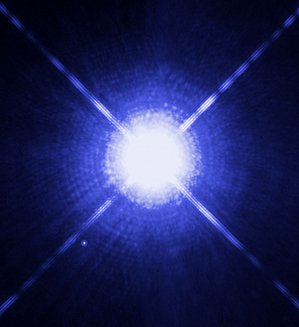
Sirius A with his faint white dwarf companion Sirius B
Legenda: This Hubble Space Telescope image highlights Sirius, the brightest star in Earth’s night sky, appearing as an intensely luminous object at the center with prominent cross-shaped diffraction spikes. These spikes, along with the saturated glow around the main star, are caused by the Sirius' light being spread out by the telescope and camera used to make this image. Slightly below and to the left of the main star, a tiny point of light marks Sirius B, a much dimmer object captured thanks to Hubble’s high sensitivity.
Sirius A is an A-type star, known for its high surface temperature and strong white-blue light, while Sirius B is a compact white dwarf, the dense remnant of a star that has exhausted its nuclear fuel. Together, they form a well-known Binary star system located about 8.6 light-years from Earth.
Sirius B was originally a higher mass and brighter star that burned through its hydrogen fuel more quickly than Sirius A. This led to Sirius B evolving into a red giant and eventually ending its life as a planetary nebula, leaving only the remains of its core as a white dwarf orbiting Sirius A.
Crédito: NASA, ESA, H. Bond (STScI), and M. Barstow (University of Leicester)
link do crédito
License: CC-BY-4.0 Creative Commons Attribution 4.0 International (CC BY 4.0) ícones
Diagramas relacionados
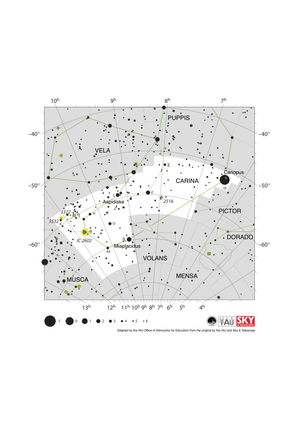
Carina Constellation Map
Legenda: The constellation Carina along with its bright stars and surrounding constellations. Carina is surrounded by (going clockwise from the top): Vela, Puppis, Pictor, Volans, Chamaeleon, Musca and Centaurus. Carina is notable for Canopus, the second brightest star in the night sky and for the famous variable star Eta Carinae. This latter object is a binary star system of two young very massive stars. Its brightness has varied greatly over the past few centuries. At one point it outshone Canopus before dimming by a factor of four thousand to become invisible to the naked eye. In recent years it has brightened enough to again be visible without the aid of a telescope.
Carina is a southern constellation and thus the whole constellation is visible at some point in the year to the entire southern hemisphere. The whole constellation is also visible from equatorial regions of the northern hemisphere with parts of the constellation visible from northern temperate regions.
The open clusters NGC 2516, NGC 3532 and IC 2602 lie in Carina. These are marked here by yellow circles. The Carina Nebula, also known as NGC 3372, lies in the constellation. This large nebula contains many massive young stars, including Eta Carinae.
This diagram maps an area around the south celestial pole. Here lines of constant right ascension converge. The right ascension values of these lines are marked on the x-axis above and below the diagram. Some of the lines of constant declination are marked on the y-axis. The sizes of the stars marked here relate to the star's apparent magnitude, a measure of its apparent brightness. The larger dots represent brighter stars. The Greek letters mark the brightest stars in the constellation. These are ranked by brightness with the brightest star being labeled alpha, the second brightest beta, etc., although this ordering is not always followed exactly. Carina was previously part of the larger Argo Navis constellation along with Vela and Puppis. As the letter designations for stars were created before this division took place, Greek letter designations are now divided between the three constellations with Carina having stars designated alpha and beta but no gamma or delta. The dotted boundary lines mark the IAU's boundaries of the constellations and the solid green lines mark one of the common forms used to represent the figures of the constellations. Neither the constellation boundaries, nor the lines joining the stars appear on the sky.
Crédito: Adapted by the IAU Office of Astronomy for Education from the original by the IAU and Sky & Telescope
License: CC-BY-4.0 Creative Commons Attribution 4.0 International (CC BY 4.0) ícones