词条 彗发
描述: 当彗星接近太阳时,冰质彗核中的部分固体物质会变成气体。这些气体主要是水蒸气,但也会含有其他化学物质,如一氧化碳、二氧化碳、氨、甲烷和甲醇。这些气体和尘埃粒子一起环绕着彗核,像一团模糊的球形云,这就是彗星大气,或称彗发。随着彗星越来越接近太阳,越来越多的分子在太阳的紫外线光子作用下裂解,加热彗发,使其外部区域膨胀。最终,彗发的外部区域被电离,并形成彗星的离子尾。
相关词条
用其他语言查看该词条
词条和定义状态: 该术语的英文原始定义已通过天文研究人员和教师的审核 该术语及其定义的译文仍待审核
OAE 多语言词汇表是由国际天文学联合会(IAU) 天文教育办公室(OAE) 和 国际天文学联合会(IAU) 天文推广办公室(OAO)合作的项目。. 术语和定义由 OAE中心, OAE 国家天文教育协调员(NAECs) 以及其他志愿者共同选择、撰写和审阅。您可以在 找到完整的致谢列表。所有词汇表术语及其定义均根据 Creative Commons CC BY-4.0许可证发布 且版权归属于 "IAU OAE"。
如果您发现此词汇术语或定义中的事实或翻译错误, 请向 发邮件 联系.
其他语言版本
- 阿拉伯语: هالة المذنب
- 德语: Koma (Komet)
- 英语: Cometary Coma
- 西班牙语: Coma de un cometa
- 法语: La chevelure (ou coma) de comète
- 意大利语: Chioma della cometa
- 日语: コマ(彗星の) (外部链接)
- 韩语: 혜성의 코마
- 马拉地语: धूमकेतूचे वातावरण (कोमा)
- 尼泊尔语: धूमकेतुको कोमा
- 巴西葡萄牙语: Coma cometária
- 繁体中文: 彗發
相关媒体
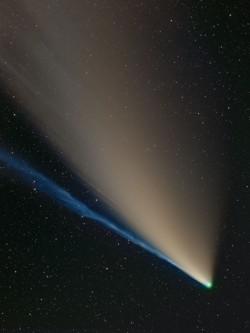
彗星 C/2020F3 (Neowise),有分开的尘埃尾和离子气体尾,以及发出绿色光芒的彗发,作者 Dietmar Gutermuth,德国
图注: 2021 年国际天文学联合会 OAE 天体摄影比赛彗星类第二名。
彗星的结构非常有趣,主要由四个部分组成:由岩石、尘埃和冰冻气体组成的彗核,大小通常为几公里,但也观测到过更大的彗星;彗核周围的一小团气体(只有在彗星最接近太阳时才会出现),称为彗发;以及两条独特的彗尾(有时还有第三条尾)。彗发的绿色是由于其中的碳和氮与太阳的紫外辐射发生反应。我们通常观测到的尾迹是尘埃尾,由微米级的尘埃粒子组成;第二条尾迹由带电粒子组成--即离子尾或气体尾。只有当彗星在一定距离内接近太阳,来自恒星的热量和辐射强到足以使冰冻气体气化时,彗尾才会出现。尘埃尾是弯曲的,而气体尾则是笔直的,并且始终指向远离太阳的方向,因为这是由太阳风携带的--太阳发出的带电粒子流。由于彗星是由残留物质形成的,它们携带着太阳系形成早期的重要信息。这幅美丽的图片显示的是 2020 年 7 月从德国看到的彗星 C/2020 F3(Neowise),四个结构中的三个:彗尾、气体尾和尘埃尾清晰可见。
来源: Dietmar Gutermuth/IAU OAE
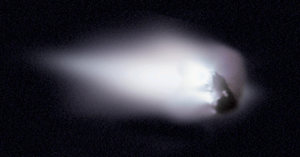
An Encounter With Halley's Comet
图注: This image shows the solid core, or nucleus, of Halley’s Comet, captured in 1986 by the European Space Agency spacecraft Giotto during its flyby of the comet in the inner Solar System. The nucleus appears irregular and potato-shaped, measuring roughly 15 kilometers (about 9 miles) across, and is composed of a mixture of ice, dust, and rock. Unlike the glowing fuzzy cloud (coma) and long tail that make comets visible from Earth, the nucleus itself is dark and difficult to see until a spacecraft passes close enough to take detailed images.
Halley’s Comet is one of the best-known comets because it returns to the inner Solar System approximately every 76 years, allowing generations of astronomers to observe it repeatedly. The material that is released from the nucleus as the comet warms near the Sun forms a glowing coma and long tails of gas and dust, and over many returns leaves trails of debris that produce meteor showers on Earth, such as the Eta Aquarids in May and the Orionids in October.
来源: NASA/ESA/Giotto Project
来源链接
License: PD 公共领域 图标