Termo do glossário: Coma cometária
Descrição: À medida que um cometa se aproxima do Sol, parte das substâncias sólidas ligadas ao núcleo gelado do cometa se transforma em gás. Esse gás, que consiste principalmente de água, mas também contém outros produtos químicos, como monóxido de carbono, dióxido de carbono, amônia, metano e metanol, bem como partículas de poeira, envolve o núcleo como uma nuvem esférica e difusa, que é chamada de atmosfera cometária ou coma. À medida que o cometa se aproxima do Sol, mais e mais moléculas são divididas pelos fótons ultravioletas do Sol, aquecendo a coma e fazendo com que suas regiões externas se expandam. Por fim, as regiões externas são ionizadas, formando a cauda iônica do cometa.
Termos relacionados:
Ver este termo em outros idiomas
Status do termo e da definição: A definição original deste termo em inglês foi aprovada por um astrônomo(a) pesquisador(a) e um(a) professor(a) A tradução deste termo e de sua definição ainda aguarda aprovação
O Glossário Multilíngue da OAE é um projeto do Escritório da IAU de Astronomia para a Educação(OAE) em colaboração com o Escritório da IAU para Divulgação da Astronomia (OAO). Os termos e definições foram selecionados, escritos e revisados por meio de um esforço coletivo da OAE, dos Centros e Nós da OAE, dos Coordenadores Nacionais de Educação em Astronomia (NAECs) da OAE e de outros voluntários. Você pode encontrar uma lista completa dos créditos aqui. Todos os termos do glossário e suas definições são disponibilizados sob uma licença Creative Commons CC BY-4.0 e devem ser creditados à "IAU OAE".
Se você notar algum erro factual ou de tradução neste termo do glossário ou em sua definição, por favor entre em contato.
Em outros idiomas
- Árabe: هالة المذنب
- Alemão: Koma (Komet)
- Inglês: Cometary Coma
- Espanhol: Coma de un cometa
- Francês: La chevelure (ou coma) de comète
- Italiano: Chioma della cometa
- Japonês: コマ(彗星の) (link externo)
- Coreano: 혜성의 코마
- Marathi: धूमकेतूचे वातावरण (कोमा)
- Nepalês: धूमकेतुको कोमा
- Chinês Simplificado: 彗发
- Chinês Tradicional: 彗發
Mídia relacionada
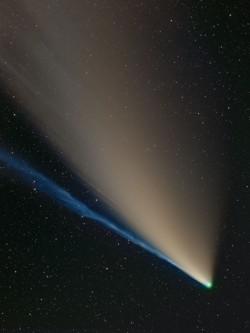
Comet C/2020F3 (Neowise) with separate dust and ion gas tails and a green glowing coma, by Dietmar Gutermuth, Germany
Legenda: Second place in the 2021 IAU OAE Astrophotography Contest, category Comets.
Comets have a very interesting structure comprising of four main parts: the nucleus, composed of rock, dust and frozen gases, typically spanning a few kilometres, although bigger ones have been observed; a small atmosphere of gas surrounding the nucleus (only present when the comet approaches its closest point to the Sun), called coma; and the two distinctive cometary tails (there is at times third tail). The green colour of the coma is due to carbon and nitrogen present in the coma reacting with the Sun’s ultraviolet radiation. The tail that we are mostly used to observing – dust tail and is composed of micron sized dust particles, the second tail composed of charged particles – ion or gas tail. The tails are released only when the comet approaches the Sun at a distance where the heat and radiation emanating from our star is intense enough to vaporize the frozen gases. The dust tail is curved, while the gas tail is straight and always points away from the Sun as this is carried by the solar wind - flow of charged particles emitted by the Sun. As comets are formed by leftover material, they carry with them important information about the early stages of the Solar System’s formation. This beautiful image shows the comet C/2020 F3 (Neowise), as seen from Germany in July 2020, with three of the four structures clearly visible – coma, gas, and dust tail.
Crédito: Dietmar Gutermuth/IAU OAE
License: CC-BY-4.0 Creative Commons Attribution 4.0 International (CC BY 4.0) ícones
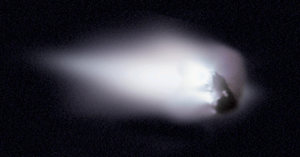
An Encounter With Halley's Comet
Legenda: This image shows the solid core, or nucleus, of Halley’s Comet, captured in 1986 by the European Space Agency spacecraft Giotto during its flyby of the comet in the inner Solar System. The nucleus appears irregular and potato-shaped, measuring roughly 15 kilometers (about 9 miles) across, and is composed of a mixture of ice, dust, and rock. Unlike the glowing fuzzy cloud (coma) and long tail that make comets visible from Earth, the nucleus itself is dark and difficult to see until a spacecraft passes close enough to take detailed images.
Halley’s Comet is one of the best-known comets because it returns to the inner Solar System approximately every 76 years, allowing generations of astronomers to observe it repeatedly. The material that is released from the nucleus as the comet warms near the Sun forms a glowing coma and long tails of gas and dust, and over many returns leaves trails of debris that produce meteor showers on Earth, such as the Eta Aquarids in May and the Orionids in October.
Crédito: NASA/ESA/Giotto Project
link do crédito
License: PD Domínio Público ícones