تنزيل الملف ( صورة 150.09 kB)
تنزيل ملف PDF (PDF file 216.56 kB)
شرح الرسم التوضيحي:
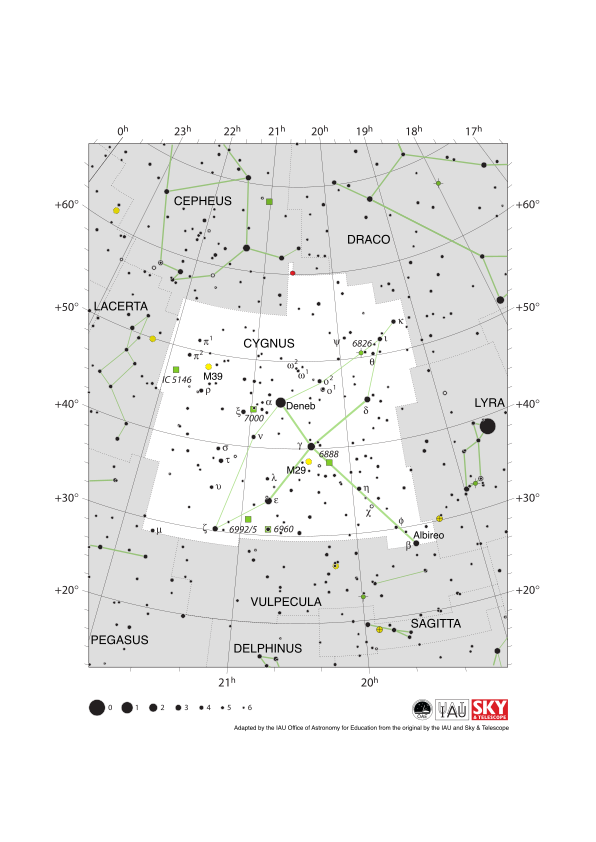
The constellation Cygnus with its bright stars and surrounding constellations. Cygnus is surrounded by (going clockwise from the top): Cepheus, Draco, Lyra, Vulpecula, Pegasus and Lacerta. Cygnus is notable for its brightest star Deneb. This forms one vertex of the prominent Summer Triangle asterism that is visible in northern hemisphere summer evenings.
Cygnus is a northern constellation and thus the whole of the constellation is visible at some point in the year in the whole northern hemisphere. The whole constellation is also visible from equatorial regions of the southern hemisphere with parts of the constellation visible from temperate southern regions.
The plane of the Milky Way runs through Cygnus and thus the constellation is rich in nebulae and star clusters. These include the North America Nebula (NGC 7000) and the Crescent Nebula (NGC 6888). The Veil Nebula is a huge supernova remnant, parts of which are marked here as NGC 6960 and NGC 6992/5. All of the previously-mentioned nebulae are marked with green squares. The planetary nebula NGC 6826 is marked here with a green circle superimposed on a plus sign. The open star clusters M29 and M39 are marked here with yellow circles.
The y-axis of this diagram is in degrees of declination with north as up and the x-axis is in hours of right ascension with east to the left. The sizes of the stars marked here relate to the star's apparent magnitude, a measure of its apparent brightness. The larger dots represent brighter stars. The Greek letters mark the brightest stars in the constellation. These are ranked by brightness with the brightest star being labeled alpha, the second brightest beta, etc., although this ordering is not always followed exactly. The dotted boundary lines mark the IAU's boundaries of the constellations and the solid green lines mark one of the common forms used to represent the figures of the constellations. Neither the constellation boundaries, nor the lines joining the stars appear on the sky.
مصدر الرسم التوضيحي: Adapted by the IAU Office of Astronomy for Education from the original by the IAU and Sky & Telescope. رابط المصدر
حالة ترجمة الرسم التوضيحي: لم تتم الموافقة من قبل مُراجع بعد
ترخيص الرسم التوضيحي: المشاع الإبداعي نَسب المُصنَّف 4.0 دولي (CC BY 4.0) المشاع الإبداعي نَسب المُصنَّف 4.0 دولي (CC BY 4.0) أيقونات
مصطلحات معجم ذات صلة:
الإحداثيات السماوية
, السديم
, السديم الكوكبي
, العنقود المفتوح
, القدرالظاهري
, المجمة
, المطلع المستقيم
, الميل
, بقايا المستعر الأعظم
, درب التبانة
, مجموعة نجمية او حشد نجمى
فئات:
علم الفلك بالعين المجردة
Want to make your own translation or version of this diagram? Then
download the SVG
version of this diagram in English (738.89 kB). You can edit this using
software like Inkscape (free) or Adobe Illustrator
(proprietary). Just remember to credit the author of the original appropriately.
You can also make your own version or translation of this diagram by adding adding text to a version of
this diagram with no text. Just download one of the following files:
Download Text-Free File ( صورة 137.66 kB)
Download Text-Free PDF File (PDF file 197.19 kB)