بلغات أخرى
- الألمانيّة: Geomagnetischer Sturm
- الإنجليزيّة: Geomagnetic Storm
- الإسبانيّة: Tormenta geomagnética
- الفرنسيّة: Tempête géomagnétique
- الإيطاليّة: Tempesta Geomagnetica
- اليابانيّة: 磁気嵐 (رابط خارجي)
- البرتغاليّة البرازيليّة: Tempestade geomagnética
- الصينيّة المبسطة: 地磁暴
- الصينيّة التقليدية: 地磁暴
وسائط ذات صلة
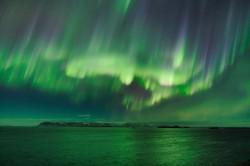
صورة للشفق القطبي في أيسلندا، التقطها إيمانوي
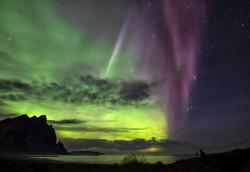
Multicolored aurora in Iceland, by Marco Migliardi on behalf of Associazione Astronomica Cortina, Italy
الشرح: First place in the 2021 IAU OAE Astrophotography Contest, category Aurorae (still images)
Aurorae are the result of ionisation and excitation processes in Earth's upper atmosphere, caused by charged particles from the solar wind or from coronal mass ejections. The different colours in an aurora display indicate the species of atmospheric atoms and molecules involved. The most common colour is a bright green, which, together with deep red, originates from atomic oxygen. Blue, purple and pink hues are much rarer and originate from molecular nitrogen. The reflection of the aurora in the water indicates the brightness of intense aurorae at higher latitudes.
المصدر: Marco Migliardi on behalf of Associazione Astronomica Cortina/IAU OAE.
License: CC-BY-4.0 المشاع الإبداعي نَسب المُصنَّف 4.0 دولي (CC BY 4.0) أيقونات
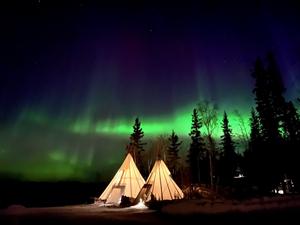
Northern Lights - Teepees
الشرح: Honorable mention in the 2023 IAU OAE Astrophotography Contest, category of Still images taken exclusively with smartphones/mobile devices.
Taken with a smartphone at Cassidy Point, Yellowknife, Canada, on 24 March 2023, this stunning display captured the ethereal Northern Lights painting the night sky. The biting cold of -20°F (-29°C) set the stage for the vibrant hues of the Aurora Borealis, a celestial ballet created by collisions between charged solar particles and the Earth's atmosphere. The Earth’s magnetic field directs the charged particles towards the polar regions, where they interact with the various atoms and molecules in the atmosphere. This natural phenomenon transforms the sky into a canvas of radiant greens, pinks, and purples, casting a mesmerising glow above. The different colours of an aurora are determined by the gases in Earth’s atmosphere, the altitude where the aurora occurs, the density of the atmosphere, and the energy of the charged particles. In general, green is attributed to atomic oxygen, red is associated with high-altitude atomic oxygen and molecular nitrogen, while purple and blue are associated with molecular nitrogen only. Pink auroras are typically associated with a mix of nitrogen blue and red. Against this cosmic backdrop, the teepees of Aurora Village below provide a tranquil contrast to the celestial spectacle unfolding overhead. Preserving the pristine darkness of this location ensures the continued splendour of such awe-inspiring natural light shows.
المصدر: Oanh Vuong/IAU OAE (CC BY 4.0)
License: CC-BY-4.0 المشاع الإبداعي نَسب المُصنَّف 4.0 دولي (CC BY 4.0) أيقونات
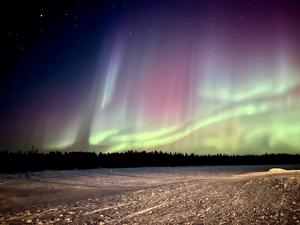
Northern Lights Color
الشرح: Winner in the 2023 IAU OAE Astrophotography Contest, category of Still images taken exclusively with smartphones/mobile devices.
This photograph taken with a smartphone captures the ethereal beauty of the Northern Lights at Cassidy Point, Yellowknife, NT, Canada on 24 March 2023, at temperatures well below freezing (–29°C). The mesmerising dance of the Aurora Borealis (Australis), commonly known as the Northern (Southern) Lights, paints the night sky in striking hues. The aurora is a natural phenomenon caused by charged particles from the Sun interacting with Earth’s atmosphere, and being redirected by Earth’s magnetic field towards the north and south polar regions. The charged particles excite atoms and molecules in the atmosphere, resulting in a light display that varies in colour and form. The different colours of an aurora are determined by the gases (atoms and molecules) in Earth's atmosphere, the altitude of the aurora, the density of the atmosphere, and the energy of the charged particles. In general, green is attributed to atomic oxygen, red is associated with high-altitude atomic oxygen and molecular nitrogen, while purple and blue are associated with molecular nitrogen only. Pink auroras are typically associated with a mix of nitrogen blue and red. On this particular night, the serene environment of Cassidy Point provided an unobstructed view of the lights.
المصدر: Jason Johnson/IAU OAE (CC BY 4.0)
License: CC-BY-4.0 المشاع الإبداعي نَسب المُصنَّف 4.0 دولي (CC BY 4.0) أيقونات
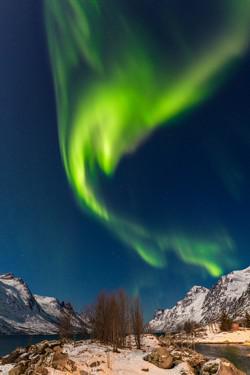
تنين النور الشمالي فوق قرية اسفيوردباتن/ النرويج