بلغات أخرى
- البنغاليّة: অ্যান্ড্রোমিডা ছায়াপথ
- الألمانيّة: Andromedagalaxie
- الإنجليزيّة: Andromeda Galaxy
- الإسبانيّة: Galaxia de Andrómeda
- الفرنسيّة: Galaxie d'Andromède
- الهندية: एंड्रोमेडा आकाशगंगा
- الإيطاليّة: Galassia di Andromeda
- اليابانيّة: アンドロメダ銀河 (رابط خارجي)
- الكوريّة: 안드로메다은하
- المهاراتية: अॅन्ड्रोमेडा
- البرتغاليّة البرازيليّة: Galáxia de Andrômeda
- الصينيّة المبسطة: 仙女座星系
- الصينيّة التقليدية: 仙女座星系
وسائط ذات صلة
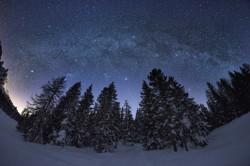
Winter Milky Way
الشرح: Winner in the 2022 IAU OAE Astrophotography Contest, category Still images of celestial patterns.
Taken near Lake Misurina in the Veneto region of Italy in February 2019, this image shows a clear and starry sky over a winter landscape.
We can see part of the Milky Way arc. From the left side, towards the south-east, we see Sirius, "The Burner" in Greek, the brightest star in the night sky. It is part of the constellation Canis Major, The Great Dog, one of the dogs of Orion, the great hunter, in Greek mythology. Orion’s other dog, Canis Minor, the Small Dog, is represented by the bright star Procyon and its fainter neighbours. The Greek star name means “The One [rising] before The Dog” and the star is seen at the top left side of the image just above the arc of the Galaxy. Orion lies to the right of Canis Major. We can spot its characteristic “belt”, an asterism composed of three bright stars aligned in a straight line.
Above the treetops to the right of Orion, the open star clusters of the Hyades and the Pleiades in the constellation Taurus, the Bull, are visible. According to ancient lore, these two clusters form a Celestial Gate directly next to the intersection of the great circles of the ecliptic and the Milky Way. In Greco-Roman mythology, Taurus is associated with the god Zeus who is said to have used a bull to seduce the Phoenician princess Europa.
Above the constellation Taurus, we can see a bright star just above the arc of the Galaxy. This is Capella, the brightest star of the constellation Auriga, The Charioteer. This is one of the 88 modern constellations and is associated with the Greek hero Erichthonius of Athens. Hindu astronomy considers Capella as the heart of Brahma, one of the three major gods. The indigenous people of Bororo in Brazil have a constellation representing a cayman, comprising some of the stars of Auriga and some stars from neighbouring constellations.
To the right of Taurus, we find the modern constellation Perseus with the bright double star cluster h+chi Perseii, which represents the metal of Perseus’s sabre in Greek mythology. Perseus is the hero who was sent out to prove himself, and happened to rescue Andromeda from the sea monster Cetus as the Roman poet Ovid wrote. We can also see the constellation Cassiopeia, associated with the queen and mother of Andromeda in Greek mythology. It is composed of five bright stars in the shape of a W, which was considered the asterism of The Key by the Greeks according to the poet Aratus. The recognisable shape is also associated with other mythologies: for instance, it represents the princess Sharmishtha in Hindu astronomy, a bat in Thailand, and a camel in native Arabic astronomy.
In the gap between the trees, the Andromeda Galaxy is visible.
المصدر: Giorgia Hofer/IAU OAE
License: CC-BY-4.0 المشاع الإبداعي نَسب المُصنَّف 4.0 دولي (CC BY 4.0) أيقونات

A visible light image of the Andromeda Galaxy
الشرح: The Andromeda Galaxy viewed in visible light. Like our Milky Way, Andromeda is a barred spiral galaxy. Here we can see its bright core and spiral disk. The glow from the stars in the disk is interrupted by lanes of dust that form part of its spiral structure.
Andromeda is the largest galaxy in the Local Group of galaxies that includes the Milky Way.
To the left of the core and just above the disk we see the dwarf galaxy M32 and to the right and below the disk we see the dwarf galaxy M110. These are both satellite galaxies of the Andromeda Galaxy.
المصدر: Torben Hansen
رابط المصدر
License: CC-BY-2.0 المشاع الإبداعي نَسب المُصنَّف 2.0 عام أيقونات
الرسوم التوضيحية المرتبطة

خريطة كوكبة أندروميدا

خريطة كوكبة كاسيوبيا او ذات الكرسى

Triangulum Constellation Map
الشرح: The constellation Triangulum with its bright stars and surrounding constellations. Triangulum is surrounded by (going clockwise from the top): Andromeda, Pisces, Aries and Perseus.
Triangulum is a northern constellation and thus the whole constellation is visible at some point in the year throughout the northern hemisphere. The whole constellation is also visible from equatorial and most temperate regions of the southern hemisphere. Triangulum is best viewed in the evening in the northern hemisphere winter and southern hemisphere summer.
The Triangulum Galaxy M33 lies in the constellation. This spiral galaxy is the third largest member of the local group of galaxies after the Andromeda Galaxy and Milky Way. It is marked here with a red ellipse.
The y-axis of this diagram is in degrees of declination with north as up and the x-axis is in hours of right ascension with east to the left. The sizes of the stars marked here relate to the star's apparent magnitude, a measure of its apparent brightness. The larger dots represent brighter stars. The Greek letters mark the brightest stars in the constellation. These are ranked by brightness with the brightest star being labeled alpha, the second brightest beta, etc., although this ordering is not always followed exactly. The dotted boundary lines mark the IAU's boundaries of the constellations and the solid green lines mark one of the common forms used to represent the figures of the constellations. The blue line at the bottom left of the diagram marks the ecliptic. Neither the constellation boundaries, nor the lines joining the stars, nor the ecliptic, appear on the sky.
المصدر: Adapted by the IAU Office of Astronomy for Education from the original by the IAU and Sky & Telescope
License: CC-BY-4.0 المشاع الإبداعي نَسب المُصنَّف 4.0 دولي (CC BY 4.0) أيقونات
الأنشطة المرتبطة

3D Universe: the Milky Way and friends
astroEDU educational activity (links to astroEDU website) Description: Use tactile models printed in 3D to explore our galactic neighborhood.
License: CC-BY-4.0 المشاع الإبداعي نَسب المُصنَّف 4.0 دولي (CC BY 4.0) أيقونات
الفئات العمرية:
10-12
, 12-14
, 14-16
, 16-19
, 19+
المرحلة التعليمية:
المرحلة المتوسطة
, المرحلة الثانوية
, الجامعة
مجالات التعلم:
تعلم استكشافي موجه
, محاضرة تفاعلية
, النمذجة
التكاليف:
تكلفة متوسطة
المدة:
ساعة واحدة
حجم المجموعة:
جماعي
المهارات:
تحليل البيانات وتفسيرها
, تطوير النماذج واستخدامها






.jpg)
