Glossar-Begriff: Supernova-Überrest
Beschreibung: Ein Supernova-Überrest ist das, was von einer Supernova-Explosion übrig bleibt: eine riesige Wolke aus heißem Gas und Plasma, welche durch die Schockwelle der Supernova erzeugt wurde. Viele Supernova-Überreste enthalten noch das Schwarze Loch oder den Neutronenstern, d.h. die Überreste des Sterns, der als Supernova explodiert ist. In manchen Fällen hat die Explosion aber das Schwarze Loch oder den Neutronenstern hinausgeschleudert.
Die explosive Energie einer Supernova erzeugt eine Schockwelle, die das interstellare Gas in der Umgebung durchläuft. Dieser Schock erhitzt und ionisiert das umgebende Gas auf extrem hohe Temperaturen (über eine Million Kelvin). Das heiße Gas sendet Licht in verschiedenen Wellenlängen aus, unter anderem sehr viel Röntgenstrahlung. Der Schock beschleunigt auch Teilchen auf hohe Geschwindigkeiten. Das macht Supernova-Überreste zu einer bedeutenden Quelle von kosmischer Strahlung.
Anhand der Geschwindigkeit, mit der sich ein Supernova-Überrest ausdehnt, können Astronomen abschätzen, wie lange es gedauert hat, bis der Supernova-Überrest seine beobachtete Größe erreicht hat. So können sie herausfinden, wann ungefähr die Supernova explodiert ist. Mehrere große Supernova-Überreste in der Milchstraße wurden auf diese Weise datiert und mit Supernovae in Verbindung gebracht, die von Astronomen vor Hunderten von Jahren am Himmel beobachtet wurden.
Ähnliche Begriffe:
- Kosmische Strahlung
- Planetarischer Nebel
- Kompakte Objekte
- Supernova
- Interstellares Medium
- Röntgenstrahlung
Dieser Begriff in anderen Sprachen
Begriffs- und Definitionsstatus Die Originaldefinition dieses Begriffes auf Englisch wurden von einem forschenden Astronom und einer Lehrkraft bestätigt Die Übersetzung dieses Begriffs und seiner Definition warten auf Prüfung und Bestätigung
The OAE Multilingual Glossary is a project of the IAU Office of Astronomy for Education (OAE) in collaboration with the IAU Office of Astronomy Outreach (OAO). The terms and definitions were chosen, written and reviewed by a collective effort from the OAE, the OAE Centers and Nodes, the OAE National Astronomy Education Coordinators (NAECs) and other volunteers. You can find a full list of credits here. All glossary terms and their definitions are released under a Creative Commons CC BY-4.0 license and should be credited to "IAU OAE".
Wenn dir ein inhaltlicher oder Übersetzungsfehler in diesem Glossarbegriff oder dieser Definition auffallen, bitte kontaktiere uns.
Auf anderen Sprachen
- Arabisch: بقايا المستعر الأعظم
- Englisch: Supernova Remnant
- Spanisch: Remanente de supernova
- Französisch: Rémanent de supernova
- Italienisch: Resto di Supernova
- Japanisch: 超新星残骸 (externer Link)
- Koreanisch: 초신성잔해
- Brasilianisches Portugiesisch: Remanescente de supernova
- Vereinfachtes Chinesisch: 超新星遗迹
- Traditionelles Chinesisch: 超新星遺跡
Ähnliche Medien

Überbleibsel von SN 1006
Unterschrift: Dieses Bild zeigt den Überrest der Supernova SN 1006. Wahrscheinlich waren sie das Ergebnis eines Weißen Zwerges, der so viel Material von einem binären Begleitstern akkretierte, dass der Weiße Zwerg explodierte (dies wird von den Astronomen als Supernova vom Typ 1a bezeichnet). Diese Explosion ereignete sich vor mehreren tausend Jahren, aber es dauerte lange, bis das Licht dieses Ereignisses die Erde erreichte und erst im Jahr 1006 ankam. Diese helle Explosion wurde von Beobachtern auf der ganzen Erde bemerkt, und ihr Erscheinen wurde in den Aufzeichnungen vieler verschiedener Gesellschaften vermerkt.
Hier sehen wir die Auswirkungen, die die Supernova auf ihre Umgebung in der Galaxie hatte. Die Kraft der Explosion hat eine riesige Blase in das umgebende interstellare Gas gesprengt, an deren Rand sich eine heiße Schockwelle gebildet hat. Das Bild scheint ein einfaches Farbbild zu sein, aber es repräsentiert tatsächlich Licht, das weit über das hinausgeht, was unser Auge sehen kann. Das Blaue sind Röntgendaten des Chandra-Röntgenobservatoriums der NASA, das Gelbe und das Orange sind Daten von optischen Teleskopen und das Rote sind Entdeckungen von Radiowellen des Very Large Array und des Green Bank Teleskops. Das helle Blau der äußeren Hülle zeigt, dass das Gas dort sehr heiß ist und dass die Explosion energiereiche Schockwellen erzeugt hat.
Bild: Röntgenstrahlen: NASA/CXC/Rutgers/G.Cassam-Chenai, Hughes et al.; Radio: NRAO/AUI/NSF/GBT/VLA/Dyer, Maddalena & Cornwell; Optisch: Middlebury College/F.Winkler, NOAO/AURA/NSF/CTIO Schmidt & DSS
Quellenlink
License: PD Gemeinfrei Symbole

Der Krebsnebel
Unterschrift: Der Krebsnebel befindet sich in 6500 Lichtjahren Entfernung im Sternbild Taurus. Er ist das Überbleibsel einer Supernova-Explosion, die von einem massereichen Stern am Ende seines Lebens verursacht wurde. Dies geschah vor mehreren tausend Jahren, aber das Licht dieser Explosion erreichte die Erde erst im Jahr 1054. Dieses Himmelsereignis wurde von Menschen auf der ganzen Welt beobachtet und von vielen verschiedenen Gesellschaften in ihren Aufzeichnungen festgehalten.
Die Kraft der Supernova-Explosion hat die äußeren Schichten des Sterns in das umgebende Gas hinausgedrückt. Hier sehen wir die blasige orangefarbene Struktur, die durch die Kraft der Explosion in das umgebende Gas gedrückt wird. In seinem Herzen befindet sich der Krebsnebel-Pulsar, ein Neutronenstern, der aus den Überresten des explodierten Sterns besteht. Dieser Neutronenstern hat ein starkes Magnetfeld. Die Elektronen im Nebel tanzen in diesem Magnetfeld und strahlen das diffuse blaue Licht aus, das wir im Inneren der orangefarbenen Blase sehen.
Bild: NASA, ESA, J. Hester und A. Loll (Arizona State University)
Quellenlink
License: PD Gemeinfrei Symbole
Ähnliche Diagramme
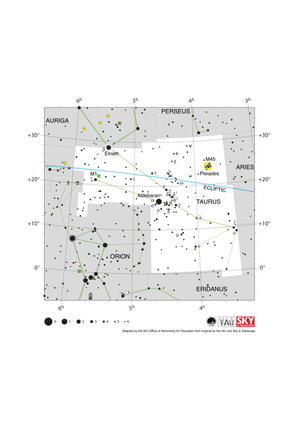
Taurus Constellation Map
Unterschrift: The constellation Taurus along with its bright stars and surrounding constellations. Taurus is surrounded by (going clockwise from the top) Perseus, Aries, Cetus, Eridanus, Orion, Gemini and Auriga. Taurus’s brightest star Aldebaran appears in the middle of the constellation. Taurus lies on the ecliptic (shown here as a blue line), this is the path the Sun appears to take across the sky over the course of a year. The Sun is in Taurus from mid May to late June. The other planets of the Solar System can often be found in Taurus.
Taurus lies mostly north of the celestial equator with a small part in the celestial southern hemisphere. The whole constellation is visible at some point in the year to whole planet except for the Antarctic and a small region around the North Pole. Taurus is most visible in the evenings in the northern hemisphere winter and southern hemisphere summer.
In the eastern part of Taurus we can find the supernova remnant M1 (commonly known as the Crab Nebula), marked here with a green square. In Taurus’s north-east find one of the sky’s most famous open stars clusters M45 (the Pleiades), marked here with a yellow circle. Many of the stars near Aldebaran (but not) Aldebaran are members of another star cluster, the Hyades. However this cluster is close to the solar system so is too dispersed on the sky to have a Messier object designation like the Pleiades has.
The y-axis of this diagram is in degrees of declination with north as up and the x-axis is in hours of right ascension with east to the left. The sizes of the stars marked here relate to the star's apparent magnitude, a measure of its apparent brightness. The larger dots represent brighter stars. The Greek letters mark the brightest stars in the constellation. These are ranked by brightness with the brightest star being labeled alpha, the second brightest beta, etc., although this ordering is not always followed exactly. The dotted boundary lines mark the IAU's boundaries of the constellations and the solid green lines mark one of the common forms used to represent the figures of the constellations. Neither the constellation boundaries, nor the line marking the ecliptic, nor the lines joining the stars appear on the sky.
Bild: Adapted by the IAU Office of Astronomy for Education from the original by IAU/Sky & Telescope
License: CC-BY-4.0 Creative Commons Namensnennung 4.0 International (CC BY 4.0) Symbole
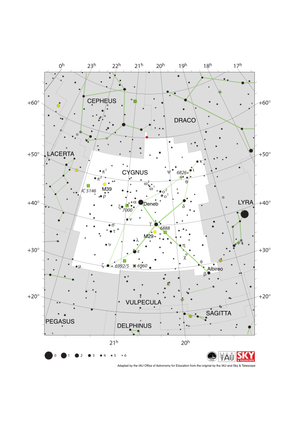
Cygnus Constellation Map
Unterschrift: The constellation Cygnus with its bright stars and surrounding constellations. Cygnus is surrounded by (going clockwise from the top): Cepheus, Draco, Lyra, Vulpecula, Pegasus and Lacerta. Cygnus is notable for its brightest star Deneb. This forms one vertex of the prominent Summer Triangle asterism that is visible in northern hemisphere summer evenings.
Cygnus is a northern constellation and thus the whole of the constellation is visible at some point in the year in the whole northern hemisphere. The whole constellation is also visible from equatorial regions of the southern hemisphere with parts of the constellation visible from temperate southern regions.
The plane of the Milky Way runs through Cygnus and thus the constellation is rich in nebulae and star clusters. These include the North America Nebula (NGC 7000) and the Crescent Nebula (NGC 6888). The Veil Nebula is a huge supernova remnant, parts of which are marked here as NGC 6960 and NGC 6992/5. All of the previously-mentioned nebulae are marked with green squares. The planetary nebula NGC 6826 is marked here with a green circle superimposed on a plus sign. The open star clusters M29 and M39 are marked here with yellow circles.
The y-axis of this diagram is in degrees of declination with north as up and the x-axis is in hours of right ascension with east to the left. The sizes of the stars marked here relate to the star's apparent magnitude, a measure of its apparent brightness. The larger dots represent brighter stars. The Greek letters mark the brightest stars in the constellation. These are ranked by brightness with the brightest star being labeled alpha, the second brightest beta, etc., although this ordering is not always followed exactly. The dotted boundary lines mark the IAU's boundaries of the constellations and the solid green lines mark one of the common forms used to represent the figures of the constellations. Neither the constellation boundaries, nor the lines joining the stars appear on the sky.
Bild: Adapted by the IAU Office of Astronomy for Education from the original by the IAU and Sky & Telescope
License: CC-BY-4.0 Creative Commons Namensnennung 4.0 International (CC BY 4.0) Symbole