This page describes an image Cepheus Constellation Map
Descargar archivo ( imagen 162.00 kB)
Descargar archivo PDF (PDF file 212.38 kB)
Pie de foto del diagrama:
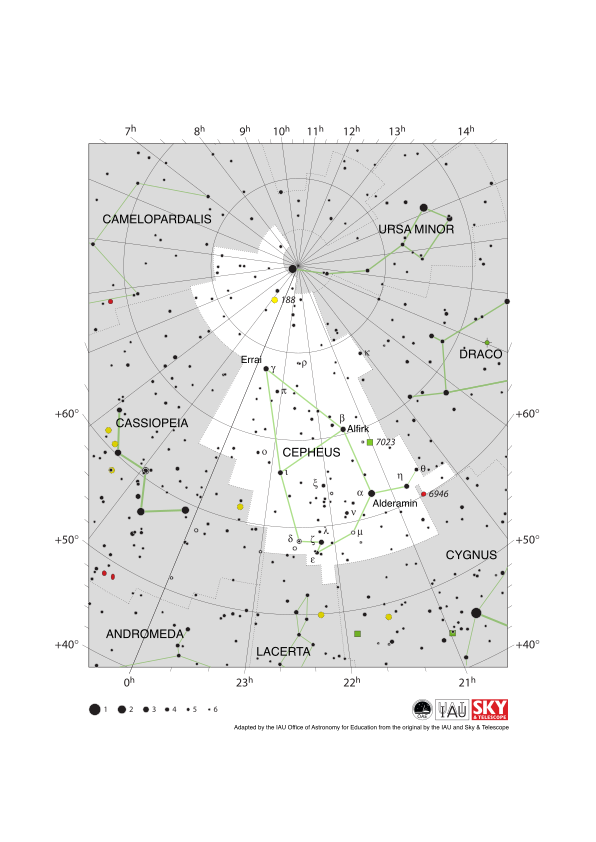
The constellation Cepheus along with its bright stars and surrounding constellations. Cepheus is surrounded by (going clockwise from the top): Camelopardalis, Ursa Minor, Draco, Cygnus, Lacerta and Cassiopeia. Cepheus is a large constellation. Its most notable star is Delta Cephei, the prototype for the class of variable stars known as Cepheid variables. These are variable stars which can be used to estimate distances both within our galaxy and to nearby galaxies.
Cepheus lies close to the north celestial pole. As such it is circumpolar for arctic and temperate regions of the northern hemisphere. The whole of the constellation is also visible at some point in the year in equatorial regions of the northern hemisphere with parts of it visible in equatorial regions of the southern hemisphere. It is best viewed in the evening in the northern hemisphere late autumn and southern hemisphere late spring.
The open cluster NGC 188 lies in Cepheus and is marked here with a yellow circle. The nebula NGC 7023 also lies in the constellation and is marked with a green square. The red ellipse in the lower right marks the position of the spiral galaxy NGC 6946.
This diagram maps an area around the north celestial pole. Here lines of constant right ascension converge. The right ascension values of these lines are marked on the x-axis above and below the diagram. Some of the lines of constant declination are marked on the y-axis. The sizes of the stars marked here relate to the star's apparent magnitude, a measure of its apparent brightness. The larger dots represent brighter stars. The Greek letters mark the brightest stars in the constellation. Delta Cephei is marked with a circle around a dot as it is a variable star. Mu Cephei is also a variable star marked here as an open circle. These are ranked by brightness with the brightest star being labeled alpha, the second brightest beta, etc., although this ordering is not always followed exactly. The dotted boundary lines mark the IAU's boundaries of the constellations and the solid green lines mark one of the common forms used to represent the figures of the constellations. Neither the constellation boundaries, nor the lines joining the stars appear on the sky.
Crédito del diagrama Adapted by the IAU Office of Astronomy for Education from the original by the IAU and Sky & Telescope. Enlace del crédito
Estado de la traducción del diagrama: Aún no ha sido aprobado por un revisor o revisora
Licencia del diagrama: Creative Commons Reconocimiento 4.0 Internacional (CC BY 4.0) Creative Commons Reconocimiento 4.0 Internacional (CC BY 4.0) íconos
Términos relacionados del glosario:
Ascensión recta (AR)
, Constelación
, Coordenadas celestes
, Cúmulo abierto
, Declinación
, Estrellas circumpolares
, Galaxia espiral
, Magnitud Aparente
, Nebulosa
, Polo Norte Celeste (PNC)
Categorías:
Astronomía a simple vista
¿Quieres hacer tu propia traducción o versión de este diagrama? Entonces
descarga la versión SVG
de este diagrama en inglés (718.48 kB). Puedes editarla utilizando
programas como Inkscape (gratuito) o Adobe Illustrator
(de pago). Solo recuerda citar al autor del original de forma adecuada.
También puedes crear tu propia versión o traducción de este diagrama añadiendotexto a una versión de
este diagrama sin texto. Solo tienes que descargar uno de los siguientes archivos:
Descargar archivo sin texto( imagen 149.64 kB)
Descargar archivo PDF sin texto (Archivo PDF 192.54 kB)
En otros idiomas
Inglés: Cepheus Constellation MapItaliano: Mappa della costellazione di Cefeo
Nepalí: सेफियस तारामण्डलको नक्सा
Los pies de foto de los diagramas que aparecen en la página web de la OAE fueron redactados, traducidos y revisados gracias al esfuerzo colectivo de la OAE, los Centros y Nodos de la OAE, los Coordinadores Nacionales de Education Astronómica (NAECs) de la OAE y otros voluntarios. Una lista completa de créditos para nuestro proyecto de traducción puede encontrarse aquí. Todos los pies de foto de los archivos multimedia se publican bajo una licencia Creative Commons CC BY-4.0 license y deben atribuirse a la "IAU OAE" como fuente. Los propios archivos multimedia pueden tener diferentes licencias (véase más arriba) y deben citarse tal y como se indica más arriba en "credit".
Si detectas algún error en este diagrama o en su pie de foto, por favor get contáctanos.