Término del glosario: Ionización
Descripción: La ionización es el proceso de sustracción o adición de electrones a átomos previamente neutros, lo que transforma un gas de átomos (o moléculas) neutros en otro formado por iones cargados, es decir, un plasma.
Términos relacionados:
Ver este término en otros idiomas
Estado del término y la definición: La definición original de este término en inglés ha sido aprobada por unastrónomo o astrónoma investigadora y un docente La traducción de este término y su definición aún están pendientes de aprobación
El Glosario multilingüe de la OAE es un proyecto de la Oficina de Astronomía para la Educación de la UAI (OAE) en colaboración con la Oficina de Divulgación de Astronomía de la UAI (OAO). Los términos y definiciones fueron seleccionados, redactados y revisados gracias al esfuerzo colectivo de la OAE, los Centros y Nodos de la OAE, los Coordinadores Nacionales de Educación Astronómica (NAECs) y otros voluntarios. Puedes encontrar una lista completa de créditos aquí. Todos los términos del glosario y sus definiciones se publican bajo la licencia Creative Commons CC BY-4.0 y deben atribuirse a la "IAU OAE".
Si detectas algún error de contenido o de traducción en este término del glosario o en ladefinición, ponte en contacto con nosotros.
En otros idiomas
- Árabe: التأيُّن
- Alemán: Ionisierung
- Inglés: Ionization
- Francés: Ionisation
- Italiano: Ionizzazione
- Coreano: 이온화
- Portugués de Brasil: Ionização
- Chino simplificado: 电离
- Chino tradicional: 電離
Contenidos relacionados
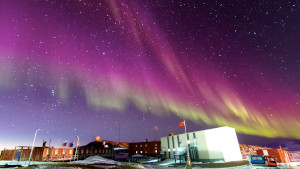
Till the End of the World, by Hang Li, China
Pie de foto: First place in the 2021 IAU OAE Astrophotography Contest, category Aurorae (time-lapses).
Aurorae are often called "Northern Lights" in Europe or North America but here we see that they also exist at the extreme south of our planet. Taken at Zhongshan Station, Antarctica, this time-lapse (speeded up) video shows how some bands of Aurora can remain stable over longer times while other features appear to "dance". See how many different patterns of swirls and waves you can spot in the video.
Crédito: Hang Li/IAU OAE
License: CC-BY-4.0 Creative Commons Reconocimiento 4.0 Internacional (CC BY 4.0) íconos
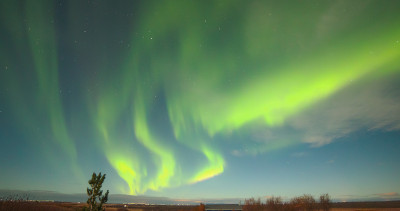
Icelandic Rivers of Light, by Sergio Díaz Ruiz, Spain
Pie de foto: Second place in the 2021 IAU OAE Astrophotography Contest, category Aurorae (time-lapses)
This video shows how aurorae evolve slowly over timescales of a few minutes. Note the clouds being illuminated from behind in the last two shots. Aurorae are caused by interactions between the charged particles blown out in huge explosions from the Sun and the Earth's magnetic field. The changes over time are caused by huge waves of particles pushing the Earth's magnetic field into strange shapes before it snaps back into place.
Crédito: Sergio Díaz Ruiz/IAU OAE
License: CC-BY-4.0 Creative Commons Reconocimiento 4.0 Internacional (CC BY 4.0) íconos
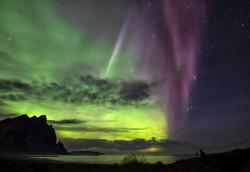
Multicolored aurora in Iceland, by Marco Migliardi on behalf of Associazione Astronomica Cortina, Italy
Pie de foto: First place in the 2021 IAU OAE Astrophotography Contest, category Aurorae (still images)
Aurorae are the result of ionisation and excitation processes in Earth's upper atmosphere, caused by charged particles from the solar wind or from coronal mass ejections. The different colours in an aurora display indicate the species of atmospheric atoms and molecules involved. The most common colour is a bright green, which, together with deep red, originates from atomic oxygen. Blue, purple and pink hues are much rarer and originate from molecular nitrogen. The reflection of the aurora in the water indicates the brightness of intense aurorae at higher latitudes.
Crédito: Marco Migliardi on behalf of Associazione Astronomica Cortina/IAU OAE.
License: CC-BY-4.0 Creative Commons Reconocimiento 4.0 Internacional (CC BY 4.0) íconos
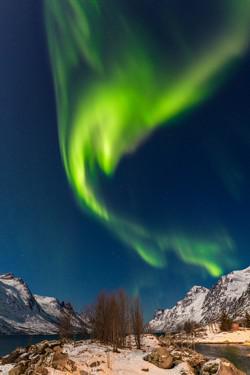
Aurora boreal con forma de dragón sobre Ersfjordbotn (Noruega)
Pie de foto: Segundo puesto en el Concurso de Astrofotografía de la IAU OAE 2021, categoría «Auroras» (imágenes fijas)
Las auroras suelen presentar patrones ondulantes similares a cortinas, en los que los arcos o bandas forman rizos, pliegues o incluso espirales en movimiento. Estas formas irregulares reflejan la estructura a pequeña escala del campo magnético terrestre al interactuar con los flujos de partículas cargadas. Aunque la luna llena ilumina tanto el paisaje como el cielo nocturno, la aurora es fácilmente visible, lo que demuestra que puede ser un fenómeno muy brillante y colorido.
Crédito: Rainer Sparenberg/IAU OAE
License: CC-BY-4.0 Creative Commons Reconocimiento 4.0 Internacional (CC BY 4.0) íconos