Glossary term: Ionization
Description: Ionization is the process of subtracting electrons from or adding electrons to previously neutral atoms, thereby changing a gas of neutral atoms (or molecules) to one made up of charged ions, i.e. a plasma.
Related Terms:
See this term in other languages
Term and definition status: This term and its definition have been approved by a research astronomer and a teacher
The OAE Multilingual Glossary is a project of the IAU Office of Astronomy for Education (OAE) in collaboration with the IAU Office of Astronomy Outreach (OAO). The terms and definitions were chosen, written and reviewed by a collective effort from the OAE, the OAE Centers and Nodes, the OAE National Astronomy Education Coordinators (NAECs) and other volunteers. You can find a full list of credits here. All glossary terms and their definitions are released under a Creative Commons CC BY-4.0 license and should be credited to "IAU OAE".
If you notice a factual error in this glossary definition then please get in touch.
In Other Languages
- Arabic: التأيُّن
- German: Ionisierung
- Spanish: Ionización
- French: Ionisation
- Italian: Ionizzazione
- Korean: 이온화
- Brazilian Portuguese: Ionização
- Simplified Chinese: 电离
- Traditional Chinese: 電離
Related Media
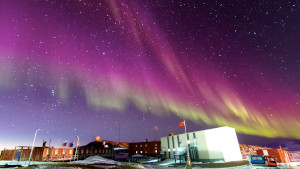
Till the End of the World, by Hang Li, China
Caption: First place in the 2021 IAU OAE Astrophotography Contest, category Aurorae (time-lapses).
Aurorae are often called "Northern Lights" in Europe or North America but here we see that they also exist at the extreme south of our planet. Taken at Zhongshan Station, Antarctica, this time-lapse (speeded up) video shows how some bands of Aurora can remain stable over longer times while other features appear to "dance". See how many different patterns of swirls and waves you can spot in the video.
Credit: Hang Li/IAU OAE
License: CC-BY-4.0 Creative Commons Attribution 4.0 International (CC BY 4.0) icons
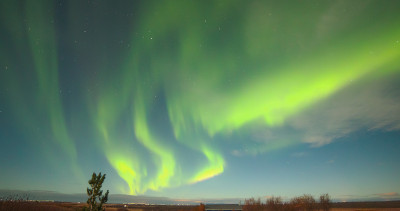
Icelandic Rivers of Light, by Sergio Díaz Ruiz, Spain
Caption: Second place in the 2021 IAU OAE Astrophotography Contest, category Aurorae (time-lapses)
This video shows how aurorae evolve slowly over timescales of a few minutes. Note the clouds being illuminated from behind in the last two shots. Aurorae are caused by interactions between the charged particles blown out in huge explosions from the Sun and the Earth's magnetic field. The changes over time are caused by huge waves of particles pushing the Earth's magnetic field into strange shapes before it snaps back into place.
Credit: Sergio Díaz Ruiz/IAU OAE
License: CC-BY-4.0 Creative Commons Attribution 4.0 International (CC BY 4.0) icons
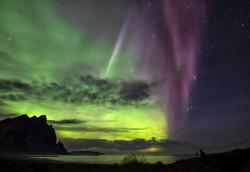
Multicolored aurora in Iceland, by Marco Migliardi on behalf of Associazione Astronomica Cortina, Italy
Caption: First place in the 2021 IAU OAE Astrophotography Contest, category Aurorae (still images)
Aurorae are the result of ionisation and excitation processes in Earth's upper atmosphere, caused by charged particles from the solar wind or from coronal mass ejections. The different colours in an aurora display indicate the species of atmospheric atoms and molecules involved. The most common colour is a bright green, which, together with deep red, originates from atomic oxygen. Blue, purple and pink hues are much rarer and originate from molecular nitrogen. The reflection of the aurora in the water indicates the brightness of intense aurorae at higher latitudes.
Credit: Marco Migliardi on behalf of Associazione Astronomica Cortina/IAU OAE.
License: CC-BY-4.0 Creative Commons Attribution 4.0 International (CC BY 4.0) icons
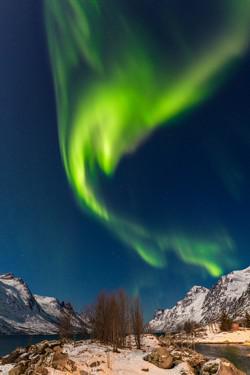
Northern light dragon over Ersfjordbotn/Norway
Caption: Second place in the 2021 IAU OAE Astrophotography Contest, category Aurorae (still images)
Aurorae often display waving curtain-like patterns where arcs or bands form moving curls, folds, or even spirals. These irregular shapes mirror the small-scale structure of Earth's magnetic field interacting with charged particle flows. Although the full Moon illuminates both the landscape and the night sky, the auroa is easily visible, which demonstrates that it can be a very bright and colourful phenomenon.
Credit: Rainer Sparenberg/IAU OAE
License: CC-BY-4.0 Creative Commons Attribution 4.0 International (CC BY 4.0) icons