Término del glosario: Nova
Descripción: Una nova es una estrella que se vuelve repentinamente mucho más brillante, hasta alcanzar un brillo muchas veces superior al que tenía antes. El nombre proviene del latín «nova stella» (estrella nueva), término que se utilizaba en la Europa de principios de la Edad Moderna para describir las estrellas brillantes que aparecían de repente en el cielo. Las novas han sido observadas como «estrellas invitadas» por muchas culturas diferentes.
Las novas se producen cuando una enana blanca acumula gas procedente de una estrella compañera en un sistema binario cercano. Este gas se acumula en la atmósfera de la enana blanca hasta que alcanza la temperatura suficiente para encenderse mediante fusión nuclear. Esta bola de fuego nuclear hace que la enana blanca aumente su brillo en varios órdenes de magnitud. A diferencia de una supernova de tipo Ia, la enana blanca permanece intacta tras esta explosión. Esto significa que todo el proceso puede volver a comenzar y que la nova puede repetirse.
Términos relacionados:
Ver este término en otros idiomas
Estado del término y la definición: La definición original de este término en inglés ha sido aprobada por unastrónomo o astrónoma investigadora y un docente La traducción de este término y su definición aún están pendientes de aprobación
El Glosario multilingüe de la OAE es un proyecto de la Oficina de Astronomía para la Educación de la UAI (OAE) en colaboración con la Oficina de Divulgación de Astronomía de la UAI (OAO). Los términos y definiciones fueron seleccionados, redactados y revisados gracias al esfuerzo colectivo de la OAE, los Centros y Nodos de la OAE, los Coordinadores Nacionales de Educación Astronómica (NAECs) y otros voluntarios. Puedes encontrar una lista completa de créditos aquí. Todos los términos del glosario y sus definiciones se publican bajo la licencia Creative Commons CC BY-4.0 y deben atribuirse a la "IAU OAE".
Si detectas algún error de contenido o de traducción en este término del glosario o en ladefinición, ponte en contacto con nosotros.
Contenidos relacionados
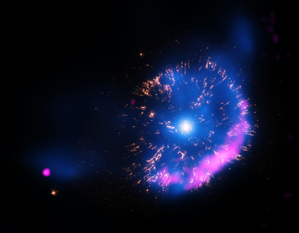
The Classical Nova GK Persei
Pie de foto: This composite image shows the aftermath of a stellar explosion known as a nova, specifically the remnant of a classical nova called GK Persei. A nova occurs when a very dense star called a white dwarf pulls hydrogen-rich gas from a companion star in a binary system until the accumulated material ignites in a powerful thermonuclear explosion. This sudden release of energy sweeps material outward and produces bright X-ray, optical, and radio emission that can be studied long after the blast.
GK Persei was for a very short time in 1901 one of the brightest stars in the sky. Classical novae like GK Persei temporarily brighten dramatically — sometimes to thousands of times their usual luminosity — before fading over months or years as the expanding shell moves through space. In this image taken over 100 years since the nova's 1901 brightening, X-rays (shown in blue) reveal very hot gas left behind by the explosion, optical data (yellow) show clumps of matter ejected from the star’s surface, and radio information (pink) highlights high-energy electrons energized by the expanding nova shock wave. Studying novae helps scientists learn about how stars interact in binary systems and how powerful bursts of energy shape the material around them.
The nature of the pink blob in the lower left is not known.
Crédito: X-ray: NASA/CXC/RIKEN/D.Takei et al; Optical: NASA/STScI; Radio: NRAO/VLA
enlace de crédito
License: PD Dominio público íconos