Glossary term: नोव्हा
Description: नोव्हा हा एक तारा आहे जो अचानक उजळतो, पूर्वीपेक्षा अनेक पटींनी उजळ होतो. हे नाव लॅटिन नोव्हा स्टेला किंवा नवीन तारेवरून आले आहे, ज्याचा वापर सुरुवातीच्या-आधुनिक युरोपमध्ये अचानक आकाशात दिसणाऱ्या तेजस्वी ताऱ्यांचे वर्णन करण्यासाठी केला जात असे. नोव्हा हे विविध संस्कृतींनी "अतिथी तारे" म्हणून पाहिले आहेत.
नोव्हा पांढर्या बटू किव्वा व्हाइट ड्वॉर्फ मुळे होतात जे जवळच्या बायनरी तारा सहचरातून वायू ग्रहण करतात. हा वायू व्हाइट ड्वॉर्फच्या वातावरणात अणु संलयनाद्वारे प्रज्वलित होण्याइतका गरम होईपर्यंत तयार होतो. या आण्विक फायरबॉलमुळे व्हाइट ड्वॉर्फला अनेक परिमाणाने चमक येते. टाईप Ia सुपरनोव्हाच्या विपरीत, या स्फोटानंतर व्हाइट ड्वॉर्फ शाबूत राहतो. याचा अर्थ असा की संपूर्ण प्रक्रिया पुन्हा सुरू होऊ शकते आणि नोव्हा पुन्हा येऊ शकतो.
Related Terms:
See this term in other languages
Term and definition status: The original definition of this term in English have been approved by a research astronomer and a teacher The translation of this term and its definition is still awaiting approval
The OAE Multilingual Glossary is a project of the IAU Office of Astronomy for Education (OAE) in collaboration with the IAU Office of Astronomy Outreach (OAO). The terms and definitions were chosen, written and reviewed by a collective effort from the OAE, the OAE Centers and Nodes, the OAE National Astronomy Education Coordinators (NAECs) and other volunteers. You can find a full list of credits here. All glossary terms and their definitions are released under a Creative Commons CC BY-4.0 license and should be credited to "IAU OAE".
If you notice a factual or translation error in this glossary term or definition then please get in touch.
Related Media
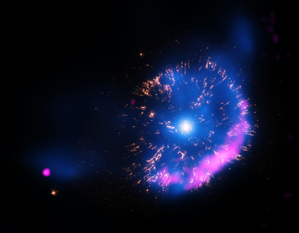
The Classical Nova GK Persei
Caption: This composite image shows the aftermath of a stellar explosion known as a nova, specifically the remnant of a classical nova called GK Persei. A nova occurs when a very dense star called a white dwarf pulls hydrogen-rich gas from a companion star in a binary system until the accumulated material ignites in a powerful thermonuclear explosion. This sudden release of energy sweeps material outward and produces bright X-ray, optical, and radio emission that can be studied long after the blast.
GK Persei was for a very short time in 1901 one of the brightest stars in the sky. Classical novae like GK Persei temporarily brighten dramatically — sometimes to thousands of times their usual luminosity — before fading over months or years as the expanding shell moves through space. In this image taken over 100 years since the nova's 1901 brightening, X-rays (shown in blue) reveal very hot gas left behind by the explosion, optical data (yellow) show clumps of matter ejected from the star’s surface, and radio information (pink) highlights high-energy electrons energized by the expanding nova shock wave. Studying novae helps scientists learn about how stars interact in binary systems and how powerful bursts of energy shape the material around them.
The nature of the pink blob in the lower left is not known.
Credit: X-ray: NASA/CXC/RIKEN/D.Takei et al; Optical: NASA/STScI; Radio: NRAO/VLA
credit link
License: PD Public Domain icons