Término del glosario: Observatorio Astronómico
Descripción: Un observatorio astronómico es un lugar diseñado y construido exclusivamente para facilitar la observación científica de objetos extraterrestres. Dispone de instrumentos especializados, como telescopios, cámaras CCD con filtros especiales, salas de ordenadores y herramientas adecuadas para analizar imágenes y otros tipos de datos científicos. Suele tener cúpulas o techos en forma de cúpula diseñados para proteger los telescopios y otros instrumentos de las inclemencias del tiempo. Estos techos se abren y se mueven para permitir la observación de una determinada región del cielo. El observatorio puede tener controles especiales de temperatura para mantener sus espejos o lentes y otros equipos en las mejores condiciones. Cabe señalar que los telescopios espaciales suelen denominarse observatorios espaciales (por ejemplo, el Observatorio de rayos X Chandra o el Observatorio Solar y Heliosférico).
Ver este término en otros idiomasEstado del término y la definición: La definición original de este término en inglés ha sido aprobada por unastrónomo o astrónoma investigadora y un docente La traducción de este término y su definición aún están pendientes de aprobación
El Glosario multilingüe de la OAE es un proyecto de la Oficina de Astronomía para la Educación de la UAI (OAE) en colaboración con la Oficina de Divulgación de Astronomía de la UAI (OAO). Los términos y definiciones fueron seleccionados, redactados y revisados gracias al esfuerzo colectivo de la OAE, los Centros y Nodos de la OAE, los Coordinadores Nacionales de Educación Astronómica (NAECs) y otros voluntarios. Puedes encontrar una lista completa de créditos aquí. Todos los términos del glosario y sus definiciones se publican bajo la licencia Creative Commons CC BY-4.0 y deben atribuirse a la "IAU OAE".
Si detectas algún error de contenido o de traducción en este término del glosario o en ladefinición, ponte en contacto con nosotros.
En otros idiomas
- Árabe: المرصد الفلكي
- Alemán: Astronomisches Observatorium
- Inglés: Astronomical Observatory
- Francés: Observatoire astronomique
- Italiano: Osservatorio astronomico
- Coreano: 천문대
- Portugués de Brasil: Observatório Astronômico
- Chino simplificado: 天文台
- Chino tradicional: 天文臺
Contenidos relacionados
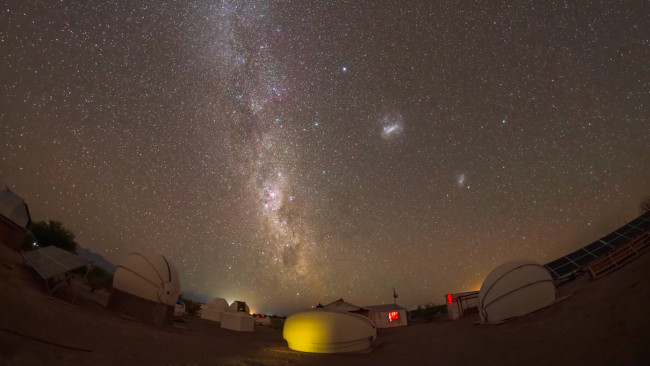
Chilean Nights
Pie de foto: Honourable mention in the 2022 IAU OAE Astrophotography Contest, category Time lapses of celestial patterns.
Shot in December 2020, this time-lapse shows the sky from San Pedro de Atacama, Chile, in the southern hemisphere.
Right in the first frame we can see our home galaxy, the Milky Way, as well as both the Large and Small Magellanic clouds, two satellite galaxies orbiting the Milky Way. In the bottom of the image the bright stars Rigil Kentaurus and Hadar (also known as Alpha and Beta Centauri) are visible, both in the constellation Centaurus. Just above, we can also see the small constellation Crux, visible from the northern tropical circles southwards. It is important for navigation purposes because its longer axis indicates the direction of the celestial south pole. The bright whitish star in the top of the image and to the right of the Galaxy is Canopus, one of the brightest stars in the night sky, located in the constellation Carina. Canopus is the second brightest star in the sky, while Rigil Kentaurus is the third brightest.
In some of the next frames, Orion, the great hunter, appears clearly with its bright stars and its characteristic asterism, the belt, composed of three aligned bright stars. Since this video was taken from the southern hemisphere, the Greek hero from the northern hemisphere seems to be performing a headstand.
We can also see the planets Jupiter and Saturn in a close conjunction, even finding themselves in the significant beam of Zodiacal light setting down below the horizon. There are also a few meteors blinking in some of the frames, one of them with a long-lasting and developing trail. The very bright object rising from behind the volcanoes of the Andes, creating spectacular shadows and crepuscular rays, is the Moon. In the last frame we see the Moon next to Saturn and Jupiter.
Crédito: Robert Barsa/IAU OAE
License: CC-BY-4.0 Creative Commons Reconocimiento 4.0 Internacional (CC BY 4.0) íconos
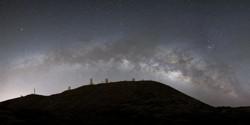
Teide Observatory
Pie de foto: Honourable mention in the 2022 IAU OAE Astrophotography Contest, category Still images of celestial patterns.
Taken in May 2022 in Teide National Park in Tenerife, Spain, this image shows the arc of the Milky Way galaxy crossing the sky, accompanied by prominent constellations over the professional telescopes located on the mountains of that island. While the telescopes and the people working with them may ignore the constellations, the photographer managed to catch the Milky Way in such a way that it almost matches the shape of the mountain.
The bright star in the top-left side of the image is Vega, one of the brightest stars in the night sky and located in the small constellation Lyra. Being a white star, it is the standard star astrophysicists use to define the colour scale. As it is also a relatively close star, only about 25 light-years away, with a relatively simple name, it frequently appears in modern science fiction, for example in Carl Sagan’s famous novel “Contact”, which was filmed in 1997 with Jodie Foster starring as a radio astronomer.
The bright star seen below the galaxy and on the left half of the image is Altair, also one of the brightest stars in the night sky and located in the constellation Aquila. Together with Deneb — a star in the constellation Cygnus (the Swan) that is not visible in this image — Altair and Vega form the Summer Triangle, a characteristic asterism of popular astronomy in the northern hemisphere, where these telescopes are located.
On the right side of the image we can see the constellation Scorpius. This is easily identified by its brightest star, Antares, the reddish star in the Scorpion’s heart. Below it, the whole body and tail of the Scorpion can be found and above it the celestial Scorpion's head is represented by three bright bluish stars. Below the tail and above the horizon, the constellation of Ara, the Altar, is half-visible, but like all the stars of Sagittarius in the Milky Way and the much fainter ones in Hercules and Ophiuchus above it, these constellations are more difficult to pinpoint in this photograph full of stars. The head of Ophiuchus is the relatively bright star in the middle between Vega and Antares. In addition to the huge size of this constellation, it is also important because it is the thirteenth one of the Zodiac, and the Sun spends roughly three weeks in Ophiuchus, after only five days in Scorpius. Furthermore, Ophiuchus represents the model for the mythological best doctor in the world, called Asklepios in Greek mythology, and Aesculab in Latin. His constellation praises all people working in medical professions, including nurses, pharmacists and doctors.
Crédito: Curd-Christian Tengeler/IAU OAE
License: CC-BY-4.0 Creative Commons Reconocimiento 4.0 Internacional (CC BY 4.0) íconos
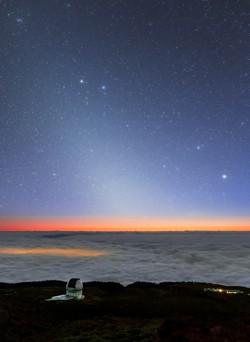
Zodiacal Light over GTC Observatory
Pie de foto: Winner in the 2022 IAU OAE Astrophotography Contest, category Still images of celestial patterns.
Taken from La Palma, Canary Islands, in May 2022, this image captures the Zodiacal light, three prominent constellations (Gemini, Cancer and Auriga), and the Beehive Cluster, which appears as a small nebulosity to the unaided eye under dark skies. The Zodiacal light is a triangular white glow stretching along the ecliptic that is visible here at the western horizon shortly after sunset.The Canary Islands were considered the westernmost land of the inhabited world by the ancient Greeks. The dim shimmer in the Zodiac might have inspired the Greek philosopher Plato to think that the Sun leaves a trace of sunny glitter in its wake, and that the current path of the Sun, the ecliptic, has not always been its path. Plato believed that the Milky Way was a former path of the Sun and that its bright clouds are sparks of the Sun’s glory left behind. Today, we know that these two phenomena in the sky have different causes; while the Zodiacal light is really caused by reflection of sunlight from very tiny dust particles in the plane of the ecliptic, the Milky Way consists of billions of stars. The Zodiacal light is a smooth cone of light from the horizon upwards, while the Milky Way crosses the whole sky and also includes dark clouds.
The Zodiac is described by Indigenous Australians as the Dreaming Road, and the Zodiacal light is a celestial rope connecting Venus to the Sun. The two bright stars in the top-left of the image are Castor (the bluish star) and Pollux (the whitish star), which are part of the constellation Gemini, the Twins. The two bright stars towards the bottom-right of the image are Menkalinan (the dimmer one) and Capella (the brighter one), which are part of the constellation Auriga, the Charioteer.
The Wergaia people of Western Victoria in Australia see Castor and Pollux as brothers who hunt the kangaroo Purra in their stories. This has coincidental similarities to the Babylonian story, where they are considered two strong gods of the Netherworld, depicted with weapons. The Greco-Roman myth of the twins describes them as two brothers who accompanied the first ocean sailor, Jason, on voyages with the The Ship, Argo. A similar myth exists in the Blackfoot traditions of the First Nations people of Canada and the USA, where they are considered the two brothers Ashes Chief and Struck-behind.
Crédito: Amirreza Kamkar/IAU OAE
License: CC-BY-4.0 Creative Commons Reconocimiento 4.0 Internacional (CC BY 4.0) íconos