Término del glosario: Plutón
Descripción: Plutón es uno de los cuerpos celestes de nuestro Sistema Solar. Se encuentra en el cinturón de Kuiper, más allá de la órbita de Neptuno. Antes se le consideraba el noveno planeta del Sistema Solar, pero en 2006 fue reclasificado como planeta enano. Fue descubierto en 1930 por Clyde Tombaugh. La distancia media de Plutón al Sol es de 6 mil millones de kilómetros (km), y su radio es de 1 185 km (menor que el de la Luna de la Tierra). Un año en Plutón equivale a 247.9 años terrestres y su día equivale a 6.4 días terrestres.
La misión New Horizons de la NASA fue la primera nave espacial en sobrevolar Plutón, en 2015, y proporcionó la primera visión detallada de su superficie y su atmósfera. La superficie de Plutón es tan fría que apenas hay hidrógeno en estado gaseoso. La escasa atmósfera que tiene Plutón está compuesta principalmente por nitrógeno, y la superficie presenta grandes llanuras de nitrógeno congelado. Su atmósfera se extiende hasta una distancia de 1 600 km. Plutón está compuesto por rocas (70 %) y hielo (30 %). Tiene cinco lunas conocidas: Caronte, Estigia, Nix, Cerbero e Hidra.
Términos relacionados:
Ver este término en otros idiomas
Estado del término y la definición: La definición original de este término en inglés ha sido aprobada por unastrónomo o astrónoma investigadora y un docente La traducción de este término y su definición aún están pendientes de aprobación
El Glosario multilingüe de la OAE es un proyecto de la Oficina de Astronomía para la Educación de la UAI (OAE) en colaboración con la Oficina de Divulgación de Astronomía de la UAI (OAO). Los términos y definiciones fueron seleccionados, redactados y revisados gracias al esfuerzo colectivo de la OAE, los Centros y Nodos de la OAE, los Coordinadores Nacionales de Educación Astronómica (NAECs) y otros voluntarios. Puedes encontrar una lista completa de créditos aquí. Todos los términos del glosario y sus definiciones se publican bajo la licencia Creative Commons CC BY-4.0 y deben atribuirse a la "IAU OAE".
Si detectas algún error de contenido o de traducción en este término del glosario o en ladefinición, ponte en contacto con nosotros.
Contenidos relacionados
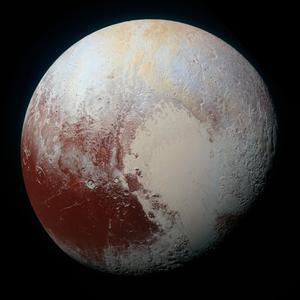
Pluto
Pie de foto: NASA's New Horizons spacecraft captured this high-resolution enhanced colour view of the dwarf planet Pluto on in July 2015. The image combines blue, red and infrared images taken by the Ralph/Multispectral Visual Imaging Camera (MVIC). Pluto’s surface appears enhanced in this view to a rainbow of pale blues, yellows, oranges, and deep reds. The image resolves details and colours on scales as small as 1.3 kilometers.
Crédito: NASA/Johns Hopkins University Applied Physics Laboratory/Southwest Research Institute
enlace de crédito
License: PD Dominio público íconos

Detailed View of Charon, Moon of Pluto
Pie de foto: Charon is the largest natural moon of the dwarf planet Pluto. This detailed image was taken by NASA’s New Horizons spacecraft in 2015 during its historic mission through the outer Solar System. Charon’s surface shows a fascinating mix of light and dark regions, including vast canyons, broad plains, and impact crater. With a diameter of about 1,200 kilometers, Charon is more than half the diameter of Pluto, making it unusually large compared to its parent body. Charon's mass is roughly 12% of that of Pluto.
Because Pluto and Charon are so close in mass, the center of mass of the system (the point both Pluto and Charon orbit) is not within Pluto but between Pluto and Charon. This is in contrast to systems like the Earth and its Moon where the center of mass lies within the larger body, the Earth in this case. Scientists think the Pluto-Charon system may have formed by a collision of two objects that then separated and began to orbit each other. By studying Charon and the smaller moons that circle Pluto, astronomers gain insight into how moons form and how distant icy bodies evolve over billions of years.
Crédito: NASA/Johns Hopkins University Applied Physics Laboratory/Southwest Research Institute/Alex Parker
enlace de crédito
License: PD Dominio público íconos
Actividades relacionadas
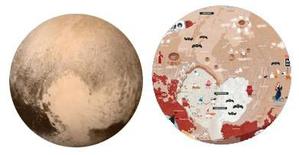
Children's Planetary Maps: Pluto & Charon
astroEDU educational activity (links to astroEDU website) Description: Learn about our furthest neighbors
License: CC-BY-4.0 Creative Commons Reconocimiento 4.0 Internacional (CC BY 4.0) íconos
Etiquetas:
Maps
, Planetary cartography
, Spatial thinking
, Charon
Rango de edades:
6-8
, 8-10
, 10-12
, 12-14
Nivel educativo:
Educación secundaria
, Primaria
, Secondary
Áreas de aprendizaje:
Aprendizaje basado en la investigación estructurada
Costos:
Bajo coste
Duración:
2 horas
Tamaño del grupo:
Grupo
Competencias:
Analizar e interpretar datos
, Plantear preguntas
, Comunicar información
, Elaborar explicaciones
, Desarrollar y utilizar modelos
, Participar en debates basados en pruebas
, Planificar y llevar a cabo investigaciones