Término del glosario: Nave espacial
Descripción: Una nave espacial es un vehículo construido para viajar por el espacio exterior. La propulsión suele realizarse mediante algún tipo de motor cohete, que emite gas o plasma en una dirección para acelerar en la dirección opuesta. Las naves espaciales que no transportan seres humanos se denominan naves espaciales no tripuladas o robóticas; algunos ejemplos son diversos tipos de satélites, telescopios espaciales o sondas espaciales que se utilizan para la exploración. Las naves espaciales tripuladas, por su parte, deben garantizar la supervivencia de sus ocupantes humanos, por ejemplo, mediante una atmósfera presurizada, protección contra la radiación y una temperatura regulada. Las naves espaciales que pueden regresar a la Tierra se denominan recuperables; aquellas que pueden volver a lanzarse tras su recuperación, reutilizables. Una nave espacial diseñada para servir de base de operaciones a largo plazo, por ejemplo, en órbita terrestre, se denomina estación espacial.
Términos relacionados:
Ver este término en otros idiomas
Estado del término y la definición: La definición original de este término en inglés ha sido aprobada por unastrónomo o astrónoma investigadora y un docente La traducción de este término y su definición aún están pendientes de aprobación
El Glosario multilingüe de la OAE es un proyecto de la Oficina de Astronomía para la Educación de la UAI (OAE) en colaboración con la Oficina de Divulgación de Astronomía de la UAI (OAO). Los términos y definiciones fueron seleccionados, redactados y revisados gracias al esfuerzo colectivo de la OAE, los Centros y Nodos de la OAE, los Coordinadores Nacionales de Educación Astronómica (NAECs) y otros voluntarios. Puedes encontrar una lista completa de créditos aquí. Todos los términos del glosario y sus definiciones se publican bajo la licencia Creative Commons CC BY-4.0 y deben atribuirse a la "IAU OAE".
Si detectas algún error de contenido o de traducción en este término del glosario o en ladefinición, ponte en contacto con nosotros.
En otros idiomas
- Árabe: المركبة الفضائية
- Alemán: Raumschiff
- Inglés: Spacecraft
- Francés: Vaisseau spatial
- Italiano: Veicolo spaziale
- Portugués de Brasil: Espaçonave
- Chino simplificado: 航天器
- Chino tradicional: 航天器
Contenidos relacionados
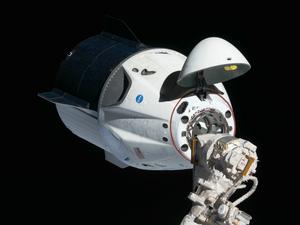
SpaceX crew dragon spacecraft
Pie de foto: The SpaceX Crew Dragon spacecraft is the first Commercial Crew vehicle to visit the International Space Station (ISS). It is pictured with its nose cone open revealing its docking mechanism while approaching the station's Harmony module.
Crédito: NASA
License: PD Dominio público íconos
Space debris orbiting the Earth
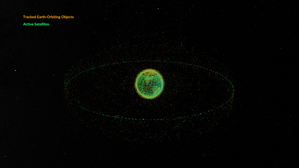
Pie de foto: This animation shows objects orbiting the Earth. The data date from February 2024 and are taken from space-track.org which maintains a public catalogue of objects tracked by the United States Space Command (USSPACECOM).
At first in this video we see green dots, each representing one of the 31,000 human-made objects orbiting Earth. These include both operational and decommissioned satellites, used rocket stages from space launches, and fragments larger than 10cm created by collisions or explosions. Later in the video, some of the green dots are replace by orange dots, each of these representing one of the 9,300 operational satellites orbiting the Earth. Note that since February 2024 more satellites and rockets have been launched in to space and some objects will have fallen back to Earth, so these numbers will have changed.
We see two main groups of objects. The first are those objects orbiting close to the Earth, objects in low Earth orbit. These include communication satellites (many from the satellite constellations used to provide satellite internet services), Earth observation satellites, military satellites, two operational space stations and other objects such as rocket stages and other debris.
More distant from Earth we see a thin ring of satellites. These are in geostationary orbit. This is a special orbit where the orbital period matches the rotation period of the Earth. This means that a satellite in geostationary orbit stays above the same point on the equator and, when observed from the side of the Earth facing the satellite, will appear to stay at a position on the sky that does not change over time. Because of this, geostationary orbit is used by many communications satellites as a satellite dish on Earth used to receive or transmit a signal to that satellite can point in a fixed direction and does not need to dynamically track the satellite. Geostationary orbit is also used by weather observation satellites.
Crédito: NASA's Scientific Visualization Studio
enlace de crédito
License: PD Dominio público íconos