بلغات أخرى
- الألمانيّة: Raumschiff
- الإنجليزيّة: Spacecraft
- الإسبانيّة: Nave espacial
- الفرنسيّة: Vaisseau spatial
- الإيطاليّة: Veicolo spaziale
- البرتغاليّة البرازيليّة: Espaçonave
- الصينيّة المبسطة: 航天器
- الصينيّة التقليدية: 航天器
وسائط ذات صلة
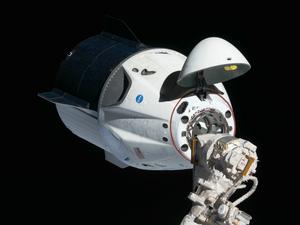
مركبة الفضاء سبيس إكس التنين
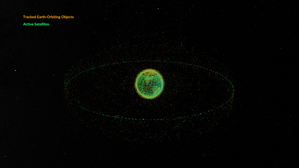
Space debris orbiting the Earth
الشرح: This animation shows objects orbiting the Earth. The data date from February 2024 and are taken from space-track.org which maintains a public catalogue of objects tracked by the United States Space Command (USSPACECOM).
At first in this video we see green dots, each representing one of the 31,000 human-made objects orbiting Earth. These include both operational and decommissioned satellites, used rocket stages from space launches, and fragments larger than 10cm created by collisions or explosions. Later in the video, some of the green dots are replace by orange dots, each of these representing one of the 9,300 operational satellites orbiting the Earth. Note that since February 2024 more satellites and rockets have been launched in to space and some objects will have fallen back to Earth, so these numbers will have changed.
We see two main groups of objects. The first are those objects orbiting close to the Earth, objects in low Earth orbit. These include communication satellites (many from the satellite constellations used to provide satellite internet services), Earth observation satellites, military satellites, two operational space stations and other objects such as rocket stages and other debris.
More distant from Earth we see a thin ring of satellites. These are in geostationary orbit. This is a special orbit where the orbital period matches the rotation period of the Earth. This means that a satellite in geostationary orbit stays above the same point on the equator and, when observed from the side of the Earth facing the satellite, will appear to stay at a position on the sky that does not change over time. Because of this, geostationary orbit is used by many communications satellites as a satellite dish on Earth used to receive or transmit a signal to that satellite can point in a fixed direction and does not need to dynamically track the satellite. Geostationary orbit is also used by weather observation satellites.
المصدر: NASA's Scientific Visualization Studio
رابط المصدر
License: PD الملكية العامة أيقونات