Glossary term: Sun
Description: The Sun is the star that is closest to the Earth. For astronomers, it is a star of type "G2V". This means the Sun is a main sequence star with a typical temperature ("effective temperature") of 5800 kelvins (K). Main sequence stars are stable, with energy released by hydrogen fusion in their core balancing the inwards force due to gravity. The Sun appears white to the human eye as it emits lots of light all across the visible spectrum. When lower in the sky, increased atmospheric extinction can make the Sun appear yellow or orange, hence its common depiction as yellow. Stars range from more than 1000 times brighter than the Sun to some 1000 times fainter, but the brighter ones are relatively rare: the Sun is brighter (and heavier) than most (perhaps some 85%) of the stars in the Galaxy.
For astronomers, the Sun is interesting because of its proximity, which means that the surface can be resolved in greater detail, allowing structures and phenomena to be studied. For example, detailed studies of solar activity, which is related to the Sun's magnetic fields, can include: sunspots (cooler areas), flares (short-lived bright flashes), and even coronal mass ejections (electrically charged particles flung away from the Sun). Physicists have also detected elementary particles known as neutrinos from the Sun's core; this is direct evidence for nuclear fusion processes. The element helium was first detected in the solar spectrum, hence the name helium, which comes from Helios (in Greek mythology the Sun god).
Related Terms:
- Main Sequence
- Nuclear Fusion
- Solar Flare
- Star
- Sunspot
- Effective Temperature
- Magnetic Field
- Neutrino
- Coronal Mass Ejection (CME)
See this term in other languages
Term and definition status: This term and its definition have been approved by a research astronomer and a teacher
The OAE Multilingual Glossary is a project of the IAU Office of Astronomy for Education (OAE) in collaboration with the IAU Office of Astronomy Outreach (OAO). The terms and definitions were chosen, written and reviewed by a collective effort from the OAE, the OAE Centers and Nodes, the OAE National Astronomy Education Coordinators (NAECs) and other volunteers. You can find a full list of credits here. All glossary terms and their definitions are released under a Creative Commons CC BY-4.0 license and should be credited to "IAU OAE".
If you notice a factual error in this glossary definition then please get in touch.
Related Media
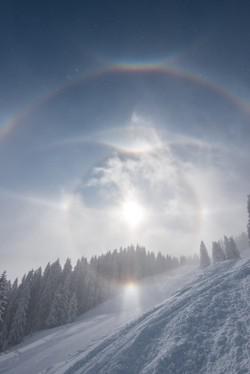
Winter Haloes, by Thomas Gigl, Germany
Caption: Second place in the 2021 IAU OAE Astrophotography Contest, category Sun/Moon haloes.
Captured in Jochberg located in the famous Austrian ski-region of Tirol, this image shows multiple features related to ice halos, which are a more common appearance around the sun, due to its brightness, than the moon. External and internal reflection of sun rays from ice crystal faces and within different types of ice crystals lead to these halo related phenomena. The 22° halo encircles the sun, with two bright spots at the edge called Sundogs, Parhelia or Mock Suns observed to the left and right at the same height as the sun. The horizontal white band called the parhelic circle, named after the sun god Helios, passes through the sun and the Sundogs at the same angular elevation. An Upper tangent arc, a suncave parry arc and a lower tangent arc are also seen touching the top and bottom of the 22° halo. An upside down rainbow like arc or the circumzenithal arc is seen touching the bright supralateral arc, both of which are less frequently observed.
Credit: Thomas Gigl/IAU OAE
License: CC-BY-4.0 Creative Commons Attribution 4.0 International (CC BY 4.0) icons
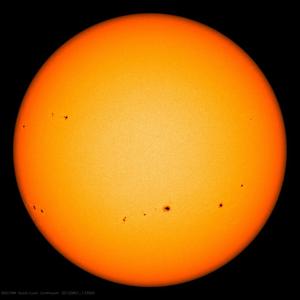
Sunspots
Caption: In this image the sun peppered with groups of sunspots over almost nine days between July and August 2012. The sunspots seen in this image have been sources of the solar flares and coronal mass ejections (CME). In this image particulary, the sun is approaching solar maximum in its cycle (solar cycle), where we see many spots forming along the suns' equator. These sunspots and activity are seen in the southern hemisphere, before then most of the activity was on the northern hemisphere.
Credit: NASA/SDO/HMI
credit link
License: PD Public Domain icons
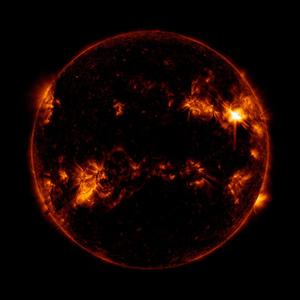
Solar flare
Caption: This image shows the mid-level solar flare that was observed in March 2022 by the Solar Dynamic Observatory (SDO). The SDO observes the Sun activity, hence it shows the regions on the Sun where there is activity. A solar flare is brief brightening on the sun's surface, this particular flare is an M-class, which means that it is a tenth of the size of the most intense flares, namely the X-flares. Solar flares are barely visible with the naked eye, thus the SDO. The image here, is captured in extreme ultravoilet light that was colourized by red in the SDO, the flare appears in the upper of the solar disk.
Credit: NASA/SDO
credit link
License: PD Public Domain icons

H-alpha image of the Sun's chromosphere
Caption: This false-color image was captured with a 10-cm telescope at the Big Bear Solar Observatory (BBSO) in the United States in July 2002. It depicts the full disk of the Sun using the H-alpha emission line of hydrogen. When observed in this spectral line, the Sun's chromosphere appears particularly prominent due to hydrogen atoms emitting light at the specific wavelength. This emission produces a distinctive red color, making features such as spicules (jets of plasma that look hair-like) and plage (bright patches in the chromosphere) highly visible. Several small solar prominences can be seen protruding from the edge of the solar disk. When prominences (also known as filaments) cross the face of the disk they appear as dark threads caused by the cooler material in the prominence absorbing light. The chromosphere is also visible in the violet part of the solar spectrum due to ionized calcium showing emissions in these wavelengths.
Credit: Big Bear Solar Observatory (BBSO)/New Jersey Institut of Technology (NJIT)
credit link
License: PD Public Domain icons

Close-up view of a sunspot
Caption: This image of a sunspot was taken by the Daniel K Inouye Solar Telescope (DKIST), operated by the U.S. National Science Foundation. It was taken only in light with a wavelength of 530 nanometers, within the greenish-yellow part of the visible spectrum.
The picture reveals the detail of the spot's structure and the Sun’s photosphere. The dark central region, known as the umbra, is surrounded by a lighter area called the penumbra with radially elongated features stretching towards the umbra. Note that the umbra and penumbra here are not the same as the umbra and penumbra that occur during an eclipse.
The sunspot measures approximately 5000 kilometres in diameter, roughly equivalent to the east-west span of China. While the umbra appears black, it is actually hot and bright. It only appears dark because it is a few thousand kelvin cooler than the surrounding solar photosphere. Surrounding the sunspot, granulation patterns of plasma are visible on the photospheric surface of the Sun.
Credit: NSO/NSF/AURA
credit link
License: CC-BY-4.0 Creative Commons Attribution 4.0 International (CC BY 4.0) icons
Related Diagrams
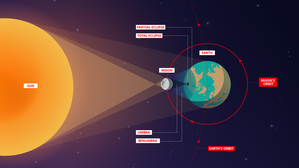
Total Solar Eclipse
Caption: This not to scale diagram shows what happens during a total solar eclipse. The Moon orbits the Earth, but its orbit is slightly tilted with respect to the Earth’s orbit around the Sun. During the new moon lunar phase, the Moon lies between the Earth and the Sun, but due to the Moon’s tilted orbit around the Earth, the Moon normally lies above or below the Sun at this point. However twice a year the Moon’s orbit lines up in such a way that the Moon can lie in a direct line between the Earth and Sun. During each of these periods (each of which last roughly a month) solar (and lunar) eclipses can occur. The Moon is about 400 times smaller than the Sun, but is 400 times closer to the Earth than the Sun. Hence the Sun and Moon have approximately the same angular size when viewed from the Earth. This means that it is possible for the Moon to completely cover the Sun when viewed from Earth. This is known as a total solar eclipse.
Here we see a schematic of such and eclipse. The Moon casts a shadow on the Earth known as the umbra. This is a roughly circular shadow a few hundred kilometres across although its shape can be severely distorted when the eclipse is at the edge of the illuminated part of the Earth. Any region within the umbra will see the Moon completely cover the Sun and thus will experience a total solar eclipse. Outside of the umbra there are regions where the Moon will cover part of the Sun. This partial shadow is known as the penumbra. Regions in the penumbra will experience a partial solar eclipse.
An eclipse is a dynamic event with the Moon moving in its orbit and the Earth rotating. Hence the umbra and penumbra move across the Earth’s surface together. The path the umbra takes across the Earth is known as the path of totality. Let’s consider one particular region that lies in the path of totality: except in rare cases where an eclipse begins at sunrise, a region that experiences totality will first see the Moon cover part of the Sun and gradually move across Sun until it is totally covered. From outside the Earth this would appear as the penumbra moving over this particular region followed by the umbra moving over this region. Once the Moon moves so that it no longer completely covers the Sun, totality ends and the umbra moves away from this particular region. The Moon will continue to uncover the Sun until (unless the Sun sets before the end of the eclipse) the Sun is completely uncovered. From outside the Earth this would appear as the umbra moving away from our particular region and the edge of the penumbra approaching and eventually passing over the region.
Outside of the path or totality there is a much broader region that will lie in the penumbra but will be missed by the umbra. Such regions will not experience a total solar eclipse during this event, only a partial solar eclipse.
Credit: Aneta Margraf/IAU OAE
License: CC-BY-4.0 Creative Commons Attribution 4.0 International (CC BY 4.0) icons
Related Activities
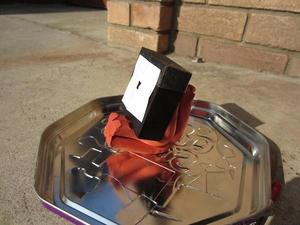
Measure the Solar Diameter
astroEDU educational activity (links to astroEDU website) Description: Hands-on activity to measure the Sun by using household materials.
License: CC-BY-4.0 Creative Commons Attribution 4.0 International (CC BY 4.0) icons
Tags:
Hands-on
, Scales
, Observing
, Measurement
Age Ranges:
12-14
, 14-16
, 16-19
, 19+
Education Level:
Middle School
Areas of Learning:
Structured-inquiry learning
Costs:
Low Cost
Group Size:
Group
Skills:
Communicating information
, Constructing explanations
, Using mathematics and computational thinking
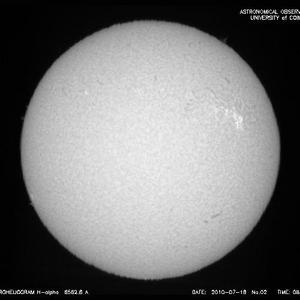
Counting Sunspots
astroEDU educational activity (links to astroEDU website) Description: Counting the Sunspots using real solar images and data.
License: CC-BY-4.0 Creative Commons Attribution 4.0 International (CC BY 4.0) icons
Tags:
Hands-on
, Sunspots
, Data analysis
Age Ranges:
16-19
Areas of Learning:
Observation based
Costs:
Low Cost
Duration:
1 hour
Group Size:
Group
Skills:
Analysing and interpreting data
, Constructing explanations
, Using mathematics and computational thinking
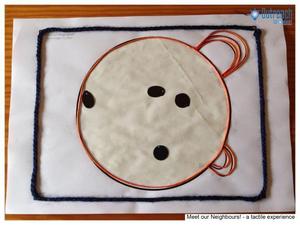
Meet Our Neighbours: Sun
astroEDU educational activity (links to astroEDU website) Description: Explore the tactile version of our star; the Sun with household materials.
License: CC-BY-4.0 Creative Commons Attribution 4.0 International (CC BY 4.0) icons
Tags:
Hands-on
, Model
, Sunspots
, Visually Impaired
, Tactile
Age Ranges:
6-8
, 8-10
, 10-12
Education Level:
Middle School
, Primary
, Secondary
Areas of Learning:
Interactive Lecture
, Modelling
Costs:
Low Cost
Duration:
1 hour
Group Size:
Group
Skills:
Analysing and interpreting data
, Developing and using models
Build a Safe Sun Viewer
astroEDU educational activity (links to astroEDU website) Description: Build a safe Sun viewer using cheap household items and learn why it is dangerous to look directly at the Sun, even briefly.
License: CC-BY-4.0 Creative Commons Attribution 4.0 International (CC BY 4.0) icons
Tags:
Hands-on
, Safety
Age Ranges:
6-8
, 8-10
, 10-12
Education Level:
Primary
, Secondary
Areas of Learning:
Modelling
, Observation based
Costs:
Low Cost
Group Size:
Group
Skills:
Planning and carrying out investigations
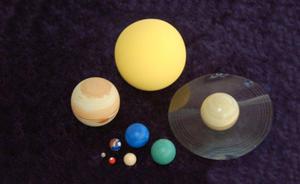
Solar System Model
astroEDU educational activity (links to astroEDU website) Description: Make a model of the Solar System planets using household materials.
License: CC-BY-4.0 Creative Commons Attribution 4.0 International (CC BY 4.0) icons
Tags:
Hands-on
, Model
, Planets
Age Ranges:
4-6
, 6-8
, 8-10
Education Level:
Pre-school
, Primary
Areas of Learning:
Modelling
Costs:
Low Cost
Duration:
30 mins
Group Size:
Group
Skills:
Analysing and interpreting data
, Asking questions
, Communicating information
, Developing and using models