Terme du glossaire : Météoroïde
Description : Un météoroïde est un fragment d'astéroïde ou de comète dont la taille varie de quelques millimètres à plusieurs dizaines de mètres. Les météoroïdes peuvent rencontrer n'importe quel objet céleste, avec ou sans atmosphère, à très grande vitesse. Si l'objet céleste possède une atmosphère, le météoroïde est ralenti par les collisions avec les molécules atmosphériques. Les météoroïdes sont observés dans l'atmosphère terrestre sous forme de météores. Si le météoroïde n'est pas complètement détruit dans l'atmosphère (ou si l'objet céleste n'a pas d'atmosphère), il atteint et reste sur la surface de l'objet, et on l'appelle alors une météorite.
Termes associés :
Voir ce terme dans d'autres langues
Statut du terme et de sa définition : La définition initiale de ce terme en anglais a été aprouvée par un·e spécialiste de la recherche en astronomie et un·e spécialiste de l’éducation La traduction de ce terme et de sa définition n'ont pas encore été aprouvées
Le glossaire multilangue de l'OAE est un projet du Bureau de l'IAU de l'Astronomie pour l'Education (OAE) en collaboration avec le Bureau de l'IAU de diffusion de l'Astronomie (OAO). Les termes et définitions ont été choisis, écrits et relues grâce à un effort collectif de l'OAE, les Centres et les Noeuds de l'OAE, les Coordinateurs Nationaux de l'Astronomie pour l'Education de l'OAE(NAECs) et d'autres volontaires. La liste complète des crédits pour ce projet est disponible ici . Tous les termes du glossaire et leur définition sont déposés sous licence Creative Commons CC BY-4.0 et doivent être créditées au nom de "IAU OAE".
Si vous constatez une erreur dans ce terme ou sa définition, veuillez nous contacter .
Dans d'autres langues
- Arabe: نيزك
- Allemand: Meteoroid
- Anglais: Meteoroid
- Espagnol: Meteoroide
- Italien: Meteoroide
- Japonais: 流星物質 (Liens externes)
- Coréen: 유성체
- Portugais brésilien: Meteoroide
- Chinois simplifié: 流星体
- Chinois traditionnel: 流星體
Media associé
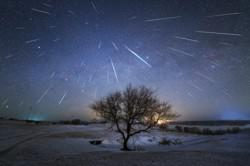
Geminid Meteor Shower from China, by Dai Jianfeng, China
Légende : First place in the 2021 IAU OAE Astrophotography Contest, category Meteor showers.
A meteor shower occurs when the Earth in its orbit around the Sun, passes through a debris trail left previously by a comet on its approach around the Sun. As the Earth enters this debris (small sand grain sized), they enter the atmosphere at high speeds and on parallel trajectories, burning completely leaving beautiful tracks (streaks) in the sky. These streaks can appear and disappear in the blink of an eye, or last much longer. On rare occasions the debris originates from asteroids, as in the case of the Geminid meteor shower, shown in this image, picturing many streaks of debris captured in the sky of China in 2017. Due to relative motions and perspective, the shower appears to come from one single point, known as the radiant point, beautifully pictured in this image. This is similar to driving in a car on a rainy day without any wind, looking out the front window it seems that the rain is coming directly towards the window, when in fact the rain is falling vertically downwards.
Crédit : Dai Jianfeng/IAU OAE
License: CC-BY-4.0 Creative Commons (CC) Attribution 4.0 International (CC BY 4.0) Icônes
Activités associées
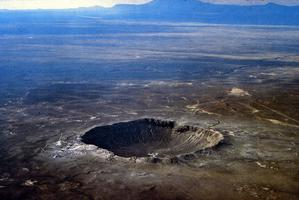
Meteoroids, Meteors and Meteorites
astroEDU educational activity (links to astroEDU website) Description: Unveiling the mystery of "shooting stars": meteors, meteorites and meteroids
License: CC-BY-4.0 Creative Commons (CC) Attribution 4.0 International (CC BY 4.0) Icônes
Mots clés :
Geology
Tranches d'âge :
6-8
, 8-10
, 10-12
, 12-14
Niveau scolaire :
Collège
, Primaire
Domaines d'apprentissage :
Cours interactif
Coûts :
Faible
Durée :
1h 30m
Taille du groupe :
Par groupe
Compétences :
Analyser et interpréter des données
, Poser des questions
, Communiquer des informations
, S'engager dans des arguments fondés sur des preuves
Ceci pourrait vous intéresser également








- Ressources
- Moteur de recherche des ressources pédagogiques
- Parcourir les ressources pédagogiques par Sujet
- Parcourir les images
- AstroEdu - Activités en classe
- Grandes Idées - Littéracie en astronomie
- Glossaire
- Rapports de l'OAE
- L'astronomie pour l'Education à travers le monde
- Sélection de ressources externes