This page describes an image The Hale Telescope
Télécharger le fichier ( image 12.65 MB)
Légende d'image :
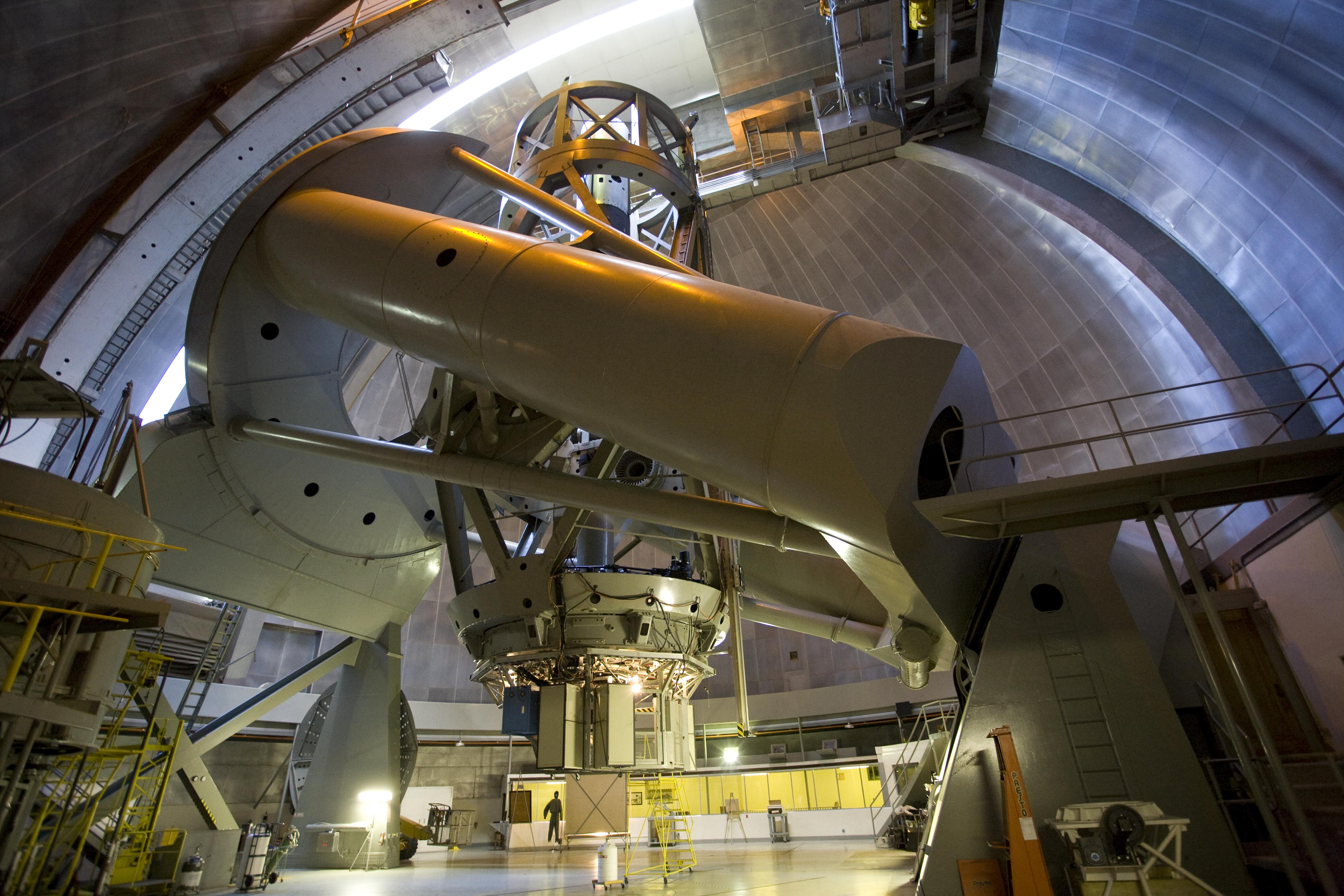
This image shows the Hale Telescope at the Palomar Observatory in northern San Diego County, California, USA and operated by the California Institute of Technology (Caltech). With its 5.1 m primary mirror, the Hale Telescope was the largest effective optical telescope in the world from its first light in 1949 until 1993.
Here we see the Hale Telescope when not in operation. The telescope itself is the large, vertical, approximately cylindrical object in the centre of the image. Telescopes like this use mirrors to gather faint light and form clear images of distant targets, enabling scientists to study everything from nearby stars and planets to remote galaxies. The primary mirror, seen here at the bottom of the telescope, focusses light from the sky to the prime focus at the top of the telescope. Instruments such as cameras and spectrographs can be placed at this prime focus or alternatively a secondary mirror can reflect light back down the telescope and through a hole in the primary mirror to instruments.
The telescope is supported by a large mount, seen here at an angle to the telescope. This particular mount is a type of equatorial mount. This means that one of the rotation axes of the mount points to the celestial poles. When a star or galaxy moves across the sky due to the Earth's rotation, the telescope only has rotate on this axis to keep pointing at that star or galaxy. Most modern large telescopes use a different kind of mount and rely on computer calculations to accurately track an object across the sky.
The Hale Telescope is housed under a large rotating dome that opens at night so the telescope can track objects across the sky.
Faire défiler pour afficher les légendes dans d'autres langues
Crédits pour l'image : JPL/Caltech/Palomar Observatory Lien du crédit
Termes du glossaire en rapport :
Télescope
, Télescope à réflexion
Catégories :
Astronomie observationnelle
, Télescopes, instruments et observatoires
Licence de l'image : Domaine Public Domaine Public Icônes
Les légendes des fichiers média présents sur le site de l'OAE ont été écrites, traduites et relues grâce à un effort collectif de l'OAE, les Centres et les Noeuds de l'OAE, les Coordinateurs Nationaux de l'Astronomie pour l'Education de l'OAE(NAECs) et d'autres volontaires. La liste complète des crédits pour ce projet est disponible ici . Toutes les légendes des fichiers média sont déposés sous licence Creative Commons CC BY-4.0 et doivent être créditées au nom de "IAU OAE". Les fichiers média eux-mêmes peuvent avoir des licences différentes (voir plus haut) et et doivent être crédités comme indiqué ci-dessus sous le terme "credit".
Si vous constatez une erreur dans cette légende ou dans un de ses traductions, veuillez nous contacter veuillez nous contacter.
Légendes proposées dans différentes langues :
Légende d'image : Dieses Bild zeigt das Hale-Teleskop am Palomar-Observatorium im Norden des San Diego County, Kalifornien, USA, das vom California Institute of Technology (Caltech) betrieben wird. Mit seinem 5,1 m großen Hauptspiegel war das Hale-Teleskop von seiner Inbetriebnahme im Jahr 1949 bis 1993 das größte optische Teleskop der Welt.
Hier sehen wir das Hale-Teleskop, wenn es gerade nicht in Betrieb ist. Das Teleskop selbst ist das große, senkrecht stehende, annähernd zylindrische Objekt in der Bildmitte. Teleskope wie dieses nutzen Spiegel, um schwaches Licht zu sammeln und klare Bilder von weit entfernten Objekten zu erzeugen, wodurch Wissenschaftler alles untersuchen können – von nahen Sternen und Planeten bis hin zu weit entfernten Galaxien. Der Hauptspiegel, hier am unteren Ende des Teleskops zu sehen, bündelt das Licht vom Himmel auf den Primärfokus am oberen Ende des Teleskops. Instrumente wie Kameras und Spektrographen können direkt in diesem Primärfokus platziert werden. Alternativ kann ein Sekundärspiegel das Licht zurück ins Teleskop reflektieren, von wo es durch eine Öffnung im Hauptspiegel zu den Instrumenten gelangt.
Das Teleskop wird von einer großen Montierung getragen, die hier schräg zum Teleskop zu sehen ist. Bei dieser speziellen Montierung handelt es sich um eine äquatoriale Montierung. Das bedeutet, dass eine der Drehachsen der Montierung auf einen der Himmelspole ausgerichtet ist. Wenn sich ein Stern oder eine Galaxie aufgrund der Erdrotation über den Himmel bewegt, muss sich das Teleskop lediglich um diese Achse drehen, um weiterhin auf diesen Stern oder diese Galaxie ausgerichtet zu bleiben. Die meisten modernen Großteleskope verwenden eine andere Art von Montierung und stützen sich auf Computerberechnungen, um ein Objekt am Himmel präzise zu verfolgen.
Das Hale-Teleskop befindet sich unter einer großen, drehbaren Kuppel, die sich nachts öffnet, damit das Teleskop Objekte am Himmel verfolgen kann.
Crédits pour l'image : JPL/Caltech/Palomar Observatory
Termes du glossaire en rapport : Spiegelteleskop , Teleskop Statuts de la traduction de la légende: Pas encore approuvé par un·e relecteur(rice)
Traducteurs de la légende: Simon Kraus
Légende d'image : This image shows the Hale Telescope at the Palomar Observatory in northern San Diego County, California, USA and operated by the California Institute of Technology (Caltech). With its 5.1 m primary mirror, the Hale Telescope was the largest effective optical telescope in the world from its first light in 1949 until 1993.
Here we see the Hale Telescope when not in operation. The telescope itself is the large, vertical, approximately cylindrical object in the centre of the image. Telescopes like this use mirrors to gather faint light and form clear images of distant targets, enabling scientists to study everything from nearby stars and planets to remote galaxies. The primary mirror, seen here at the bottom of the telescope, focusses light from the sky to the prime focus at the top of the telescope. Instruments such as cameras and spectrographs can be placed at this prime focus or alternatively a secondary mirror can reflect light back down the telescope and through a hole in the primary mirror to instruments.
The telescope is supported by a large mount, seen here at an angle to the telescope. This particular mount is a type of equatorial mount. This means that one of the rotation axes of the mount points to the celestial poles. When a star or galaxy moves across the sky due to the Earth's rotation, the telescope only has rotate on this axis to keep pointing at that star or galaxy. Most modern large telescopes use a different kind of mount and rely on computer calculations to accurately track an object across the sky.
The Hale Telescope is housed under a large rotating dome that opens at night so the telescope can track objects across the sky.
Crédits pour l'image : JPL/Caltech/Palomar Observatory
Termes du glossaire en rapport : Reflecting Telescope , Telescope
Légende d'image : Questa immagine mostra il telescopio Hale presso l'Osservatorio di Palomar, nella parte settentrionale della contea di San Diego, in California (USA), gestito dal California Institute of Technology (Caltech). Con il suo specchio primario di 5,1 m, il telescopio Hale è stato il più grande telescopio ottico effettivo al mondo dalla sua prima luce nel 1949 fino al 1993.
Qui vediamo il telescopio Hale quando non è in funzione. Il telescopio stesso è il grande oggetto verticale, di forma approssimativamente cilindrica, al centro dell’immagine. Telescopi come questo utilizzano specchi per raccogliere la luce debole e formare immagini nitide di obiettivi lontani, consentendo agli scienziati di studiare qualsiasi cosa, dalle stelle e dai pianeti vicini alle galassie remote. Lo specchio primario, visibile qui nella parte inferiore del telescopio, focalizza la luce proveniente dal cielo sul fuoco primario situato nella parte superiore del telescopio. Strumenti quali telecamere e spettrografi possono essere posizionati su questo fuoco primario oppure, in alternativa, uno specchio secondario può riflettere la luce verso il basso lungo il telescopio e attraverso un foro nello specchio primario fino agli strumenti.
Il telescopio è sostenuto da una grande montatura, visibile qui di profilo rispetto al telescopio. Questa particolare montatura è di tipo equatoriale. Ciò significa che uno degli assi di rotazione della montatura è orientato verso i poli celesti. Quando una stella o una galassia si sposta nel cielo a causa della rotazione terrestre, il telescopio deve solo ruotare su questo asse per continuare a puntare verso quella stella o galassia. La maggior parte dei grandi telescopi moderni utilizza un diverso tipo di montatura e si affida a calcoli al computer per seguire con precisione un oggetto nel cielo.
Il telescopio Hale è ospitato sotto una grande cupola girevole che si apre di notte in modo che il telescopio possa seguire gli oggetti nel cielo.
Crédits pour l'image : JPL/Caltech/Osservatorio di Palomar
Termes du glossaire en rapport : Telescopio , Telescopio a riflessione Statuts de la traduction de la légende: Pas encore approuvé par un·e relecteur(rice)
Traducteurs de la légende: Giuliana Giobbi
Ceci pourrait vous intéresser également









- Ressources
- Moteur de recherche des ressources pédagogiques
- Parcourir les ressources pédagogiques par Sujet
- Parcourir les images
- AstroEdu - Activités en classe
- Grandes Idées - Littéracie en astronomie
- Glossaire
- Rapports de l'OAE
- L'astronomie pour l'Education à travers le monde
- Sélection de ressources externes