This page describes an image Solar absorption lines
Télécharger le fichier ( image 3.09 MB)
Légende d'image :
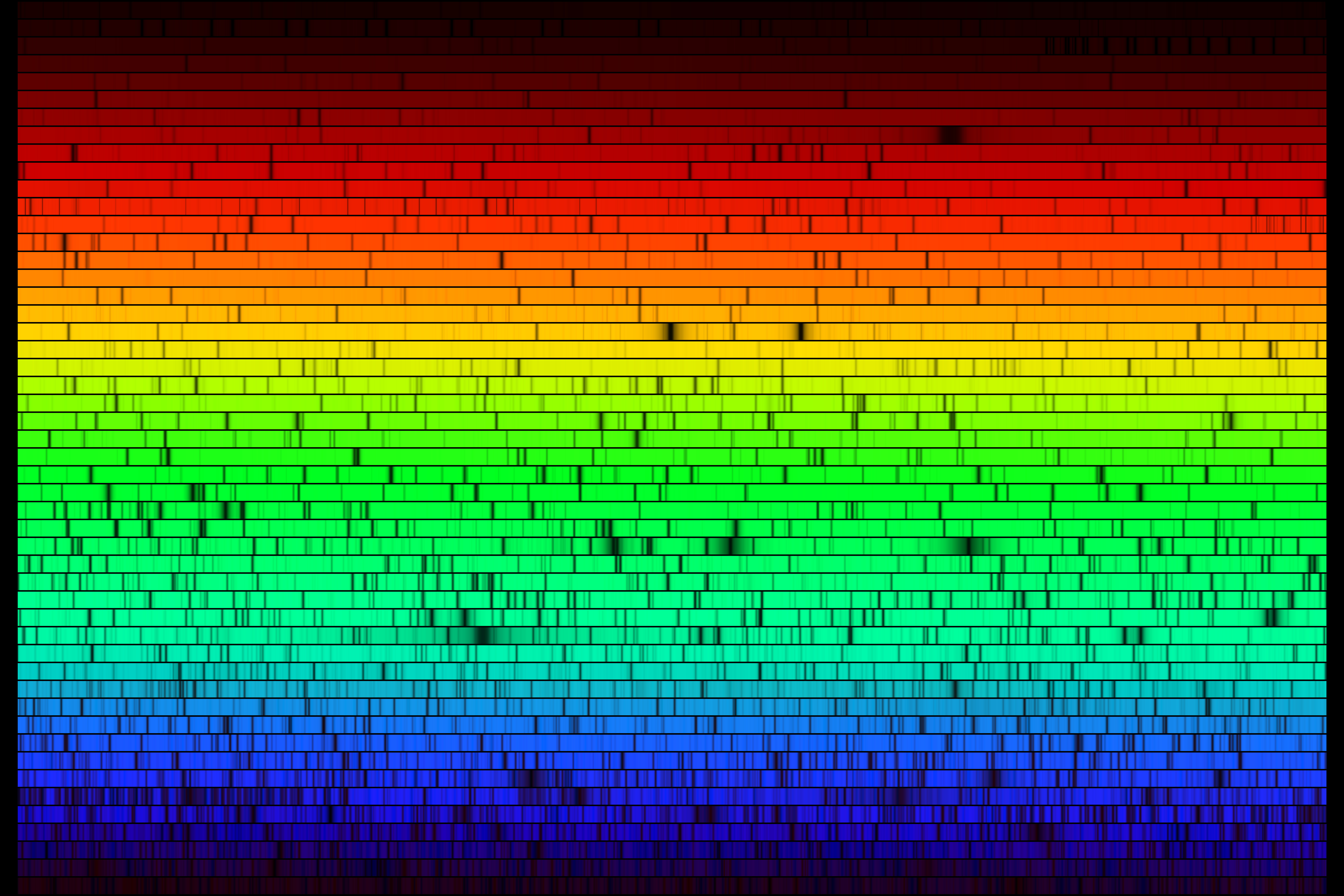
This is a high resolution spectrum of light from our Sun showing visible region of the electromagnetic spectrum. The absorption lines are visible clearly as narrow black regions. The visualization shown here was created to mimic a so-called echelle spectrum, with wavelength increasing from left to right along each strip, and from bottom to top. Each of the 50 horizontal strips covers 6 nanometers, for a complete spectrum across the visible range from 400 to 700 nanometers.
This spectrum was created from a digital atlas observed with the Fourier Transform Spectrometer at the McMath-Pierce Solar Facility at the National Solar Observatory on Kitt Peak, near Tucson, Arizona (‘Solar Flux Atlas from 296 to 1300 nm" by Robert L. Kurucz, Ingemar Furenlid, James Brault, and Larry Testerman: National Solar Observatory Atlas No. 1, June 1984).
Note: NSO/Kitt Peak FTS data used here were produced by NSF/NOAO.
Faire défiler pour afficher les légendes dans d'autres langues
Crédits pour l'image : N.A. Sharp/KPNO/NOIRLab/NSO/NSF/AURA Lien du crédit
Termes du glossaire en rapport :
Astrophysique
, Raie d'absorption
, Raie spectrale
, Spectre visible
Licence de l'image : Creative Commons (CC) Attribution 4.0 International (CC BY 4.0) Creative Commons (CC) Attribution 4.0 International (CC BY 4.0) Icônes
Les légendes des fichiers média présents sur le site de l'OAE ont été écrites, traduites et relues grâce à un effort collectif de l'OAE, les Centres et les Noeuds de l'OAE, les Coordinateurs Nationaux de l'Astronomie pour l'Education de l'OAE(NAECs) et d'autres volontaires. La liste complète des crédits pour ce projet est disponible ici . Toutes les légendes des fichiers média sont déposés sous licence Creative Commons CC BY-4.0 et doivent être créditées au nom de "IAU OAE". Les fichiers média eux-mêmes peuvent avoir des licences différentes (voir plus haut) et et doivent être crédités comme indiqué ci-dessus sous le terme "credit".
Si vous constatez une erreur dans cette légende ou dans un de ses traductions, veuillez nous contacter veuillez nous contacter.
Légendes proposées dans différentes langues :
Légende d'image : Zu sehen ist ein hochauflösendes Spektrum unserer Sonne, das den sichtbaren Bereich des elektromagnetischen Spektrums zeigt. Die Absorptionslinien sind deutlich als schmale, schwarze Bereiche zu erkennen. Die hier gezeigte Darstellung wurde so gestaltet, dass sie einem sogenannten Echelle-Spektrum nachempfunden ist, bei dem die Wellenlänge entlang jedes Streifens von links nach rechts sowie von unten nach oben zunimmt. Jeder der 50 horizontalen Streifen deckt 6 Nanometer ab, sodass ein vollständiges Spektrum über den sichtbaren Bereich von 400 bis 700 Nanometer entsteht.
Dieses Spektrum wurde anhand eines digitalen Atlas erstellt, der mit dem Fourier-Transform-Spektrometer an der McMath-Pierce Solar Facility des National Solar Observatory auf dem Kitt Peak in der Nähe von Tucson, Arizona, beobachtet wurde („Solar Flux Atlas from 296 to 1300 nm“ von Robert L. Kurucz, Ingemar Furenlid, James Brault und Larry Testerman: National Solar Observatory Atlas Nr. 1, Juni 1984).
Anmerkung: Die hier verwendeten NSO/Kitt Peak-FTS-Daten wurden von der NSF/NOAO erstellt.
Crédits pour l'image : N.A. Sharp/KPNO/NOIRLab/NSO/NSF/AURA
Termes du glossaire en rapport : Absorptionslinie , Astrophysik , Sichtbares Spektrum , Spektrallinie Statuts de la traduction de la légende: Pas encore approuvé par un·e relecteur(rice)
Traducteurs de la légende: Simon Kraus
Légende d'image : This is a high resolution spectrum of light from our Sun showing visible region of the electromagnetic spectrum. The absorption lines are visible clearly as narrow black regions. The visualization shown here was created to mimic a so-called echelle spectrum, with wavelength increasing from left to right along each strip, and from bottom to top. Each of the 50 horizontal strips covers 6 nanometers, for a complete spectrum across the visible range from 400 to 700 nanometers.
This spectrum was created from a digital atlas observed with the Fourier Transform Spectrometer at the McMath-Pierce Solar Facility at the National Solar Observatory on Kitt Peak, near Tucson, Arizona (‘Solar Flux Atlas from 296 to 1300 nm" by Robert L. Kurucz, Ingemar Furenlid, James Brault, and Larry Testerman: National Solar Observatory Atlas No. 1, June 1984).
Note: NSO/Kitt Peak FTS data used here were produced by NSF/NOAO.
Crédits pour l'image : N.A. Sharp/KPNO/NOIRLab/NSO/NSF/AURA
Termes du glossaire en rapport : Absorption Line , Astrophysics , Spectral Line , Visible Spectrum
Légende d'image : Questo è uno spettro ad alta risoluzione della luce proveniente dal nostro Sole che mostra la regione visibile dello spettro elettromagnetico. Le righe di assorbimento sono chiaramente visibili come sottili bande nere. La visualizzazione qui riportata è stata creata per riprodurre un cosiddetto spettro echelle, con la lunghezza d’onda che aumenta da sinistra a destra lungo ciascuna striscia e dal basso verso l’alto. Ciascuna delle 50 strisce orizzontali copre 6 nanometri, per uno spettro completo che abbraccia l’intervallo visibile da 400 a 700 nanometri.
Questo spettro è stato ricavato da un atlante digitale ottenuto con lo spettrometro a trasformata di Fourier presso la McMath-Pierce Solar Facility del National Solar Observatory a Kitt Peak, vicino a Tucson, in Arizona («Solar Flux Atlas from 296 to 1300 nm» di Robert L. Kurucz, Ingemar Furenlid, James Brault e Larry Testerman: National Solar Observatory Atlas n. 1, giugno 1984).
Nota: i dati FTS dell’NSO/Kitt Peak qui utilizzati sono stati prodotti dalla NSF/NOAO.
Crédits pour l'image : N.A. Sharp/KPNO/NOIRLab/NSO/NSF/AURA
Termes du glossaire en rapport : Astrofisica , Linea spettrale , Riga di assorbimento , Spettro visibile Statuts de la traduction de la légende: Pas encore approuvé par un·e relecteur(rice)
Traducteurs de la légende: Giuliana Giobbi
Ceci pourrait vous intéresser également








- Ressources
- Moteur de recherche des ressources pédagogiques
- Parcourir les ressources pédagogiques par Sujet
- Parcourir les images
- AstroEdu - Activités en classe
- Grandes Idées - Littéracie en astronomie
- Glossaire
- Rapports de l'OAE
- L'astronomie pour l'Education à travers le monde
- Sélection de ressources externes