Glossar-Begriff: Astrophysik
Beschreibung: Die Astrophysik ist eine Wissenschaft, die sich die Prinzipien der Physik zunutze macht, um astronomische Objekte zu untersuchen.
In der Astrophysik werden die Strahlung des gesamten elektromagnetischen Spektrums sowie nicht-elektromagnetische Signale wie Gravitationswellen und Neutrinos, die von astronomischen Objekten ausgesandt werden, untersucht, ebenso wie deren Eigenschaften in Bezug auf Helligkeit, Dichte und Temperatur. Die Astrophysik ist eine sehr breit aufgestellte Wissenschaft, die sowohl Methoden der theoretischen als auch der beobachtenden Physik nutzt.
Ähnliche Begriffe:
Dieser Begriff in anderen Sprachen
Begriffs- und Definitionsstatus Die Originaldefinition dieses Begriffes auf Englisch wurden von einem forschenden Astronom und einer Lehrkraft bestätigt Die Übersetzung dieses Begriffs und seiner Definition warten auf Prüfung und Bestätigung
The OAE Multilingual Glossary is a project of the IAU Office of Astronomy for Education (OAE) in collaboration with the IAU Office of Astronomy Outreach (OAO). The terms and definitions were chosen, written and reviewed by a collective effort from the OAE, the OAE Centers and Nodes, the OAE National Astronomy Education Coordinators (NAECs) and other volunteers. You can find a full list of credits here. All glossary terms and their definitions are released under a Creative Commons CC BY-4.0 license and should be credited to "IAU OAE".
Wenn dir ein inhaltlicher oder Übersetzungsfehler in diesem Glossarbegriff oder dieser Definition auffallen, bitte kontaktiere uns.
Auf anderen Sprachen
- Arabisch: الفيزياء الفلكية
- Englisch: Astrophysics
- Spanisch: Astrofísica
- Französisch: Astrophysique
- Italienisch: Astrofisica
- Koreanisch: 천체물리학
- Brasilianisches Portugiesisch: Astrofísica
- Vereinfachtes Chinesisch: 天体物理学
- Traditionelles Chinesisch: 天體物理學
Ähnliche Medien
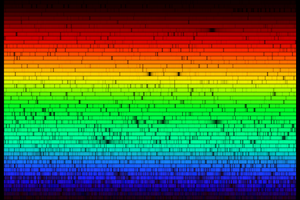
Absorptionslinien im Sonnenspektrum
Unterschrift: Zu sehen ist ein hochauflösendes Spektrum unserer Sonne, das den sichtbaren Bereich des elektromagnetischen Spektrums zeigt. Die Absorptionslinien sind deutlich als schmale, schwarze Bereiche zu erkennen. Die hier gezeigte Darstellung wurde so gestaltet, dass sie einem sogenannten Echelle-Spektrum nachempfunden ist, bei dem die Wellenlänge entlang jedes Streifens von links nach rechts sowie von unten nach oben zunimmt. Jeder der 50 horizontalen Streifen deckt 6 Nanometer ab, sodass ein vollständiges Spektrum über den sichtbaren Bereich von 400 bis 700 Nanometer entsteht.
Dieses Spektrum wurde anhand eines digitalen Atlas erstellt, der mit dem Fourier-Transform-Spektrometer an der McMath-Pierce Solar Facility des National Solar Observatory auf dem Kitt Peak in der Nähe von Tucson, Arizona, beobachtet wurde („Solar Flux Atlas from 296 to 1300 nm“ von Robert L. Kurucz, Ingemar Furenlid, James Brault und Larry Testerman: National Solar Observatory Atlas Nr. 1, Juni 1984).
Anmerkung: Die hier verwendeten NSO/Kitt Peak-FTS-Daten wurden von der NSF/NOAO erstellt.
Bild: N.A. Sharp/KPNO/NOIRLab/NSO/NSF/AURA
Quellenlink
License: CC-BY-4.0 Creative Commons Namensnennung 4.0 International (CC BY 4.0) Symbole