Glossary term: Piringan Akresi
Description: Ketika sebuah objek astrofisika mengakresi materi, maka materi tidak bisa langsung jatuh ke atasnya, jika tidak bergerak lurus ke arah objek yang menariknya. Saat benda yang ditarik bergerak mendekati objek penarik, komponen kecepatannya yang tegak lurus terhadap garis antara benda jatuh (yang ditarik) dan benda penarik akan bertambah akibat kekekalan momentum sudut.
Dalam kebanyakan kasus, materi yang jatuh akan terkumpul dalam piringan akresi: piringan gas dan debu yang berputar mengelilingi objek penarik. Dari tepi dalam piringan, materi jatuh ke objek pusat. Untuk objek kompak di pusat, materi yang jatuh ke piringan akresi akan memeroleh energi yang sangat besar saat jatuh. Saat energi ini disimpan dalam piringan, maka temperatur dalam piringan akan memanas hingga ratusan ribu bahkan jutaan kelvin. Piringan akresi di sekeliling lubang hitam supermasif di pusat sebagian galaksi menjadi sumber tenaga untuk inti galaksi aktif (AGN). Objek yang luar biasa terang ini bisa lebih terang dari gabungan semua bintang yang ada di dalam galaksi induknya.
Piringan akresi ditemukan dalam berbagai kondisi astrofisika seperti di sekitar lubang hitam supermasif, sisa-sisa bintang, semburan sinar gamma, atau protobintang.
Related Terms:
- Active Galactic Nucleus
- Black Hole
- Neutron Star
- Protostar
- Stellar Remnants
- Supermassive Black Hole
- Accretion
- Gamma Ray Burst
See this term in other languages
Term and definition status: The original definition of this term in English have been approved by a research astronomer and a teacher The translation of this term and its definition is still awaiting approval
The OAE Multilingual Glossary is a project of the IAU Office of Astronomy for Education (OAE) in collaboration with the IAU Office of Astronomy Outreach (OAO). The terms and definitions were chosen, written and reviewed by a collective effort from the OAE, the OAE Centers and Nodes, the OAE National Astronomy Education Coordinators (NAECs) and other volunteers. You can find a full list of credits here. All glossary terms and their definitions are released under a Creative Commons CC BY-4.0 license and should be credited to "IAU OAE".
If you notice a factual or translation error in this glossary term or definition then please get in touch.
In Other Languages
- Arab: قرص التراكم
- Bengali: বিবৃদ্ধি চাকতি
- Jerman: Akkretionsscheibe
- Inggris: Accretion Disk
- Spanyol: Disco de acreción
- Perancis: Disque d'accrétion
- Italia: disco di accrescimento
- Jepang: 降着円盤 (external link)
- Portugis Brazil: Disco de acreção
- Tiongkok Sederhana: 吸积盘
- Tiongkok Tradisionil: 吸積盤
Related Media

Jet Ejected from the Active Galaxy M87
Caption: A 3000-light-year-long jet streaming from the core of galaxy M87, as captured by the Hubble Space Telescope. The center of this image shows the core of the elliptical galaxy M87 (in the constellation Virgo) which hosts an active galactic nucleus (AGN).
An AGN is a very luminous region around a supermassive black hole. It is powered by matter falling towards the black hole and forming a hot accretion disk. Many galaxies host a supermassive black hole, but not all of them are accreting enough matter to appear as an AGN.
The strong gravity of the supermassive black hole in the heart of M87 has caused a huge jet of charges particles to be flung out from the accretion disk. This extends far out into the galaxy itself, beyond the core region. Here we see the jet as a whitish-blue line which gets wider the further it goes from the core. The light emission we see here is caused by the energetic electrons in the jet interacting with magnetic fields.
Credit: NASA, ESA, A. Lessing (Stanford University), E. Baltz (Stanford University), M. Shara (AMNH), J. DePasquale (STScI)
credit link
License: CC-BY-4.0 Creative Commons Atribusi 4.0 Internasional (CC BY 4.0) icons
Related Activities
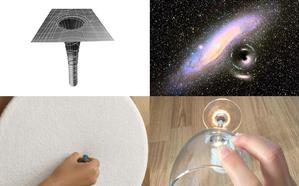
Hunting for black holes
astroEDU educational activity (links to astroEDU website) Description: How do astronomers detect invisible black holes?
License: CC-BY-4.0 Creative Commons Atribusi 4.0 Internasional (CC BY 4.0) icons
Tags:
Model
, Experiment
Age Ranges:
12-14
Education Level:
Informal
, Middle School
Areas of Learning:
Modelling
, Observation based
, Problem-solving
, Structured-inquiry learning
Costs:
Low Cost
Duration:
45 mins
Group Size:
Group
Skills:
Constructing explanations
, Developing and using models