Término del glosario: Disco de acreción
Descripción: Cuando un objeto astrofísico acumula materia, a menos que la materia en caída ya se esté moviendo en línea recta hacia el objeto atrayente, no puede caer directamente sobre él. En efecto, a medida que el objeto en caída se acerca al objeto que atrae, la componente de su velocidad perpendicular a la línea que lo separa del objeto que atrae aumenta debido a la conservación del momento angular.
En muchos casos, la materia en caída se acumula en lo que se denomina un disco de acreción: un disco arremolinado de gas y polvo que rodea al objeto atrayente. Desde el borde interior del disco, la materia puede caer sobre el objeto central. Para un objeto central compacto, la materia que caiga sobre el disco de acreción habrá ganado una enorme cantidad de energía durante su caída. A medida que esta energía se deposita en el disco, éste puede calentarse hasta alcanzar temperaturas de cientos de miles o incluso millones de kelvins. Los discos de acreción alrededor de los agujeros negros supermasivos del centro de algunas galaxias proporcionan la energía necesaria para los núcleos galácticos activos (AGN). Estos objetos extremadamente brillantes pueden ser más luminosos que todas las estrellas de su galaxia anfitriona juntas.
Los discos de acreción se encuentran en diversas situaciones astrofísicas, como alrededor de agujeros negros supermasivos, remanentes estelares, explosiones de rayos gamma o protoestrellas.
Términos relacionados:
- Núcleo Galáctico Activo
- Agujero negro
- Estrella de neutrones
- Protoestrella
- Remanentes estelares
- Agujero negro supermasivo
- Acreción
- Explosión de rayos gamma
Ver este término en otros idiomas
Estado del término y la definición: La definición original de este término en inglés ha sido aprobada por unastrónomo o astrónoma investigadora y un docente La traducción de este término y su definición aún están pendientes de aprobación
El Glosario multilingüe de la OAE es un proyecto de la Oficina de Astronomía para la Educación de la UAI (OAE) en colaboración con la Oficina de Divulgación de Astronomía de la UAI (OAO). Los términos y definiciones fueron seleccionados, redactados y revisados gracias al esfuerzo colectivo de la OAE, los Centros y Nodos de la OAE, los Coordinadores Nacionales de Educación Astronómica (NAECs) y otros voluntarios. Puedes encontrar una lista completa de créditos aquí. Todos los términos del glosario y sus definiciones se publican bajo la licencia Creative Commons CC BY-4.0 y deben atribuirse a la "IAU OAE".
Si detectas algún error de contenido o de traducción en este término del glosario o en ladefinición, ponte en contacto con nosotros.
En otros idiomas
- Árabe: قرص التراكم
- Bengalí: বিবৃদ্ধি চাকতি
- Alemán: Akkretionsscheibe
- Inglés: Accretion Disk
- Francés: Disque d'accrétion
- Indonesio: Piringan Akresi
- Italiano: disco di accrescimento
- Japonés: 降着円盤 (enlace externo)
- Portugués de Brasil: Disco de acreção
- Chino simplificado: 吸积盘
- Chino tradicional: 吸積盤
Contenidos relacionados

Jet Ejected from the Active Galaxy M87
Pie de foto: A 3000-light-year-long jet streaming from the core of galaxy M87, as captured by the Hubble Space Telescope. The center of this image shows the core of the elliptical galaxy M87 (in the constellation Virgo) which hosts an active galactic nucleus (AGN).
An AGN is a very luminous region around a supermassive black hole. It is powered by matter falling towards the black hole and forming a hot accretion disk. Many galaxies host a supermassive black hole, but not all of them are accreting enough matter to appear as an AGN.
The strong gravity of the supermassive black hole in the heart of M87 has caused a huge jet of charges particles to be flung out from the accretion disk. This extends far out into the galaxy itself, beyond the core region. Here we see the jet as a whitish-blue line which gets wider the further it goes from the core. The light emission we see here is caused by the energetic electrons in the jet interacting with magnetic fields.
Crédito: NASA, ESA, A. Lessing (Stanford University), E. Baltz (Stanford University), M. Shara (AMNH), J. DePasquale (STScI)
enlace de crédito
License: CC-BY-4.0 Creative Commons Reconocimiento 4.0 Internacional (CC BY 4.0) íconos
Actividades relacionadas
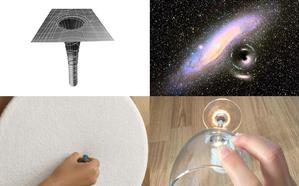
Hunting for black holes
astroEDU educational activity (links to astroEDU website) Description: How do astronomers detect invisible black holes?
License: CC-BY-4.0 Creative Commons Reconocimiento 4.0 Internacional (CC BY 4.0) íconos
Etiquetas:
Model
, Experiment
Rango de edades:
12-14
Nivel educativo:
Educación no forma
, Educación secundaria
Áreas de aprendizaje:
Modelización
, Basado en la observación
, Resolución de problemas
, Aprendizaje basado en la investigación estructurada
Costos:
Bajo coste
Duración:
45 minutos
Tamaño del grupo:
Grupo
Competencias:
Elaborar explicaciones
, Desarrollar y utilizar modelos