Glossary term: 천체물리학
Description: 천체물리학은 물리학의 원리를 이용해 천체의 본질을 탐구하는 과학 분야입니다. 천체물리학에서는 전자기스펙트럼 전체의 복사와 함께 천체에서 방출되는 중력파 및 중성미자와 같은 비전자기신호를 탐구하여 해당 천체의 밝기, 밀도, 온도와 같은 특성들을 파악합니다. 천체물리학은 이론물리학 및 관측물리학의 여러 분야를 포함하는 매우 광범위한 과학 분야입니다.
Related Terms:
See this term in other languages
Term and definition status: The original definition of this term in English have been approved by a research astronomer and a teacher The translation of this term and its definition is still awaiting approval
The OAE Multilingual Glossary is a project of the IAU Office of Astronomy for Education (OAE) in collaboration with the IAU Office of Astronomy Outreach (OAO). The terms and definitions were chosen, written and reviewed by a collective effort from the OAE, the OAE Centers and Nodes, the OAE National Astronomy Education Coordinators (NAECs) and other volunteers. You can find a full list of credits here. All glossary terms and their definitions are released under a Creative Commons CC BY-4.0 license and should be credited to "IAU OAE".
If you notice a factual or translation error in this glossary term or definition then please get in touch.
In Other Languages
- 아랍어: الفيزياء الفلكية
- 독일어: Astrophysik
- 영어: Astrophysics
- 스페인어: Astrofísica
- 프랑스어: Astrophysique
- 이탈리아어: Astrofisica
- 브라질 포르투갈어: Astrofísica
- 중국어 간체: 天体物理学
- 중국어 번체: 天體物理學
Related Media
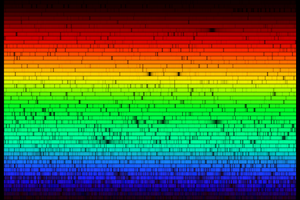
Solar absorption lines
Caption: This is a high resolution spectrum of light from our Sun showing visible region of the electromagnetic spectrum. The absorption lines are visible clearly as narrow black regions. The visualization shown here was created to mimic a so-called echelle spectrum, with wavelength increasing from left to right along each strip, and from bottom to top. Each of the 50 horizontal strips covers 6 nanometers, for a complete spectrum across the visible range from 400 to 700 nanometers.
This spectrum was created from a digital atlas observed with the Fourier Transform Spectrometer at the McMath-Pierce Solar Facility at the National Solar Observatory on Kitt Peak, near Tucson, Arizona (‘Solar Flux Atlas from 296 to 1300 nm" by Robert L. Kurucz, Ingemar Furenlid, James Brault, and Larry Testerman: National Solar Observatory Atlas No. 1, June 1984).
Note: NSO/Kitt Peak FTS data used here were produced by NSF/NOAO.
Credit: N.A. Sharp/KPNO/NOIRLab/NSO/NSF/AURA
credit link
License: CC-BY-4.0 Creative Commons 저작자표시 4.0 국제 (CC BY 4.0) icons