Término del glosario: Astrofísica
Descripción: La astrofísica es una ciencia que emplea los principios de la física para estudiar la naturaleza de los objetos astronómicos. En astrofísica se estudia la radiación en todo el espectro electromagnético, junto con las señales no electromagnéticas, como las ondas gravitacionales y los neutrinos emitidos por los objetos astronómicos, junto con sus propiedades en términos de brillo, densidad y temperatura. La astrofísica es una ciencia muy amplia que incluye ramas de la física teórica y observacional.
Términos relacionados:
Ver este término en otros idiomas
Estado del término y la definición: La definición original de este término en inglés ha sido aprobada por unastrónomo o astrónoma investigadora y un docente La traducción de este término y su definición aún están pendientes de aprobación
El Glosario multilingüe de la OAE es un proyecto de la Oficina de Astronomía para la Educación de la UAI (OAE) en colaboración con la Oficina de Divulgación de Astronomía de la UAI (OAO). Los términos y definiciones fueron seleccionados, redactados y revisados gracias al esfuerzo colectivo de la OAE, los Centros y Nodos de la OAE, los Coordinadores Nacionales de Educación Astronómica (NAECs) y otros voluntarios. Puedes encontrar una lista completa de créditos aquí. Todos los términos del glosario y sus definiciones se publican bajo la licencia Creative Commons CC BY-4.0 y deben atribuirse a la "IAU OAE".
Si detectas algún error de contenido o de traducción en este término del glosario o en ladefinición, ponte en contacto con nosotros.
En otros idiomas
- Árabe: الفيزياء الفلكية
- Alemán: Astrophysik
- Inglés: Astrophysics
- Francés: Astrophysique
- Italiano: Astrofisica
- Coreano: 천체물리학
- Portugués de Brasil: Astrofísica
- Chino simplificado: 天体物理学
- Chino tradicional: 天體物理學
Contenidos relacionados
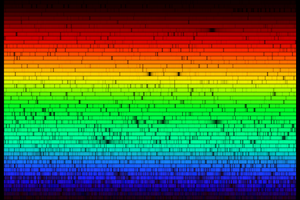
Solar absorption lines
Pie de foto: This is a high resolution spectrum of light from our Sun showing visible region of the electromagnetic spectrum. The absorption lines are visible clearly as narrow black regions. The visualization shown here was created to mimic a so-called echelle spectrum, with wavelength increasing from left to right along each strip, and from bottom to top. Each of the 50 horizontal strips covers 6 nanometers, for a complete spectrum across the visible range from 400 to 700 nanometers.
This spectrum was created from a digital atlas observed with the Fourier Transform Spectrometer at the McMath-Pierce Solar Facility at the National Solar Observatory on Kitt Peak, near Tucson, Arizona (‘Solar Flux Atlas from 296 to 1300 nm" by Robert L. Kurucz, Ingemar Furenlid, James Brault, and Larry Testerman: National Solar Observatory Atlas No. 1, June 1984).
Note: NSO/Kitt Peak FTS data used here were produced by NSF/NOAO.
Crédito: N.A. Sharp/KPNO/NOIRLab/NSO/NSF/AURA
enlace de crédito
License: CC-BY-4.0 Creative Commons Reconocimiento 4.0 Internacional (CC BY 4.0) íconos