Glossary term: 혜성핵
Description: 혜성핵은 혜성의 중심 부분으로, 얼음과 암석, 먼지 입자로 이루어진 ‘더러운 눈덩이’와 같은 고체 물체입니다. 혜성이 태양에서 멀리 떨어져 있을 때는 핵이 혜성의 유일한 구성 요소입니다. 하지만 혜성이 태양에 가까워지면, 햇빛에 의해 핵이 가열되어 표면의 얼음이 승화(고체가 바로 기체로 변함)합니다. 이때 승화된 기체와 함께 먼지가 방출되어, 핵주변에 코마(혜성의 대기)가 형성되고, 태양에서 멀어지는 방향으로 꼬리가 만들어집니다.
Related Terms:
See this term in other languages
Term and definition status: The original definition of this term in English have been approved by a research astronomer and a teacher The translation of this term and its definition is still awaiting approval
The OAE Multilingual Glossary is a project of the IAU Office of Astronomy for Education (OAE) in collaboration with the IAU Office of Astronomy Outreach (OAO). The terms and definitions were chosen, written and reviewed by a collective effort from the OAE, the OAE Centers and Nodes, the OAE National Astronomy Education Coordinators (NAECs) and other volunteers. You can find a full list of credits here. All glossary terms and their definitions are released under a Creative Commons CC BY-4.0 license and should be credited to "IAU OAE".
If you notice a factual or translation error in this glossary term or definition then please get in touch.
In Other Languages
- 아랍어: نواة المذنب
- 독일어: Kometenkern
- 영어: Comet Nucleus
- 스페인어: Núcleo del cometa
- 프랑스어: Noyau de la comète
- 이탈리아어: Nucleo della cometa
- 브라질 포르투갈어: Núcleo cometário
- 중국어 간체: 彗核
- 중국어 번체: 彗核
Related Media

Comet 67P/Churyumov-Gerasimenko
Caption: Comet 67P/Churyumov–Gerasimenko's nucleus is a "dirty snowball" made of a mixture of frozen materials and dust. It is shaped like two large lobes: one 4.1 km × 3.3 km × 1.8 km, the other 2.6 km × 2.3 km × 1.8 km. These lobes are connected by a small bridge. When a cometary nucleus such as this nears the Sun its frozen, icy material is heated, turning into gas. This, combined with the embedded dust, provide the material for the comet's characteristic coma and tail.
Credit: ESA/Rosetta/NAVCAM
credit link
License: CC-BY-SA-3.0-IGO Creative Commons 저작자표시-동일조건변경허락 3.0 정부간 국제 기구 icons
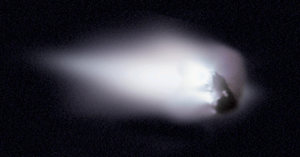
An Encounter With Halley's Comet
Caption: This image shows the solid core, or nucleus, of Halley’s Comet, captured in 1986 by the European Space Agency spacecraft Giotto during its flyby of the comet in the inner Solar System. The nucleus appears irregular and potato-shaped, measuring roughly 15 kilometers (about 9 miles) across, and is composed of a mixture of ice, dust, and rock. Unlike the glowing fuzzy cloud (coma) and long tail that make comets visible from Earth, the nucleus itself is dark and difficult to see until a spacecraft passes close enough to take detailed images.
Halley’s Comet is one of the best-known comets because it returns to the inner Solar System approximately every 76 years, allowing generations of astronomers to observe it repeatedly. The material that is released from the nucleus as the comet warms near the Sun forms a glowing coma and long tails of gas and dust, and over many returns leaves trails of debris that produce meteor showers on Earth, such as the Eta Aquarids in May and the Orionids in October.
Credit: NASA/ESA/Giotto Project
credit link
License: PD Public Domain icons