Término del glosario: Núcleo del cometa
Descripción: Es la estructura interna y sólida de un cometa. Se trata de un objeto similar a una bola de hielo sucia, formado por hielo y partículas rocosas y polvorientas. Sus componentes más destacados son: agua, amoníaco, dióxido de carbono, metano y silicatos. Este núcleo cometario cambia cuándo se acerca a su estrella. De allí que los hielos superficiales se subliman formando una especie de atmósfera a su alrededor, conocida como coma, a la vez que pierde materiales rocosos arrojados mientras completa su órbita alrededor de la estrella.
Términos relacionados:
Ver este término en otros idiomas
Estado del término y la definición: La definición original de este término en inglés ha sido aprobada por unastrónomo o astrónoma investigadora y un docente La traducción de este término y su definición aún están pendientes de aprobación
El Glosario multilingüe de la OAE es un proyecto de la Oficina de Astronomía para la Educación de la UAI (OAE) en colaboración con la Oficina de Divulgación de Astronomía de la UAI (OAO). Los términos y definiciones fueron seleccionados, redactados y revisados gracias al esfuerzo colectivo de la OAE, los Centros y Nodos de la OAE, los Coordinadores Nacionales de Educación Astronómica (NAECs) y otros voluntarios. Puedes encontrar una lista completa de créditos aquí. Todos los términos del glosario y sus definiciones se publican bajo la licencia Creative Commons CC BY-4.0 y deben atribuirse a la "IAU OAE".
Si detectas algún error de contenido o de traducción en este término del glosario o en ladefinición, ponte en contacto con nosotros.
En otros idiomas
- Árabe: نواة المذنب
- Alemán: Kometenkern
- Inglés: Comet Nucleus
- Francés: Noyau de la comète
- Italiano: Nucleo della cometa
- Coreano: 혜성핵
- Portugués de Brasil: Núcleo cometário
- Chino simplificado: 彗核
- Chino tradicional: 彗核
Contenidos relacionados

Comet 67P/Churyumov-Gerasimenko
Pie de foto: Comet 67P/Churyumov–Gerasimenko's nucleus is a "dirty snowball" made of a mixture of frozen materials and dust. It is shaped like two large lobes: one 4.1 km × 3.3 km × 1.8 km, the other 2.6 km × 2.3 km × 1.8 km. These lobes are connected by a small bridge. When a cometary nucleus such as this nears the Sun its frozen, icy material is heated, turning into gas. This, combined with the embedded dust, provide the material for the comet's characteristic coma and tail.
Crédito: ESA/Rosetta/NAVCAM
enlace de crédito
License: CC-BY-SA-3.0-IGO Creative Commons Attribution-ShareAlike 3.0 IGO íconos
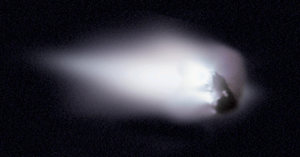
An Encounter With Halley's Comet
Pie de foto: This image shows the solid core, or nucleus, of Halley’s Comet, captured in 1986 by the European Space Agency spacecraft Giotto during its flyby of the comet in the inner Solar System. The nucleus appears irregular and potato-shaped, measuring roughly 15 kilometers (about 9 miles) across, and is composed of a mixture of ice, dust, and rock. Unlike the glowing fuzzy cloud (coma) and long tail that make comets visible from Earth, the nucleus itself is dark and difficult to see until a spacecraft passes close enough to take detailed images.
Halley’s Comet is one of the best-known comets because it returns to the inner Solar System approximately every 76 years, allowing generations of astronomers to observe it repeatedly. The material that is released from the nucleus as the comet warms near the Sun forms a glowing coma and long tails of gas and dust, and over many returns leaves trails of debris that produce meteor showers on Earth, such as the Eta Aquarids in May and the Orionids in October.
Crédito: NASA/ESA/Giotto Project
enlace de crédito
License: PD Dominio público íconos