Termo do glossário: Espectro visível
Descrição: A radiação eletromagnética com comprimentos de onda entre cerca de 380 e 750 nanômetros é visível ao olho humano e é chamada de luz visível. Quando a radiação eletromagnética é separada em um espectro, ordenando todos os diferentes tipos de radiação por comprimento de onda e mapeando a quantidade de radiação que nos atinge em cada região de comprimento de onda, a parte do espectro entre 380 e 750 nanômetros é o espectro visível. Nele, do comprimento de onda mais curto ao mais longo, encontramos luz violeta, índigo (anil), azul, verde, amarela, laranja e vermelha, dispostas continuamente – as cores do arco-íris, a maneira natural da natureza de produzir tal composição espectral, à medida que a luz do Sol é refratada em pequenas gotas de água.
Termos relacionados:
Ver este termo em outros idiomas
Status do termo e da definição: A definição original deste termo em inglês foi aprovada por um astrônomo(a) pesquisador(a) e um(a) professor(a) A tradução deste termo e de sua definição ainda aguarda aprovação
O Glossário Multilíngue da OAE é um projeto do Escritório da IAU de Astronomia para a Educação (OAE) em colaboração com o Escritório da IAU para Divulgação da Astronomia (OAO). Os termos e definições foram selecionados, escritos e revisados por meio de um esforço coletivo da OAE, dos Centros e Nós da OAE, dos Coordenadores Nacionais de Educação em Astronomia (NAECs) da OAE e de outros voluntários. Você pode encontrar uma lista completa dos créditos aqui. Todos os termos do glossário e suas definições são disponibilizados sob uma licença Creative Commons CC BY-4.0 e devem ser creditados à "IAU OAE".
Se você notar algum erro factual ou de tradução neste termo do glossário ou em sua definição, por favor entre em contato.
Em outros idiomas
- Árabe: الطيف المرئي
- Alemão: Sichtbares Spektrum
- Inglês: Visible Spectrum
- Espanhol: Espectro visible
- Francês: Spectre visible
- Italiano: Spettro visibile
- Chinês Simplificado: 可见光谱
- Chinês Tradicional: 可見光譜
Mídia relacionada

The Pillars of Creation in comparison
Legenda: The 'Pillars of Creation' are a renowned astronomical feature situated within the Eagle Nebula in the Serpens constellation. The illustration provides a direct comparison between images captured by the Hubble Space Telescope (HST) and the James Webb Space Telescope (JWST), showcasing the pillars, which span several light years in diameter, in both visible light (also known as optical light) and infrared light. On the left are the pillars as seen by Hubble in visual light, taken in 2014. It displays dark pillars against an opaque background, with only a handful of visible stars. Conversely, the counterpart on the right is Webb’s near-infrared view published in 2022, penetrating the dust and revealing numerous stars of varying sizes.
Their distance from Earth is approximately 6,500 to 7,000 light years. Within these pillars, new stars are constantly forming, making them a subject of extensive study by astronomers. Composed mostly of cool molecular hydrogen and small amounts of interstellar dust, they are subject to erosion by the intense ultraviolet radiation emitted by nearby massive and newborn stars, a process known as photoevaporation.
Crédito: NASA, ESA, CSA, STScI
link do crédito
License: CC-BY-2.0 Creative Commons Attribution 2.0 Generic ícones
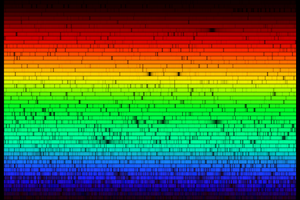
Solar absorption lines
Legenda: This is a high resolution spectrum of light from our Sun showing visible region of the electromagnetic spectrum. The absorption lines are visible clearly as narrow black regions. The visualization shown here was created to mimic a so-called echelle spectrum, with wavelength increasing from left to right along each strip, and from bottom to top. Each of the 50 horizontal strips covers 6 nanometers, for a complete spectrum across the visible range from 400 to 700 nanometers.
This spectrum was created from a digital atlas observed with the Fourier Transform Spectrometer at the McMath-Pierce Solar Facility at the National Solar Observatory on Kitt Peak, near Tucson, Arizona (‘Solar Flux Atlas from 296 to 1300 nm" by Robert L. Kurucz, Ingemar Furenlid, James Brault, and Larry Testerman: National Solar Observatory Atlas No. 1, June 1984).
Note: NSO/Kitt Peak FTS data used here were produced by NSF/NOAO.
Crédito: N.A. Sharp/KPNO/NOIRLab/NSO/NSF/AURA
link do crédito
License: CC-BY-4.0 Creative Commons Attribution 4.0 International (CC BY 4.0) ícones

Light Dispersion by a Triangular Prism
Legenda: This photograph shows a prism splitting a beam of white light into its component colors — a beautiful demonstration of optics, the branch of physics that studies how light behaves and interacts with materials. When white light enters the prism, different wavelengths (colors) bend by different amounts because of a process called refraction. This separation of colors produces a spectrum — similar to a rainbow — revealing that white light is actually made up of many colors combined going from blue, through green and yellow to red.
Understanding optics helps scientists and engineers design lenses, microscopes, telescopes, cameras, and many other tools that shape and control light for practical use. The way the prism disperses light into a spectrum is the same principle that makes rainbows form in the sky when sunlight passes through raindrops.
Crédito: Kelvinsong
link do crédito
License: CC0 CC0 1.0 Universal (CC0 1.0) Public Domain Dedication ícones





.png)
.jpg)