Termo do glossário: Buraco negro
Descrição: Um buraco negro é uma região do espaço em que a força gravitacional é tão grande que nada, nem mesmo a luz, pode escapar dele.
Muitas galáxias, incluindo a Via Láctea, têm um grande buraco negro (conhecido como buraco negro supermassivo) em seu centro.
Uma das maneiras pelas quais os astrônomos acreditam que os buracos negros menores se formam é quando uma estrela maciça entra em colapso no final de sua vida. Entretanto, os astrônomos ainda não conhecem as origens dos buracos negros supermassivos.
O limite externo de um buraco negro é conhecido como horizonte de eventos.
Perto dos buracos negros, a física é tão extrema que o tempo passa muito mais devagar (em comparação com um observador distante do buraco negro) e, ao redor de buracos negros menores, os objetos são esticados e despedaçados. A matéria que cai em direção a um buraco negro forma um disco de acreção. Isso muitas vezes pode ser acompanhado por jatos de matéria enviados por esse disco. Os discos de acreção de buracos negros são a fonte de energia dos quasares e de outros núcleos galácticos ativos (AGN), bem como de muitas outras fontes de raios X.
Termos relacionados:
Ver este termo em outros idiomas
Status do termo e da definição: A definição original deste termo em inglês foi aprovada por um astrônomo(a) pesquisador(a) e um(a) professor(a) A tradução deste termo e de sua definição ainda aguarda aprovação
O Glossário Multilíngue da OAE é um projeto do Escritório da IAU de Astronomia para a Educação (OAE) em colaboração com o Escritório da IAU para Divulgação da Astronomia (OAO). Os termos e definições foram selecionados, escritos e revisados por meio de um esforço coletivo da OAE, dos Centros e Nós da OAE, dos Coordenadores Nacionais de Educação em Astronomia (NAECs) da OAE e de outros voluntários. Você pode encontrar uma lista completa dos créditos aqui. Todos os termos do glossário e suas definições são disponibilizados sob uma licença Creative Commons CC BY-4.0 e devem ser creditados à "IAU OAE".
Se você notar algum erro factual ou de tradução neste termo do glossário ou em sua definição, por favor entre em contato.
Em outros idiomas
- Árabe: الثقب الأسود
- Bengali: কৃষ্ণবিবর
- Alemão: Schwarzes Loch
- Inglês: Black Hole
- Espanhol: Agujero negro
- Francês: Trou noir
- Italiano: Buco nero
- Japonês: ブラックホール (link externo)
- Chinês Simplificado: 黑洞
- Chinês Tradicional: 黑洞
Diagramas relacionados
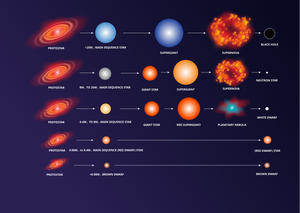
Stellar Evolution
Legenda: This diagram shows the life cycle of stars of different masses. The mass of the different types of star increases from bottom to top with time going from left to right.
The life cycle of a star depends on its mass, with lower mass stars have longer lifetimes. All stars form from clouds of gas that collapse under their own gravity. As the star collapses, its core becomes hotter and denser. If the star has a mass greater than 0.08 solar masses (0.08 times the mass of the Sun), the pressure of the star’s mass pushing down on its core creates a high enough core temperature for hydrogen fusion to ignite. This burns hydrogen into helium in the star’s core, providing a heat source to power the star and to stop its core from collapsing further. If the collapsing object has a mass below 0.08 solar masses then it does not ignite hydrogen fusion in its core. It continues to cool and slowly contract. Such substellar objects are known as brown dwarfs, shown here in the lowest row.
After stars have formed, they burn hydrogen in their cores and begin their so-called main sequence phase. The most massive stars (>25 solar masses, shown here at the top) have very high core temperatures and thus burn through their hydrogen fuel more quickly. This means they may only spend a few million years on the main sequence burning hydrogen in their cores. Once the hydrogen in the core is exhausted the star’s core contracts, becomes hotter and helium burning starts in the core. While the core contracts, the outer layers of the star expand and it becomes a supergiant. For the most massive stars strong stellar winds strip off the cooler outer layers, leading to the star being very large and very hot, a blue supergiant. Once helium is exhausted in the core, carbon is burned, and then heavier elements. Eventually the star ends with an iron core. Fusing iron into heavier elements does not generate energy so at this point fusion stops in the core. Once this core of iron is massive enough, it and the surrounding matter suddenly collapses to form a black hole and the outer layers are flung off in a supernova explosion.
Slightly lower mass stars (between 8 and 25 solar masses, seen here second top) evolve in a similar way although they do not have strong enough winds to push their outer layers away and become blue supergiants, instead it evolves into a red supergiant. While such stars also collapse and create supernova explosions. The remnant of the star’s core is not massive enough to collapse into a black hole. Instead, its electrons and protons combine to form neutrons and it is supported by a quantum mechanical effect called neutron degeneracy pressure. This results in the remnant of the star being a tiny neutron star, several solar masses in mass but only a few kilometres across.
For stars similar in mass to the Sun (between 0.4 and 8 solar masses, seen here in the middle row), the star burns hydrogen in its core until the hydrogen in its core is exhausted. At this point a hydrogen burning shell forms around the core. Eventually the core will become hot enough to burn helium into carbon and oxygen. After this the star is left with a carbon and oxygen core surrounded by shells burning helium and hydrogen. These shells are unstable producing thermal pulsations that convulse the star. Eventually these pulsations become so extreme that the star’s outer layers are thrown off. This leaves the carbon and oxygen core as a white dwarf supported by electron degeneracy pressure. The outer layers of the star form what is known as a planetary nebula (which doesn’t actually have anything to do with planets despite the name).
The lowest mass stars (seen here in the second bottom row) are so low in mass that their evolutionary timescales are much longer than the age of the universe. This means that none have evolved beyond the main-sequence. Low mass stars are fully convective meaning material in the core is constantly being mixed with material above. This means that all the hydrogen in the star would eventually be burned in the core, but this will take trillions of years.
Crédito: Danielle Futselaar/IAU OAE
License: CC-BY-4.0 Creative Commons Attribution 4.0 International (CC BY 4.0) ícones
Atividades relacionadas
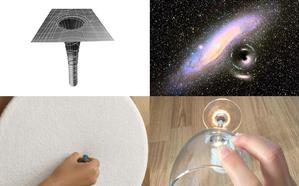
Hunting for black holes
astroEDU educational activity (links to astroEDU website) Description: How do astronomers detect invisible black holes?
License: CC-BY-4.0 Creative Commons Attribution 4.0 International (CC BY 4.0) ícones
Tags:
Model
, Experiment
Faixas etárias:
12-14
Nível de ensino:
Informal
, Ensino fundamental
Áreas de aprendizagem:
Modelagem
, Baseado em observação
, Resolução de problemas
, Aprendizagem por investigação estruturada
Custos:
Baixo custo
Duração:
45 mins
Tamanho do grupo:
Grupo
Habilidades:
Construir explicações
, Desenvolver e usar modelos
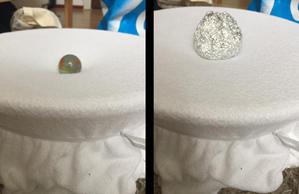
What is a black hole?
astroEDU educational activity (links to astroEDU website) Description: What are black holes and what would happen if the Sun was replaced by one of them?
License: CC-BY-4.0 Creative Commons Attribution 4.0 International (CC BY 4.0) ícones
Tags:
Model
, Experiment
, Investigation
Faixas etárias:
12-14
Nível de ensino:
Informal
, Ensino fundamental
Áreas de aprendizagem:
Grupos de discussão
, Aula interativa
, Modelagem
, Baseado em observação
, Resolução de problemas
, Aprendizagem por investigação estruturada
Custos:
Baixo custo
Duração:
45 mins
Tamanho do grupo:
Grupo
Habilidades:
Construir explicações
, Desenvolver e usar modelos
, Engajar-se em argumentação com base em evidências
, Planejar e realizar pesquisas

Model of a Black Hole
astroEDU educational activity (links to astroEDU website) Description: Understand the mystery of black holes through a hands-on activity.
License: CC-BY-4.0 Creative Commons Attribution 4.0 International (CC BY 4.0) ícones
Tags:
Hands-on
, Model
, Interactive
, Space-time
, Black holes
Faixas etárias:
8-10
, 10-12
Nível de ensino:
Básico
, Médio
Áreas de aprendizagem:
Modelagem
, Aprendizagem por investigação estruturada
Custos:
Custo médio
Duração:
1 hour
Tamanho do grupo:
Grupo
Habilidades:
Fazer perguntas
, Desenvolver e usar modelos