Termo do glossário: Cauda de cometa
Descrição: Quando um cometa está próximo do Sol, a radiação solar aquece a superfície do cometa. O gelo na superfície se transforma em gás (ele “se sublima”), levando consigo material rochoso e em pó. A mistura resultante forma uma nuvem ao redor do núcleo do cometa, chamada de coma. Em geral, um cometa tem duas caudas: as partículas de poeira ejetadas formam a cauda de poeira do cometa, que tem uma forma caracteristicamente curva. Ela é composta por partículas de poeira liberadas da superfície, que acompanham o cometa ao longo de sua órbita ao redor do Sol. As caudas de poeira podem ter milhões de quilômetros ou mais de comprimento. Elas refletem a luz solar e, se as condições forem favoráveis, sua forma esbranquiçada e difusa é responsável pela maior parte do que pode ser observado quando um cometa é visível a olho nu.
Uma fração substancial do gás é soprada para longe e ionizada pelo vento solar – as partículas eletricamente carregadas emitidas pelo Sol. Esses íons formam a cauda iônica do cometa, que normalmente apresenta uma cor azulada. A cauda iônica sempre aponta diretamente na direção oposta ao Sol. Se o próprio cometa estiver se afastando do Sol, a cauda iônica precede o cometa.
Termos relacionados:
Ver este termo em outros idiomas
Status do termo e da definição: A definição original deste termo em inglês foi aprovada por um astrônomo(a) pesquisador(a) e um(a) professor(a) A tradução deste termo e de sua definição ainda aguarda aprovação
O Glossário Multilíngue da OAE é um projeto do Escritório da IAU de Astronomia para a Educação(OAE) em colaboração com o Escritório da IAU para Divulgação da Astronomia (OAO). Os termos e definições foram selecionados, escritos e revisados por meio de um esforço coletivo da OAE, dos Centros e Nós da OAE, dos Coordenadores Nacionais de Educação em Astronomia (NAECs) da OAE e de outros voluntários. Você pode encontrar uma lista completa dos créditos aqui. Todos os termos do glossário e suas definições são disponibilizados sob uma licença Creative Commons CC BY-4.0 e devem ser creditados à "IAU OAE".
Se você notar algum erro factual ou de tradução neste termo do glossário ou em sua definição, por favor entre em contato.
Em outros idiomas
- Árabe: ذيل المذنب
- Alemão: Kometenschweif
- Inglês: Cometary Tail
- Espanhol: Cola de un cometa
- Francês: Queue cométaire
- Italiano: Coda cometaria
- Japonês: 尾(彗星の) (link externo)
- Chinês Simplificado: 彗尾
- Chinês Tradicional: 彗尾
Mídia relacionada
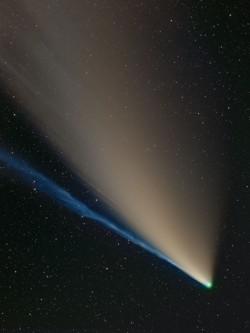
Comet C/2020F3 (Neowise) with separate dust and ion gas tails and a green glowing coma, by Dietmar Gutermuth, Germany
Legenda: Second place in the 2021 IAU OAE Astrophotography Contest, category Comets.
Comets have a very interesting structure comprising of four main parts: the nucleus, composed of rock, dust and frozen gases, typically spanning a few kilometres, although bigger ones have been observed; a small atmosphere of gas surrounding the nucleus (only present when the comet approaches its closest point to the Sun), called coma; and the two distinctive cometary tails (there is at times third tail). The green colour of the coma is due to carbon and nitrogen present in the coma reacting with the Sun’s ultraviolet radiation. The tail that we are mostly used to observing – dust tail and is composed of micron sized dust particles, the second tail composed of charged particles – ion or gas tail. The tails are released only when the comet approaches the Sun at a distance where the heat and radiation emanating from our star is intense enough to vaporize the frozen gases. The dust tail is curved, while the gas tail is straight and always points away from the Sun as this is carried by the solar wind - flow of charged particles emitted by the Sun. As comets are formed by leftover material, they carry with them important information about the early stages of the Solar System’s formation. This beautiful image shows the comet C/2020 F3 (Neowise), as seen from Germany in July 2020, with three of the four structures clearly visible – coma, gas, and dust tail.
Crédito: Dietmar Gutermuth/IAU OAE
License: CC-BY-4.0 Creative Commons Attribution 4.0 International (CC BY 4.0) ícones
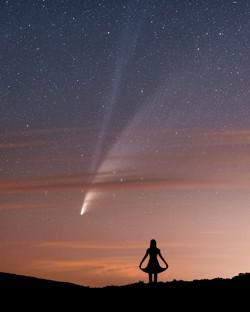
Hello Comet, shall we dance?, by Robert Barsa, Slovakia
Legenda: Third place in the 2021 IAU OAE Astrophotography Contest, category Comets.
This beautiful and poetic image taken from Slovakia in July 2020 captures the comet C/2020 F3 (Neowise). The direction of the tails of the comet provides a clue as to the position of the Sun. In the past, the appearance of a comet in the skies could be accompanied by apprehension and even fear from those who did not know what these objects really are. Through careful observations and the applications of knowledge from physics, chemistry and geology, we now understand that comets are objects left over from the earliest days when the Solar System formed. The most distinctive features of a comet are the bluish ion (gas) tail, and whitish dust tail, which can extend for tens of millions of kilometres. These distinctive features, easily observable with the unaided eye together with an understanding of the science, are no longer cause for fear, rather they help us understand the history of our Solar System, and bring awe, joy and contemplation, as portrayed in this image.
Crédito: Robert Barsa/IAU OAE
License: CC-BY-4.0 Creative Commons Attribution 4.0 International (CC BY 4.0) ícones
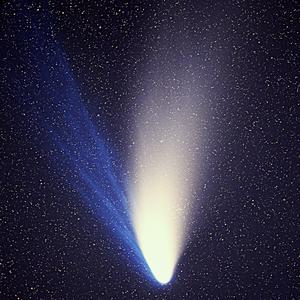
Cometa Hale-Bopp
Legenda: Imagem do cometa C/1995 O1 (Hale-Bopp), obtida em 4 de abril de 1997, com um tempo de exposição de 10 minutos. O campo mostrado tem cerca de 6,5° x 6,5°. Duas caudas se estendem a partir da coma brilhante: uma cauda de poeira de cor branco-amarelada e uma cauda de gás azulada, sempre apontando na direção oposta ao Sol.
Crédito: E. Kolmhofer, H. Raab; Observatório Johannes Kepler, Linz, Áustria
link do crédito
License: CC-BY-SA-3.0 Creative Commons Attribution-ShareAlike 3.0 Unported ícones

Halley's Comet
Legenda: Halley’s Comet, is a well-known periodic comet, named after the English astronomer Edmond Halley. It has an orbital period of approximately 75 years and is visible from Earth with the naked eye when it passes through the inner solar system.
The image shows Halley’s Comet, officially designated 1P/Halley, with a tail of gas and dust streaming away from the Sun. It was taken from the La-Silla-Observatory in Chile in 1986 during Halley's Comet's last visit to the inner solar system. The stars in this image appear elongated or as lines of three different colored dots as image was created from three separate observations in different colors of light and the telescope was tracking the comet, which was moving very slightly compared to the background stars. Note that the comets tail does not point in exactly the same direction as the elongation of the stars. This shows us that the comet tail is not always behind the comet, but instead pointing away from the Sun.
The comet passes its perihelion (closest distance to the Sun) at a distance of around 0.59 astronomical units, right between the orbits of Mercury and Venus. Beyond Neptune, it reaches its aphelion (furthest distance from the Sun) at a distance of approximately 35 astronomical units. Halley's Comet reached aphelion in December 2023 and is now moving inwards again. It is expected to be seen with the naked eye from Earth again in mid-2061.
Crédito: ESO
link do crédito
License: CC-BY-4.0 Creative Commons Attribution 4.0 International (CC BY 4.0) ícones