Glossary term: Celestial Pole
Description: The celestial North and South Poles correspond to the points where the celestial sphere intersects with the Earth's axis of rotation.
At the Earth's North Pole, the celestial North Pole is always directly overhead and at the Earth's South Pole, the celestial South Pole is always directly overhead. Due to the Earth's rotation, the sky in the northern hemisphere appears to rotate around the celestial North Pole and in the southern hemisphere the sky appears to rotate around the celestial South Pole. The celestial North Pole is at a declination of +90 degrees and the celestial South Pole is at a declination of -90 degrees.
Related Terms:
See this term in other languages
Term and definition status: This term and its definition have been approved by a research astronomer and a teacher
The OAE Multilingual Glossary is a project of the IAU Office of Astronomy for Education (OAE) in collaboration with the IAU Office of Astronomy Outreach (OAO). The terms and definitions were chosen, written and reviewed by a collective effort from the OAE, the OAE Centers and Nodes, the OAE National Astronomy Education Coordinators (NAECs) and other volunteers. You can find a full list of credits here. All glossary terms and their definitions are released under a Creative Commons CC BY-4.0 license and should be credited to "IAU OAE".
If you notice a factual error in this glossary definition then please get in touch.
In Other Languages
- Arabic: القطب السماوى
- German: Himmelspol
- Spanish: Polo Celeste
- French: Pôle céleste
- Italian: Polo Celeste
- Japanese: 天の極 (external link)
- Korean: 천극
- Brazilian Portuguese: Polo Celeste
- Simplified Chinese: 天极
- Traditional Chinese: 天極
Related Media
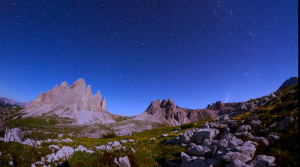
Big Dipper and Comet Neowise C2020 F3
Caption: Honorable mention in the 2023 IAU OAE Astrophotography Contest, category of Time-lapses of rotation of Big Dipper or Southern Cross.
This time-lapse documents the trajectory of the iconic Big Dipper across three frames taken in July 2020. Captured from three locations in Italy, Tre Cime di Lavaredo Auronzo di Cadore, Monte Rite, Cibiana di Cadore, and Casera Razzo, Vigo di Cadore, this visual odyssey showcases the captivating journey of the Big Dipper with the addition of trails of stars painting a celestial canvas. It not only traces the path of this renowned asterism but also features the rare appearance of comet Neowise C/2020 F3, an extraordinary event that graced our skies during July 2020.
Credit: Giorgia Hofer/IAU OAE (CC BY 4.0)
License: CC-BY-4.0 Creative Commons Attribution 4.0 International (CC BY 4.0) icons
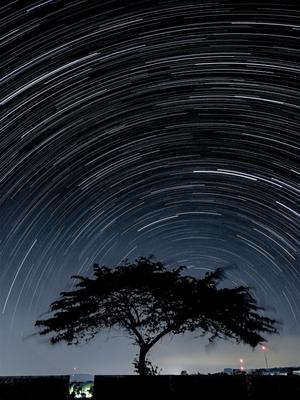
Star Trail in the Southern Hemisphere with Bortle 4 Scale Light Pollution
Caption: Winner in the 2023 IAU OAE Astrophotography Contest, category of Still images taken exclusively with smartphones/mobile devices.
This breathtaking photo, captured under the clear night sky of Linggamekar Village, Cilimus, Kuningan, West Java, Indonesia on 25 June 2020, displays star trails sweeping across the southern hemisphere’s heavens. The star trails are due to Earth’s rotation causing the apparent motion of stars, creating these mesmerising arcs of light when followed over extended periods. Here, the point the stars rotate around (the South Celestial Pole) is close to the horizon, as the image was taken close to the equator. The photographer used the star trail feature on a smartphone, which captured a series of images over an extended period and stacked them together. The striking tree in the foreground adds depth to the image, contrasting the celestial motion above with its Earthly stillness, while also masking some of the surrounding light pollution. Different parts of the world offer diverse and stunning perspectives on the night sky, emphasising the importance of preserving dark skies everywhere.
Credit: Slamat Riyadi/IAU OAE (CC BY 4.0)
License: CC-BY-4.0 Creative Commons Attribution 4.0 International (CC BY 4.0) icons
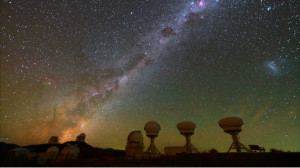
Southern Sky Over La Silla
Caption: First place winner in the 2023 IAU OAE Astrophotography Contest, category of Time-lapses of rotation of Big Dipper or Southern Cross.
This video shows the Milky Way’s sprawling brilliance across the celestial expanse. Among the stars’ grand theatre, the Southern Cross constellation claims its place in the scene, distinguished by its distinctive cross shape as seen in the top of this video and slightly to the right just over the Milky Way, slowly disappearing as the video progresses. This celestial marker, a prominent feature in the southern hemisphere, holds cultural and navigational significance, having served as a navigational guidepost for centuries. Accompanying the Milky Way’s grandeur are the two Magellanic clouds, celestial companions seen dancing in the distant sky. The Carina Nebula adds its ethereal glow to the cosmic panorama, painting a radiant hue against the darkness. In the midst of this celestial ballet, a gentle green hue envelops the atmosphere, a phenomenon known as airglow, adding a touch of subtle luminescence to the night sky. The terrestrial also makes an appearance, with planes flying overhead and vehicles driving between observatory buildings. This time-lapse, taken from the La Silla Observatory in Chile, is a window to the captivating dance of stars, offering a glimpse into the awe-inspiring beauty of our galaxy and the celestial landmarks that grace the southern sky.
Credit: José Rodrigues/IAU OAE (CC BY 4.0)
License: CC-BY-4.0 Creative Commons Attribution 4.0 International (CC BY 4.0) icons
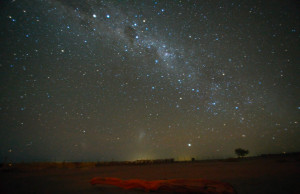
Beautiful Night in the Atacama Desert
Caption: Honorable mention in the 2023 IAU OAE Astrophotography Contest, category of Time-lapses of rotation of Big Dipper or Southern Cross.
Taken from San Pedro de Atacama, Chile, in June 2023, this time-lapse reveals the celestial ballet that unfolds as the Southern Cross takes its majestic journey across the sky, pointing the way to the South Celestial Pole around which the sky rotates, until it gracefully sets. The star-studded canvas showcases the grandeur of the Milky Way, adorned by the rotating Large and Small Magellanic Clouds swirling around the Southern Celestial Pole. The prominent constellations of Crux, Centaurus, Scorpius, and the former Argo Navis (Carina, Puppis, Vela) are also visible. The spectacle begins just after nightfall, capturing the radiant descent of Canopus, a beacon about to dip below the horizon. Throughout the sequence, there is a subtle presence of passing aeroplanes, fleeting headlights of cars, drifting clouds, and the ethereal airglow. At a stunning moment, a vivid meteor streaked across the sky, a breathtaking fireball briefly igniting the right lower corner around the 41st second mark. As the sequence progresses, the rising moon elegantly illuminates the landscape, casting its glow upon an ancient tree trunk resting on the dry, dusty grounds of the Salar de Atacama. This captivating journey through the night skies concludes before the break of dawn, offering a glimpse into the celestial marvels that are woven into the nocturnal tapestry of San Pedro de Atacama.
Credit: Uwe Reichert/IAU OAE (CC BY 4.0)
License: CC-BY-4.0 Creative Commons Attribution 4.0 International (CC BY 4.0) icons
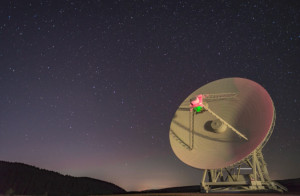
The Big Dipper with the Sardinia Radio Telescope SRT
Caption: Honorable mention in the 2023 IAU OAE Astrophotography Contest, category of Time-lapses of rotation of Big Dipper or Southern Cross.
This time-lapse captures the movement of the stars alongside the majestic 64-metre Sardinia Radio Telescope (SRT) from the National Institute of Astrophysics (INAF), with special attention to the renowned Big Dipper against the backdrop of the celestial sphere. The camera pans as the famous asterism sinks in the sky while planes fly past and the radio telescope rotates. The harmonious interplay between the stellar pathways and the colossal dish of the radio telescope creates a mesmerising visual ode to the cosmic ballet taken in September 2019.
Credit: Antonio Finazzi/IAU OAE (CC BY 4.0)
License: CC-BY-4.0 Creative Commons Attribution 4.0 International (CC BY 4.0) icons