This page describes an image Perseus Constellation Map
下载文件 ( 图像 119.08 kB)
下载 PDF 文件 (PDF file 189.39 kB)
图示说明:
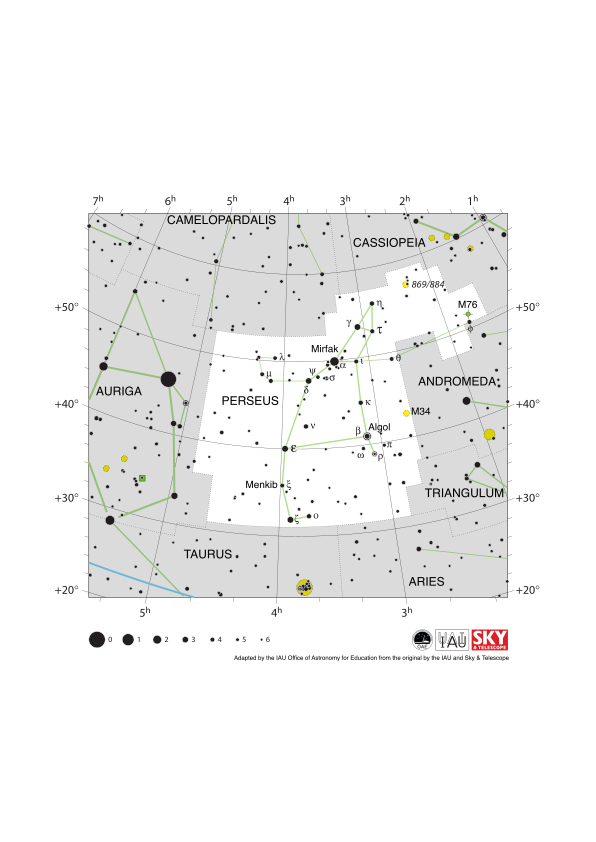
The constellation Perseus with its bright stars and surrounding constellations. Perseus is surrounded by (going clockwise from the top): Camelopardalis, Cassiopeia, Andromeda, Triangulum, Aries, Taurus and Auriga. Perseus is home to the notable variable star Algol.
Perseus is a northern constellation and thus the whole constellation is visible at some point in the year throughout the northern hemisphere. The whole constellation is also visible to equatorial regions of the southern hemisphere with parts of the constellation visible to southern temperate regions. Perseus is best viewed in the evenings in the northern hemisphere winter and southern hemisphere summer.
The open clusters NGC 869 and NGC 884 (commonly known as the Double Cluster) lie in Perseus as does the open cluster M34. These are all marked with yellow circles. The brightest star in Perseus, Mirfak (alpha Persei), along with some of the surrounding stars are members of the Alpha Persei open cluster. The planetary nebula M76 also lies in Perseus, it is marked here with a green circle superimposed on a plus sign.
The y-axis of this diagram is in degrees of declination with north as up and the x-axis is in hours of right ascension with east to the left. The sizes of the stars marked here relate to the star's apparent magnitude, a measure of its apparent brightness. The larger dots represent brighter stars. The Greek letters mark the brightest stars in the constellation. These are ranked by brightness with the brightest star being labeled alpha, the second brightest beta, etc., although this ordering is not always followed exactly. The dot marking Algol is surrounded by a circle, showing it is a variable star. The dotted boundary lines mark the IAU's boundaries of the constellations and the solid green lines mark one of the common forms used to represent the figures of the constellations. The blue line at the bottom left of the diagram marks the ecliptic. Neither the constellation boundaries, nor the lines joining the stars, nor the ecliptic, appear on the sky.
图示来源: Adapted by the IAU Office of Astronomy for Education from the original by the IAU and Sky & Telescope. 来源链接
图示翻译状态: 尚未由审核人员批准
图示授权许可: 知识共享许可协议 署名 4.0 国际 (CC BY 4.0) 知识共享许可协议 署名 4.0 国际 (CC BY 4.0) 图标
相关术语表词条:
变星
, 天球坐标
, 星座
, 疏散星团
, 行星状星云
, 视星等
, 赤纬
, 赤经(RA)
, 黄道
分类:
肉眼天文学
Want to make your own translation or version of this diagram? Then
download the SVG
version of this diagram in English (555.55 kB). You can edit this using
software like Inkscape (free) or Adobe Illustrator
(proprietary). Just remember to credit the author of the original appropriately.
You can also make your own version or translation of this diagram by adding adding text to a version of
this diagram with no text. Just download one of the following files:
Download Text-Free File ( 图像 105.41 kB)
Download Text-Free PDF File (PDF file 169.37 kB)
其他语言版本
英语: Perseus Constellation Map意大利语: Mappa della costellazione di Perseo
巴西葡萄牙语: Mapa da Constelação de Perseu
OAE 网站上展示的图示说明是由 OAE、OAE 各中心与节点、OAE 的 国家天文教育协调员 (NAEC) 和其他志愿者共同撰写、翻译与审核的。您可以在这里 查看我们翻译项目的完整致谢名单。所有媒体文件说明均遵循 Creative Commons CC BY-4.0 许可协议 进行发布,应注明来源为"IAU OAE"。媒体文件本身可能具有不同的许可协议(见上文),请根据“来源”部分注明相应来源。
如果您发现此图示或其说明中有任何错误,请联系我们。