This page describes an image Vulpecula Constellation Map
Datei runterladen ( Bild 100.83 kB)
PDF Datei runterladen (PDF file 175.44 kB)
Untertitel Diagramm:
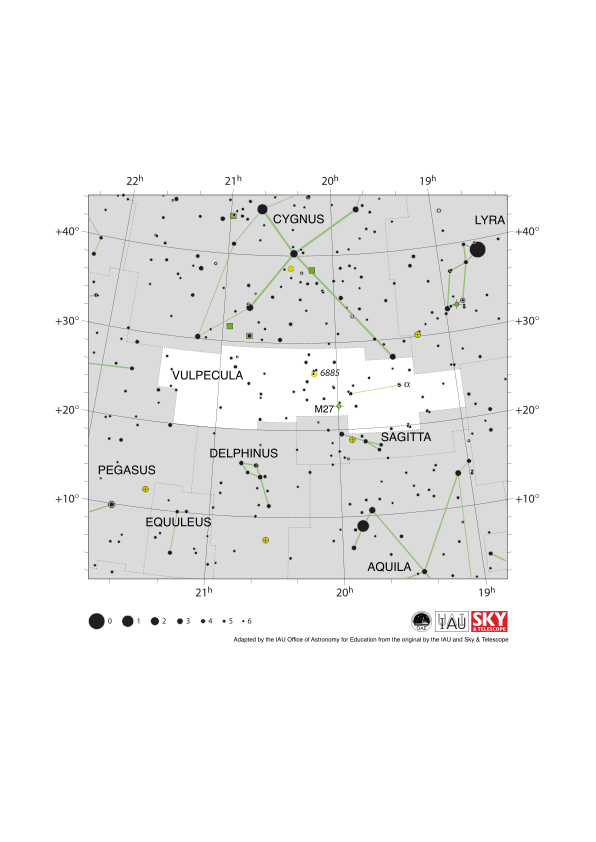
The constellation Vulpecula with its brighter stars and surrounding constellations. Vulpecula is surrounded by (going clockwise from the top): Cygnus, Lyra, Hercules, Sagitta, Delphinus and Pegasus.
Vulpecula is a northern constellation and thus the whole constellation is visible at some point in the year throughout the northern hemisphere. The whole constellation is also visible in equatorial and temperate regions of the southern hemisphere. Vulpecula is best viewed in the evening in the northern hemisphere early autumn and southern hemisphere early spring.
The planetary nebula M27, commonly known as the Dumbbell Nebula lies in Vulpecula and is marked here with a green cross superimposed on a plus sign. The open cluster NGC 6885 also lies in Vulpecula and is marked here with a yellow circle.
The y-axis of this diagram is in degrees of declination with north as up and the x-axis is in hours of right ascension with east to the left. The sizes of the stars marked here relate to the star's apparent magnitude, a measure of its apparent brightness. The larger dots represent brighter stars. The Greek letters mark the brightest stars in the constellation. These are ranked by brightness with the brightest star being labeled alpha, the second brightest beta, etc., although this ordering is not always followed exactly. The dotted boundary lines mark the IAU's boundaries of the constellations and the solid green lines mark one of the common forms used to represent the figures of the constellations. Neither the constellation boundaries, nor the lines joining the stars appear on the sky.
Quelle Diagramm: Adapted by the IAU Office of Astronomy for Education from the original by the IAU and Sky & Telescope. Link zur Quelle
Diagramm Übersetzungsstatus: Noch nicht bestätigt von einer*einem Rezensent*in
Diagramm-Lizenz: Creative Commons Namensnennung 4.0 International (CC BY 4.0) Creative Commons Namensnennung 4.0 International (CC BY 4.0) Symbole
Ähnliche Glossarbegriffe:
Deklination
, Himmelskoordinaten
, Offener Sternhaufen
, Planetarischer Nebel
, Rektaszension (RA)
, Scheinbare Helligkeit
, Sternbild
Kategorien:
Astronomie mit bloßem Auge
Möchtest du deine eigene Übersetzung oder Version dieses Diagrammes erstellen? Dann downloade die SVG
Version dieses Diagrammes auf Englisch (507.94 kB). Du kannst diese Version mit Programmen wie Inkscape (kostenlos) oder Adobe Illustrator (kostenpflichtig) bearbeiten. Bitte verweise dennoch auf die*den originale*n Autor*in.
Du kannst Deine eigene Version oder Übersetzung dieses Diagrammes erstellen, indem du einer textlosen Version dieses Diagrammes eigenen Text zufügst.
Downloade einfach eine dieser Dateien:
Download Text-Free File ( Bild 90.36 kB)
Download Text-Free PDF File (PDF file 158.04 kB)
Auf anderen Sprachen
Englisch: Vulpecula Constellation MapItalienisch: Mappa della Costellazione della Volpetta
Traditionelles Chinesisch: 天狐座星圖(狐狸座)
Vereinfachtes Chinesisch: 天狐座星图(狐狸座)
Die Diagramm-Unterschriften auf der OAE-Website wurden geschrieben, übersetzt und bestätigt durch einen kollektiven Aufwand vom OAE, dem OAE Zentren und Knotenpunkte, dem OAE Nationale astronomische Bildungskoordinator*innen (NAECs) und anderen Freiwilligen. Du findest eine volle Liste der Mitarbeitenden für unser Übersetzungsprojekt here. Alle Mediendatei-Unterschriften werden veröffentlicht unter Creative Commons CC BY-4.0 license und sollten "IAU OAE" zugeschrieben werden.Die Mediendateien selbst können andere Lizenzen haben (siehe oben), und sollten Quellenverweise erhalten wie oben aufgelistet "credit".
Sollte dir ein Fehler in diesem Diagramm oder seiner Unterschrift auffallen, bitte kontaktiere uns.