This page describes an image Karte des Sternbilds Jagdhunde
Datei runterladen ( Bild 130.97 kB)
PDF Datei runterladen (PDF file 82.93 kB)
Untertitel Diagramm:
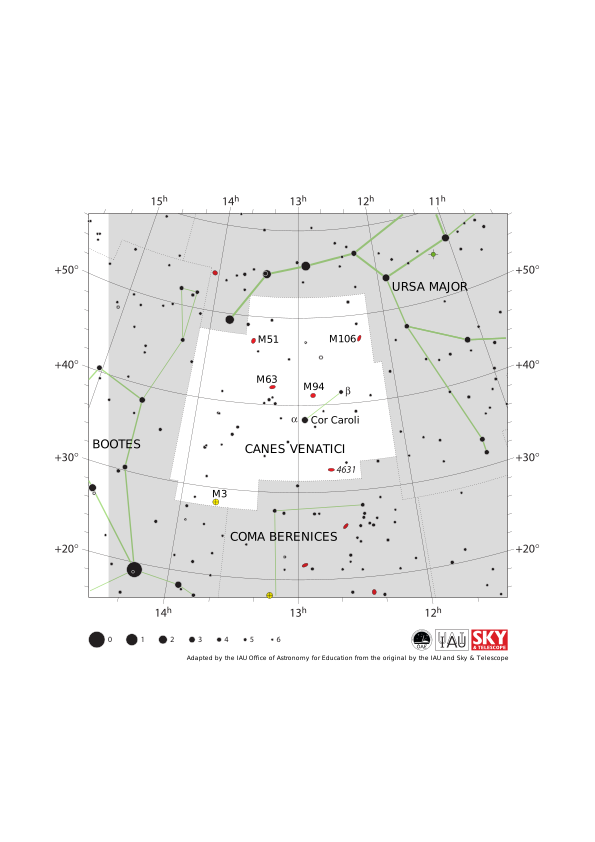
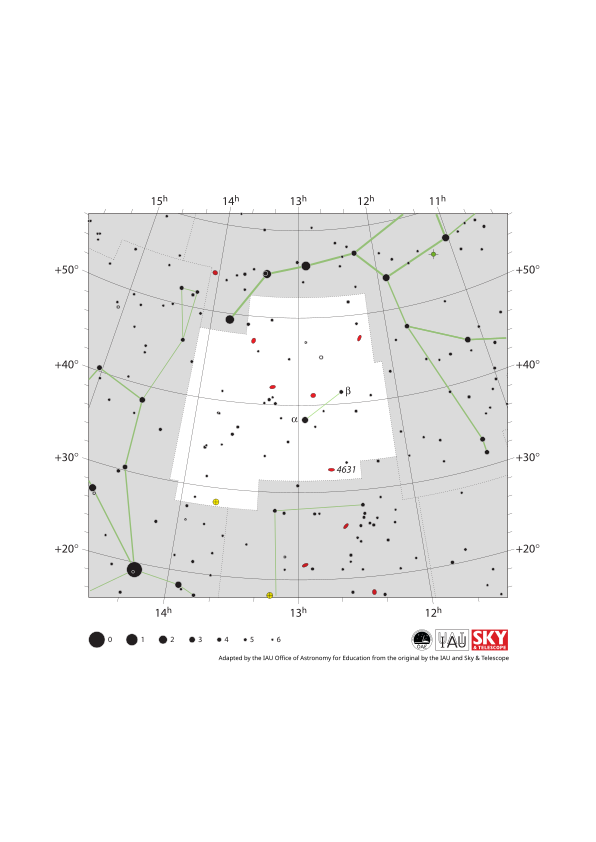
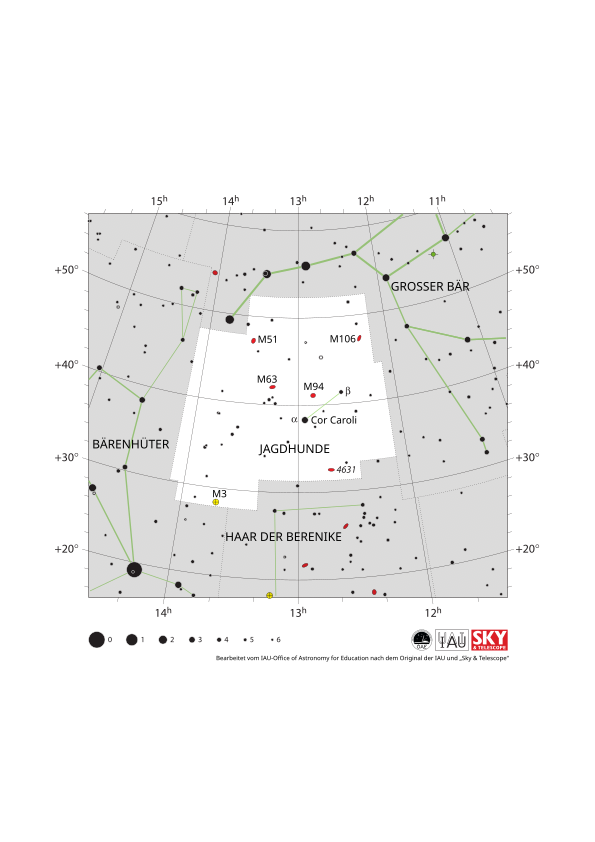
Das Sternbild Jagdhunde (Canes Venatici) mit seinen hellsten Sternen und den umliegenden Sternbildern. Jagdhunde ist umgeben von (im Uhrzeigersinn von oben beginnend): Großer Bär, Haar der Berenike und Bärenhüter.
Jagdhunde ist ein nördliches Sternbild, sodass das gesamte Sternbild zu einem bestimmten Zeitpunkt im Jahr von der gesamten nördlichen Hemisphäre aus sichtbar ist. Das gesamte Sternbild ist auch von den äquatorialen Regionen der südlichen Hemisphäre aus zu sehen, während noch Teile davon von den gemäßigten südlichen Regionen aus sichtbar sind. Am besten lässt sich das Sternbild auf der nördlichen Hemisphäre im späten Frühjahr und auf der südlichen Hemisphäre im späten Herbst beobachten.
Die berühmte Spiralgalaxie, allgemein bekannt als Whirlpool-Galaxie (M51), liegt im Sternbild Jagdhunde und ist hier mit einer roten Ellipse markiert. Weitere bemerkenswerte Spiralgalaxien in diesem Sternhaufen sind M63, M94, M106 und NGC 4631. Alle sind hier mit roten Ellipsen markiert. Der Kugelsternhaufen M3 ist hier durch einen gelben Kreis mit einem überlagerten Pluszeichen gekennzeichnet.
Die y-Achse dieses Diagramms zeigt die Deklination in Grad, wobei Norden oben liegt, und die x-Achse zeigt die Rektaszension in Stunden mit Osten nach links. Die Größe der hier markierten Sterne bezieht sich auf deren scheinbare Helligkeit, ein Maß für die ankommende Strahlungsintensität. Die größeren Punkte repräsentieren hellere Sterne. Die griechischen Buchstaben kennzeichnen die hellsten Sterne des Sternbilds. Diese sind nach Helligkeit geordnet, wobei der hellste Stern mit Alpha bezeichnet wird, der zweithellste mit Beta usw. – wobei diese Reihenfolge nicht immer exakt eingehalten wird. Die gepunkteten Grenzlinien markieren die offiziellen Sternbildgrenzen der IAU, und die durchgezogenen grünen Linien zeigen eine der üblichen Formen, um die Figuren der Sternbilder darzustellen. Weder die Sternbildgrenzen noch die Verbindungslinien zwischen den Sternen sind am realen Himmel zu sehen.
Quelle Diagramm: Bearbeitet vom IAU-Office of Astronomy for Education nach dem Original der IAU und „Sky & Telescope“. Link zur Quelle
Diagramm Übersetzungsstatus: Noch nicht bestätigt von einem Rezensenten
Diagramm-Übersetzer: Simon Kraus
Diagramm-Lizenz: Creative Commons Namensnennung 4.0 International (CC BY 4.0) Creative Commons Namensnennung 4.0 International (CC BY 4.0) Symbole
Ähnliche Glossarbegriffe:
Deklination
, Himmelskoordinaten
, Kugelsternhaufen
, Rektaszension (RA)
, Scheinbare Helligkeit
, Spiralgalaxie
, Sternbild
Kategorien:
Astronomie mit bloßem Auge
Möchtest du deine eigene Übersetzung oder Version dieses Diagrammes erstellen? Dann downloade die SVG
Version dieses Diagrammes auf Englisch (364.75 kB). Du kannst diese Version mit Programmen wie Inkscape (kostenlos) oder Adobe Illustrator (kostenpflichtig) bearbeiten. Bitte verweise dennoch auf den originalen Autor.
Du kannst Deine eigene Version oder Übersetzung dieses Diagrammes erstellen, indem du einer textlosen Version dieses Diagrammes eigenen Text zufügst.
Downloade einfach eine dieser Dateien:
Download Text-Free File ( Bild 82.86 kB)
Download Text-Free PDF File (PDF file 144.38 kB)
Auf anderen Sprachen
Englisch: Canes Venatici Constellation MapItalienisch: Mappa della Costellazione dei Cani da Caccia
The diagram captions presented on the OAE website were written, translated and reviewed by a collective effort from the OAE, the OAE Centers and Nodes, the OAE National Astronomy Education Coordinators (NAECs) and other volunteers. You can find a full list of credits for our translation project here. All media file captions are released under a Creative Commons CC BY-4.0 license and should be credited to "IAU OAE". The media files themselves may have different licenses (see above) and should be credited as listed above under "credit".
Sollte dir ein Fehler in diesem Diagramm oder seiner Unterschrift auffallen, bitte kontaktiere uns.