Glossar-Begriff: A-Stern
Beschreibung: Ein Stern mit der Spektralklasse "A". Astronomen erkennen A-Sterne daran, dass ihre Spektren starke Absorptionslinien von Wasserstoff aufweisen. Sie haben typische (effektive) Temperaturen zwischen etwa 7400 Kelvin (K) und 10.000 K. Im Vergleich zu anderen Sternen erscheinen sie dem menschlichen Auge weiß oder bläulich weiß, außer Extinktionseffekte (entweder durch die Erdatmosphäre oder durch das interstellare Medium) spielen eine Rolle. Beispiele für Sterne der Spektralklasse A sind Sirius, der hellste Stern am Nachthimmel, im Sternbild Großer Hund, sowie Wega im Sternbild Leider.
Ähnliche Begriffe:
Dieser Begriff in anderen Sprachen
Begriffs- und Definitionsstatus Die Originaldefinition dieses Begriffes auf Englisch wurden von einem forschenden Astronom und einer Lehrkraft bestätigt Die Übersetzung dieses Begriffs und seiner Definition warten auf Prüfung und Bestätigung
The OAE Multilingual Glossary is a project of the IAU Office of Astronomy for Education (OAE) in collaboration with the IAU Office of Astronomy Outreach (OAO). The terms and definitions were chosen, written and reviewed by a collective effort from the OAE, the OAE Centers and Nodes, the OAE National Astronomy Education Coordinators (NAECs) and other volunteers. You can find a full list of credits here. All glossary terms and their definitions are released under a Creative Commons CC BY-4.0 license and should be credited to "IAU OAE".
Wenn dir ein inhaltlicher oder Übersetzungsfehler in diesem Glossarbegriff oder dieser Definition auffallen, bitte kontaktiere uns.
Auf anderen Sprachen
- Arabisch: نجوم النسق الأساسي نوع A
- Bengali: "A"-টাইপ নক্ষত্র
- Englisch: A-type Star
- Spanisch: Estrella tipo A
- Französisch: Étoile de type A
- Hebräisch: כוכב מסוג A
- Indonesisch: Bintang kelas A
- Italienisch: Stella di tipo A
- Japanisch: A型星 (externer Link)
- Brasilianisches Portugiesisch: Estrela de tipo A
- Portugiesisch: Estrela de classe A
- Vereinfachtes Chinesisch: A型星
- Traditionelles Chinesisch: A型星
Ähnliche Medien
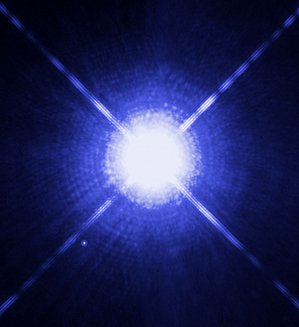
Sirius A mit seinem schwachen Begleitstern, dem Weißen Zwerg Sirius B
Unterschrift: Dieses Bild des Hubble-Weltraumteleskops zeigt Sirius, den hellsten Stern am Nachthimmel der Erde, der als intensiv leuchtendes Objekt in der Mitte mit markanten, kreuzförmigen Beugungsspitzen erscheint. Diese Strahlen sowie das übersättigte Leuchten um den Hauptstern herum entstehen dadurch, dass das Licht von Sirius durch das Teleskop und die Kamera, mit denen dieses Bild aufgenommen wurde, gestreut wird. Etwas unterhalb und links vom Hauptstern markiert ein winziger Lichtpunkt Sirius B, ein weitaus schwächeres Objekt, das dank der hohen Empfindlichkeit des Hubble-Teleskops erfasst werden konnte.
Sirius A ist ein Stern vom Typ A, bekannt für seine hohe Oberflächentemperatur und sein starkes weiß-blaues Licht, während Sirius B ein kompakter Weißer Zwerg ist, der dichte Überrest eines Sterns, der seinen Kernbrennstoff aufgebraucht hat. Zusammen bilden sie ein bekanntes Doppelsternsystem, das etwa 8,6 Lichtjahre von der Erde entfernt liegt.
Sirius B war ursprünglich ein massereicherer und hellerer Stern, der seinen Wasserstoffvorrat schneller verbrauchte als Sirius A. Dies führte dazu, dass sich Sirius B zu einem Roten Riesen entwickelte und schließlich sein Leben als planetarischer Nebel beendete, wobei nur die Überreste seines Kerns als Weißer Zwerg zurückblieben, der Sirius A umkreist.
Bild: NASA, ESA, H. Bond (STScI) und M. Barstow (Universität Leicester)
Quellenlink
License: CC-BY-4.0 Creative Commons Namensnennung 4.0 International (CC BY 4.0) Symbole
Ähnliche Diagramme
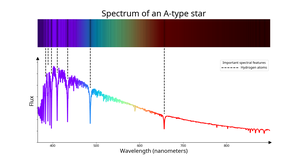
Spectrum of an A-type star
Unterschrift: The spectrum of the A-type star BD-11 1212. The colour of the line between 400 nm and 700 nm roughly corresponds to the colour the human eye would see light of that wavelength. Below 400 nm and above 700 nm, where the human eye can see little to no light, the lines are coloured blue and red respectively.
The black lines show spectral absorption lines caused by atoms and ions of different elements in the star’s atmosphere. These atoms and ions absorb at specific wavelengths, causing sharp, dark lines in the spectra. How strong these lines are depends on the temperature of the star’s atmosphere. Two stars made from the same mix of elements could have spectra with vastly different sets of lines in their spectra if they have different temperatures in their atmospheres. Lines from hydrogen atoms dominate the spectra of A-type stars and are strongest at this spectral type.
Bild: IAU OAE/SDSS/Niall Deacon
License: CC-BY-4.0 Creative Commons Namensnennung 4.0 International (CC BY 4.0) Symbole