Término del glosario: Estrella tipo A
Descripción: Estrella de tipo espectral "A". Los astrónomos identifican las estrellas de tipo A por la presencia de fuertes líneas de absorción de hidrógeno en sus espectros. Tienen temperaturas (efectivas) típicas comprendidas entre 7400 kelvins (K) y 10000 K. En comparación con otras estrellas, a los ojos humanos parecen blancas o blanco azuladas, a menos que el enrojecimiento interestelar o atmosférico sea importante. Sirio, la estrella más brillante del cielo nocturno, y Vega, la estrella con respecto a la cual se miden los brillos de todas las demás estrellas en la escala de magnitud aparente, son estrellas de tipo A.
Términos relacionados:
- Magnitud Aparente
- Sirio
- Tipo espectral
- Estrella
- Enrojecimiento
- Temperatura efectiva
- Línea de absorción
Ver este término en otros idiomas
Estado del término y la definición: La definición original de este término en inglés ha sido aprobada por unastrónomo o astrónoma investigadora y un docente La traducción de este término y su definición aún están pendientes de aprobación
El Glosario multilingüe de la OAE es un proyecto de la Oficina de Astronomía para la Educación de la UAI (OAE) en colaboración con la Oficina de Divulgación de Astronomía de la UAI (OAO). Los términos y definiciones fueron seleccionados, redactados y revisados gracias al esfuerzo colectivo de la OAE, los Centros y Nodos de la OAE, los Coordinadores Nacionales de Educación Astronómica (NAECs) y otros voluntarios. Puedes encontrar una lista completa de créditos aquí. Todos los términos del glosario y sus definiciones se publican bajo la licencia Creative Commons CC BY-4.0 y deben atribuirse a la "IAU OAE".
Si detectas algún error de contenido o de traducción en este término del glosario o en ladefinición, ponte en contacto con nosotros.
En otros idiomas
- Árabe: نجوم النسق الأساسي نوع A
- Bengalí: "A"-টাইপ নক্ষত্র
- Alemán: A-Stern
- Inglés: A-type Star
- Francés: Étoile de type A
- Hebreo: כוכב מסוג A
- Indonesio: Bintang kelas A
- Italiano: Stella di tipo A
- Japonés: A型星 (enlace externo)
- Portugués de Brasil: Estrela de tipo A
- Portugués: Estrela de classe A
- Chino simplificado: A型星
- Chino tradicional: A型星
Contenidos relacionados
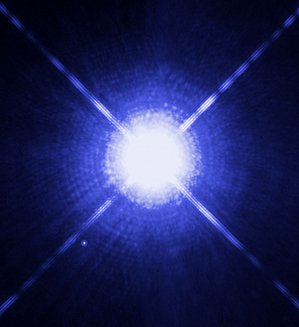
Sirius A with his faint white dwarf companion Sirius B
Pie de foto: This Hubble Space Telescope image highlights Sirius, the brightest star in Earth’s night sky, appearing as an intensely luminous object at the center with prominent cross-shaped diffraction spikes. These spikes, along with the saturated glow around the main star, are caused by the Sirius' light being spread out by the telescope and camera used to make this image. Slightly below and to the left of the main star, a tiny point of light marks Sirius B, a much dimmer object captured thanks to Hubble’s high sensitivity.
Sirius A is an A-type star, known for its high surface temperature and strong white-blue light, while Sirius B is a compact white dwarf, the dense remnant of a star that has exhausted its nuclear fuel. Together, they form a well-known Binary star system located about 8.6 light-years from Earth.
Sirius B was originally a higher mass and brighter star that burned through its hydrogen fuel more quickly than Sirius A. This led to Sirius B evolving into a red giant and eventually ending its life as a planetary nebula, leaving only the remains of its core as a white dwarf orbiting Sirius A.
Crédito: NASA, ESA, H. Bond (STScI), and M. Barstow (University of Leicester)
enlace de crédito
License: CC-BY-4.0 Creative Commons Reconocimiento 4.0 Internacional (CC BY 4.0) íconos
Diagramas relacionados
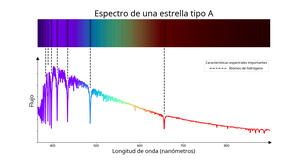
Espectro de una estrella tipo A
Pie de foto: Espectro de la estrella tipo A BD-11 1212. El color de la línea entre 400 nm y 700 nm corresponde aproximadamente al color en que el ojo humano vería la luz de esa longitud de onda. Por debajo de 400 nm y por encima de 700 nm, donde el ojo humano puede ver poca o ninguna luz, las líneas son de color azul y rojo, respectivamente.
Las líneas negras muestran las líneas de absorción espectral causadas por átomos e iones de diferentes elementos de la atmósfera de la estrella. Estos átomos e iones absorben en longitudes de onda específicas, provocando líneas nítidas y oscuras en el espectro. La intensidad de estas líneas depende de la temperatura de la atmósfera de la estrella. Dos estrellas formadas por la misma mezcla de elementos pueden tener espectros con conjuntos de líneas muy diferentes si sus atmósferas tienen temperaturas distintas. Las líneas de los átomos de hidrógeno dominan los espectros de las estrellas tipo A y son más intensas en este tipo espectral.
Crédito: IAU OAE/SDSS/Niall Deacon
License: CC-BY-4.0 Creative Commons Reconocimiento 4.0 Internacional (CC BY 4.0) íconos