Glossar-Begriff: Nebel
Beschreibung: Ein Nebel ist ein weit entferntes Himmelsobjekt, das wie eine Art Wolke aussieht. Normalerweise bestehen Nebel aus interstellarem Gas und Staub. Historisch gesehen umfasste der Begriff Nebel jedes ausgedehnte, "nebliges" Objekt: So wurden früher auch Galaxien - entfernte Sternensysteme ähnlich wie unsere eigene Milchstraße - als Nebel bezeichnet. Heute beschränkt sich der Begriff Nebel auf Gas- und Staubwolken, die Teil des interstellaren Mediums sind - das Gas und der Staub zwischen den Sternen innerhalb einer Galaxie. Es gibt verschiedene Arten von Nebeln: Molekülwolken sind vergleichsweise kalt und dunkel und bestehen überwiegend aus molekularem Wasserstoff; in solchen Wolken werden neue Sterne gebildet. Sehr große Molekülwolken (sogenannte Riesenmolekülwolken) können bis zu einigen Millionen Sonnenmassen an Wasserstoffgas enthalten. Eine andere Art von Nebel entsteht in der Umgebung von jungen Sternen: Junge Sterne stoßen häufig schmale Strahlen (Jets) aus ionisiertem Gas aus. Wenn diese Jets das umgebende Gas energetisch anregen, entsteht eine Art Nebel, der als Herbig-Haro-Objekt bezeichnet wird. Wenn sich massereiche Sterne gebildet haben, bringt ihre intensive Strahlung das umgebende Gas dazu, ein charakteristisches rötliches Licht auszustrahlen. Das Ergebnis sind Nebel aus heißem und ionisiertem Wasserstoffgas, die als HII-Regionen bezeichnet werden. Andere Arten von Nebeln sind mit dem Tod von Sternen verbunden: Sterne mit geringer Masse hinterlassen expandierende Gashüllen, die (etwas verwirrend) als planetarische Nebel bezeichnet werden. Wenn ein massereicher Stern als Supernova explodiert, bildet das ausgestoßene Gas eine Art von Nebel, der Supernova-Überrest genannt wird.
Ähnliche Begriffe:
Dieser Begriff in anderen Sprachen
Begriffs- und Definitionsstatus Die Originaldefinition dieses Begriffes auf Englisch wurden von einem forschenden Astronom und einer Lehrkraft bestätigt Die Übersetzung dieses Begriffs und seiner Definition warten auf Prüfung und Bestätigung
The OAE Multilingual Glossary is a project of the IAU Office of Astronomy for Education (OAE) in collaboration with the IAU Office of Astronomy Outreach (OAO). The terms and definitions were chosen, written and reviewed by a collective effort from the OAE, the OAE Centers and Nodes, the OAE National Astronomy Education Coordinators (NAECs) and other volunteers. You can find a full list of credits here. All glossary terms and their definitions are released under a Creative Commons CC BY-4.0 license and should be credited to "IAU OAE".
Wenn dir ein inhaltlicher oder Übersetzungsfehler in diesem Glossarbegriff oder dieser Definition auffallen, bitte kontaktiere uns.
Ähnliche Medien

Staubwolken und Nebel bei R Coronae Australis
Unterschrift: Das Bild zeigt eine dunkle, staubige Wolke und einige helle Reflexionsnebel in der Nähe des Doppelsterns R Coronae Australis. Die Dunkelwolke erstreckt sich über mehrere Lichtjahre und liegt im Sternbild Corona Australis in der Nähe des Sternbilds Schütze, in Richtung des Zentrums der Milchstraße. Die Wolke scheint das Licht der fernen Sterne hinter ihr zu verschlucken, da die Staubteilchen in ihr das eingestrahlte Licht in alle Richtungen streuen. Dadurch wirkt sie wie eine Leere am Himmel. Dieser Dunkelnebel ist Teil der ausgedehnteren Corona Australis-Molekülwolken. R Coronae Australis ist Teil des Coronet-Haufens, einer Ansammlung von jungen Sternen, die irgendwann in den letzten zwei Millionen Jahren entstanden sind.
Um R Coronae Australis in der Mitte des Bildes befindet sich der kleine Reflexionsnebel NGC 6729, rechts oben liegen die beiden bläulichen Reflexionsnebel NGC 6726 und NGC 6727. In diesen Nebeln streut der Staub das Licht von hellen Sternen in der Nähe des Nebels in Richtung eines Beobachters auf der Erde, so dass er in diesem Bild leuchtet.
Bild: ESO
Quellenlink
License: CC-BY-4.0 Creative Commons Namensnennung 4.0 International (CC BY 4.0) Symbole

The Horsehead Nebula
Unterschrift: This image shows the Horsehead Nebula, located at a distance of about 1,300 light-years from Earth in the Orion constellation, one of the most iconic examples of a dark nebula. A dark nebula is a dense cloud of interstellar dust and cold gas that absorbs and scatters visible light, preventing background stars and glowing gas from reaching our eyes. This false-color image combines data captured through multiple narrowband filters, each isolating light from different elements in the nebula. The dark, horse-shaped silhouette appears sharply outlined against the luminous nebula behind it, where energetic radiation from nearby young stars causes the gas to glow. The uneven distribution of visible stars in this image is not random: regions rich in dust in the lower part of this image appear almost empty, while clearer areas reveal many background stars. The dust acts like a cosmic curtain, hiding stars that lie behind it while allowing stars in front of the cloud to remain visible. Studying such regions helps astronomers understand how nebulae serve as environments where new stars can form.
Bild: T.A.Rector (NOIRLab/NSF/AURA) and Hubble Heritage Team (STScI/AURA/NASA)
Quellenlink
License: CC-BY-4.0 Creative Commons Namensnennung 4.0 International (CC BY 4.0) Symbole
Ähnliche Diagramme
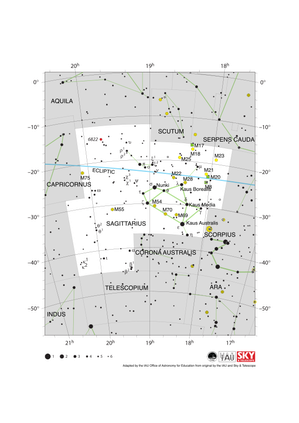
Sagittarius Constellation Map
Unterschrift: The constellation Sagittarius along with its bright stars and surrounding constellations. Sagittarius is surrounded by (going clockwise from the top) Aquila, Scutum, Serpens Cauda, Ophiuchus, Scorpius, Corona Australis, Telescopium, Microscopium and Capricornus. The brighter stars in Sagittarius form a distinctive teapot shape. Sagittarius lies on the ecliptic (shown here as a blue line), this is the path the Sun appears to take across the sky over the course of a year. The Sun is in Sagittarius from mid December to mid January. The other planets of the Solar System can often be found in Sagittarius.
Sagittarius lies south of the celestial equator. The famous teapot asterism is visible for all but the most arctic regions of the world but the most southerly parts of the constellation are not visible in northern parts of Asia, Europe and North America. Sagittarius is most visible in the evenings in the northern hemisphere summer and southern hemisphere winter.
The supermassive black hole Sagittarius A* which lies at the center of our Milky Way Galaxy is sits on the western (here right-hand) edge of Sagittarius. Due to it covering an area at the center of our Galaxy, Sagittarius is home to many star clusters including open clusters (marked here with yellow circles) and globular clusters (marked here with yellow circles with + signs superimposed on them). Three nebulae are also marked here with green squares.
The y-axis of this diagram is in degrees of declination with north as up and the x-axis is in hours of right ascension with east to the left. The sizes of the stars marked here relate to the star's apparent magnitude, a measure of its apparent brightness. The larger dots represent brighter stars. The Greek letters mark the brightest stars in the constellation. These are ranked by brightness with the brightest star being labeled alpha, the second brightest beta, etc., although this ordering is not always followed exactly. The dotted boundary lines mark the IAU's boundaries of the constellations and the solid green lines mark one of the common forms used to represent the figures of the constellations. Neither the constellation boundaries, nor the line marking the ecliptic, nor the lines joining the stars appear on the sky.
Bild: Adapted by the IAU Office of Astronomy for Education from the original by IAU/Sky & Telescope
License: CC-BY-4.0 Creative Commons Namensnennung 4.0 International (CC BY 4.0) Symbole
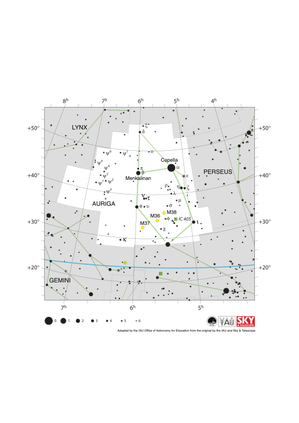
Auriga Constellation Map
Unterschrift: The constellation Auriga with its bright stars and surrounding constellations. Auriga is surrounded by (going clockwise from the top): Camelopardalis, Perseus, Taurus, Gemini and Lynx. Capella, the brightest star in Auriga, is the sixth brightest star in the night sky.
As a northern constellation, Auriga is visible from the whole of the northern hemisphere at some point in the year. The whole of the constellation is visible to equatorial regions of the southern hemisphere with parts of it visible to temperate southern regions. The whole constellation is circumpolar from arctic regions. The constellation is best viewed in the evening in the late northern hemisphere winter and late southern hemisphere summer.
Auriga lies in the plane of the Milky Way and thus hosts a number of open clusters. Of these M36, M37 and M38 are marked on this diagram with yellow circles. IC 405, also known as the flaming star nebula, is marked here with a green square.
The y-axis of this diagram is in degrees of declination with north as up and the x-axis is in hours of right ascension with east to the left. The sizes of the stars marked here relate to the star's apparent magnitude, a measure of its apparent brightness. The larger dots represent brighter stars. The Greek letters mark the brightest stars in the constellation. These are ranked by brightness with the brightest star being labeled alpha, the second brightest beta, etc., although this ordering is not always followed exactly. The dotted boundary lines mark the IAU's boundaries of the constellations and the solid green lines mark one of the common forms used to represent the figures of the constellations. The blue line at the bottom of the diagram marks the ecliptic. Neither the constellation boundaries, nor the line marking the ecliptic, nor the lines joining the stars appear on the sky.
Bild: Adapted by the IAU Office of Astronomy for Education from the original by the IAU and Sky & Telescope
License: CC-BY-4.0 Creative Commons Namensnennung 4.0 International (CC BY 4.0) Symbole
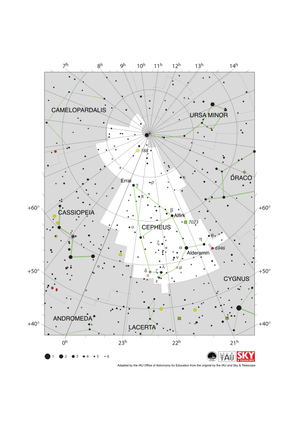
Cepheus Constellation Map
Unterschrift: The constellation Cepheus along with its bright stars and surrounding constellations. Cepheus is surrounded by (going clockwise from the top): Camelopardalis, Ursa Minor, Draco, Cygnus, Lacerta and Cassiopeia. Cepheus is a large constellation. Its most notable star is Delta Cephei, the prototype for the class of variable stars known as Cepheid variables. These are variable stars which can be used to estimate distances both within our galaxy and to nearby galaxies.
Cepheus lies close to the north celestial pole. As such it is circumpolar for arctic and temperate regions of the northern hemisphere. The whole of the constellation is also visible at some point in the year in equatorial regions of the northern hemisphere with parts of it visible in equatorial regions of the southern hemisphere. It is best viewed in the evening in the northern hemisphere late autumn and southern hemisphere late spring.
The open cluster NGC 188 lies in Cepheus and is marked here with a yellow circle. The nebula NGC 7023 also lies in the constellation and is marked with a green square. The red ellipse in the lower right marks the position of the spiral galaxy NGC 6946.
This diagram maps an area around the north celestial pole. Here lines of constant right ascension converge. The right ascension values of these lines are marked on the x-axis above and below the diagram. Some of the lines of constant declination are marked on the y-axis. The sizes of the stars marked here relate to the star's apparent magnitude, a measure of its apparent brightness. The larger dots represent brighter stars. The Greek letters mark the brightest stars in the constellation. Delta Cephei is marked with a circle around a dot as it is a variable star. Mu Cephei is also a variable star marked here as an open circle. These are ranked by brightness with the brightest star being labeled alpha, the second brightest beta, etc., although this ordering is not always followed exactly. The dotted boundary lines mark the IAU's boundaries of the constellations and the solid green lines mark one of the common forms used to represent the figures of the constellations. Neither the constellation boundaries, nor the lines joining the stars appear on the sky.
Bild: Adapted by the IAU Office of Astronomy for Education from the original by the IAU and Sky & Telescope
License: CC-BY-4.0 Creative Commons Namensnennung 4.0 International (CC BY 4.0) Symbole

Schiffskiel-Sternkarte
Unterschrift: Das Sternbild des Schiffskiel mit seinen hellen Sternen und den umliegenden Sternbildern. Im Uhrzeigersinn von oben ist der Schiffskiel umgeben von dem Segel, Hinterdeck Des Schiffs (auch Achterschiff genannt), Maler, dem Fliegenden Fisch, Chamäleon, Fliege und Zentaur. Der Schiffskiel ist bekannt für Canopus, den zweithellsten Stern am Nachthimmel, und für den berühmten veränderlichen Stern Eta Carinae. Bei letzterem handelt es sich um ein Doppelsternsystem aus zwei jungen, sehr massereichen Sternen. Seine Helligkeit hat in den letzten Jahrhunderten stark geschwankt. Zu einem bestimmten Zeitpunkt überstrahlte er Canopus, bevor er um das Viertausendfache abnahm und für das bloße Auge unsichtbar wurde. In den letzten Jahren ist er so hell geworden, dass er wieder ohne Teleskop sichtbar ist.
Da der Schiffskiel ein südliches Sternbild ist, ist die vollständige Konstellation im Laufe des Jahres irgendwann von der gesamten Südhalbkugel aus sichtbar. Das gesamte Sternbild ist auch von den äquatorialen Regionen der nördlichen Hemisphäre aus sichtbar, wobei Teile des Sternbilds auch von den nördlichen Regionen der gemäßigten Breiten aus sichtbar sind.
Die offenen Sternhaufen NGC 2516, NGC 3532 und IC 2602 liegen im Schiffskiel. Sie sind hier durch gelbe Kreise markiert. Der Carina-Nebel, auch bekannt als NGC 3372, liegt in diesem Sternbild. Dieser große Nebel enthält viele massereiche junge Sterne, darunter Eta Carinae.
Dieses Diagramm zeigt ein Gebiet um den südlichen Himmelspol. Hier konvergieren Linien konstanter Rektaszension. Die Rektaszensionswerte dieser Linien sind auf der x-Achse oberhalb und unterhalb des Diagramms markiert. Einige der Linien konstanter Deklination sind auf der y-Achse eingezeichnet. Die Größe der markierten Sterne bezieht sich auf die scheinbare Helligkeit des Sterns. Je größer die Punkte, desto heller scheinen die Sterne die sie darstellen. Die griechischen Buchstaben kennzeichnen die hellsten Sterne des Sternbildes. Sie sind nach Helligkeit geordnet, wobei der hellste Stern mit Alpha, der zweithellste mit Beta usw. bezeichnet wird, obwohl diese Reihenfolge nicht immer genau eingehalten wird. Der Schiffskiel war früher zusammen mit dem Segel und dem Hinterdeck des Schiffs (auch Achterschiff genannt) Teil des größeren Sternbilds Schiff Argo. Da die Buchstabenbezeichnungen für die Sterne vor dieser Aufteilung geschaffen wurden, sind die griechischen Buchstabenbezeichnungen jetzt zwischen den drei Sternbildern aufgeteilt, wobei der Schiffskiel Sterne mit den Bezeichnungen Alpha und Beta, aber nicht Gamma oder Delta hat. Die gepunkteten Begrenzungslinien markieren die IAU-Grenzen der Sternbilder, und die durchgezogenen grünen Linien markieren eine der üblichen Formen, die zur Darstellung der Figuren der Sternbilder verwendet werden. Weder die Sternbildgrenzen noch die Linien, die die Sterne verbinden, sind am Himmel zu sehen.
Bild: Angepasst vom IAU Office of Astronomy for Education nach dem Original der IAU und Sky & Telescope
License: CC-BY-4.0 Creative Commons Namensnennung 4.0 International (CC BY 4.0) Symbole
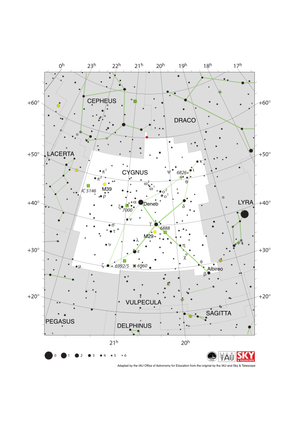
Cygnus Constellation Map
Unterschrift: The constellation Cygnus with its bright stars and surrounding constellations. Cygnus is surrounded by (going clockwise from the top): Cepheus, Draco, Lyra, Vulpecula, Pegasus and Lacerta. Cygnus is notable for its brightest star Deneb. This forms one vertex of the prominent Summer Triangle asterism that is visible in northern hemisphere summer evenings.
Cygnus is a northern constellation and thus the whole of the constellation is visible at some point in the year in the whole northern hemisphere. The whole constellation is also visible from equatorial regions of the southern hemisphere with parts of the constellation visible from temperate southern regions.
The plane of the Milky Way runs through Cygnus and thus the constellation is rich in nebulae and star clusters. These include the North America Nebula (NGC 7000) and the Crescent Nebula (NGC 6888). The Veil Nebula is a huge supernova remnant, parts of which are marked here as NGC 6960 and NGC 6992/5. All of the previously-mentioned nebulae are marked with green squares. The planetary nebula NGC 6826 is marked here with a green circle superimposed on a plus sign. The open star clusters M29 and M39 are marked here with yellow circles.
The y-axis of this diagram is in degrees of declination with north as up and the x-axis is in hours of right ascension with east to the left. The sizes of the stars marked here relate to the star's apparent magnitude, a measure of its apparent brightness. The larger dots represent brighter stars. The Greek letters mark the brightest stars in the constellation. These are ranked by brightness with the brightest star being labeled alpha, the second brightest beta, etc., although this ordering is not always followed exactly. The dotted boundary lines mark the IAU's boundaries of the constellations and the solid green lines mark one of the common forms used to represent the figures of the constellations. Neither the constellation boundaries, nor the lines joining the stars appear on the sky.
Bild: Adapted by the IAU Office of Astronomy for Education from the original by the IAU and Sky & Telescope
License: CC-BY-4.0 Creative Commons Namensnennung 4.0 International (CC BY 4.0) Symbole
Ähnliche Aktivitäten
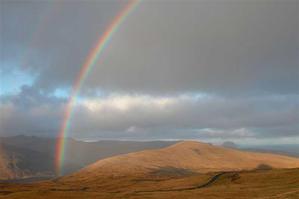
Reading the Rainbow
astroEDU educational activity (links to astroEDU website) Description: By understanding how rainbows work, you can discover about light and its properties, learning about stars, nebulae, galaxies, and our Universe.
License: CC-BY-4.0 Creative Commons Namensnennung 4.0 International (CC BY 4.0) Symbole
Altersgruppen:
14-16
, 16-19
, 19+
Bildungsniveau:
Informal
, Middle School
, Secundaria
, University
Lernbereiche:
Interactive Lecture
, Observation based
, Structured-inquiry learning
Kosten:
Low Cost
Dauer:
1 hour 30 mins
Gruppengröße:
Group
Fähigkeiten:
Analysing and interpreting data
, Asking questions
, Engaging in argument from evidence