Término del glosario: Antimateria
Descripción: A principios del siglo XX, los físicos teóricos se dieron cuenta de que para cada tipo de partícula debía existir un tipo correspondiente de antipartícula: una partícula con la misma masa, pero con propiedades completamente opuestas, en particular una carga eléctrica opuesta. Pocos años después se descubrió la antipartícula del electrón: El "positrón" tiene la misma masa que un electrón, pero carga eléctrica opuesta. Para algunas partículas neutras, como el fotón, la antipartícula es la misma que la partícula. Cuando la partícula y su correspondiente antipartícula se encuentran, pueden aniquilarse para formar fotones. Nuestro Universo parece estar hecho principalmente de materia, no de antimateria formada por antipartículas. Los detalles de este fenómeno son objeto de investigación.
Términos relacionados:
Ver este término en otros idiomas
Estado del término y la definición: La definición original de este término en inglés ha sido aprobada por unastrónomo o astrónoma investigadora y un docente La traducción de este término y su definición aún están pendientes de aprobación
El Glosario multilingüe de la OAE es un proyecto de la Oficina de Astronomía para la Educación de la UAI (OAE) en colaboración con la Oficina de Divulgación de Astronomía de la UAI (OAO). Los términos y definiciones fueron seleccionados, redactados y revisados gracias al esfuerzo colectivo de la OAE, los Centros y Nodos de la OAE, los Coordinadores Nacionales de Educación Astronómica (NAECs) y otros voluntarios. Puedes encontrar una lista completa de créditos aquí. Todos los términos del glosario y sus definiciones se publican bajo la licencia Creative Commons CC BY-4.0 y deben atribuirse a la "IAU OAE".
Si detectas algún error de contenido o de traducción en este término del glosario o en ladefinición, ponte en contacto con nosotros.
En otros idiomas
- Árabe: المادة المضادة
- Bengalí: প্রতিপদার্থ (Antimatter)
- Alemán: Antimaterie
- Inglés: Antimatter
- Francés: Antimatière
- Hindi: अँटीमॅटर (प्रतिपदार्थ)
- Italiano: Antimateria
- Japonés: 反物質 (enlace externo)
- Maratí: अँटीमॅटर (प्रतिपदार्थ)
- Portugués de Brasil: Antimatéria
- Chino simplificado: 反物质
- Chino tradicional: 反物質
Contenidos relacionados
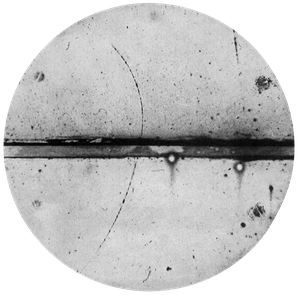
The discovery of positron
Pie de foto: This historic photograph shows the track of a positron moving through a cloud chamber from bottom to top. When a charged particle moves through a cloud chamber it leaves behind a line of condensation, making its path visible. Cloud chambers are normally build with magnetic fields. This curves the path of the charged particle, with the curve of the path giving more information about the properties of the particle.
Here we see the first positron (the antiparticle of an electron). A thick horizontal band in the middle is a lead plate in the cloud chamber that slowed the particle down, causing the positron's path to curve more sharply after crossing the plate. This image, taken in 1932, provided the first clear visual evidence of the positron.
The discovery of the positron confirmed that antimatter exists and opened an important field of research in modern physics.
Crédito: Carl D. Anderson
enlace de crédito
License: PD Dominio público íconos