Glossary term: अँटीमॅटर (प्रतिपदार्थ)
Description: 20 व्या शतकाच्या सुरुवातीस, सैद्धांतिक भौतिकशास्त्रज्ञांना असे समजले की प्रत्येक प्रकारच्या कणांसाठी संबंधित प्रकारचे प्रतिकण असावेत: समान वस्तुमान असलेला कण, परंतु अन्यथा पूर्णपणे विरुद्ध गुणधर्म, विशेषतः विरुद्ध विद्युत चार्ज. काही वर्षांनंतर, इलेक्ट्रॉनचे प्रतिकण सापडले: "पॉझिट्रॉन" चे वस्तुमान इलेक्ट्रॉन सारखेच आहे, परंतु विद्युत शुल्काच्या विरुद्ध आहे. काही उदासीन कणांसाठी, जसे फोटॉन, प्रतिकण सारखाच असतो. जेव्हा कण आणि संबंधित प्रतिकण एकत्र येतात तेव्हा ते नष्ट होऊन फोटॉन तयार करतात. आपले विश्व पदार्थांपासून बनलेले दिसते, प्रतिकणांनी बनलेले प्रतिपदार्थांचे नाही. ते कसे घडले याचा तपशील हा चालू संशोधनाचा विषय आहे.
Related Terms:
See this term in other languages
Term and definition status: The original definition of this term in English have been approved by a research astronomer and a teacher The translation of this term and its definition is still awaiting approval
The OAE Multilingual Glossary is a project of the IAU Office of Astronomy for Education (OAE) in collaboration with the IAU Office of Astronomy Outreach (OAO). The terms and definitions were chosen, written and reviewed by a collective effort from the OAE, the OAE Centers and Nodes, the OAE National Astronomy Education Coordinators (NAECs) and other volunteers. You can find a full list of credits here. All glossary terms and their definitions are released under a Creative Commons CC BY-4.0 license and should be credited to "IAU OAE".
If you notice a factual or translation error in this glossary term or definition then please get in touch.
In Other Languages
- अरेबिक: المادة المضادة
- बंगाली: প্রতিপদার্থ (Antimatter)
- जर्मन: Antimaterie
- इंग्रजी: Antimatter
- स्पॅनिश : Antimateria
- फ्रेंच: Antimatière
- हिंदी: अँटीमॅटर (प्रतिपदार्थ)
- इटालियन: Antimateria
- जपानी: 反物質 (external link)
- ब्रझिलियन पोर्तुगीज: Antimatéria
- सोपी चायनिज: 反物质
- पारंपारिक चायनिज: 反物質
Related Media
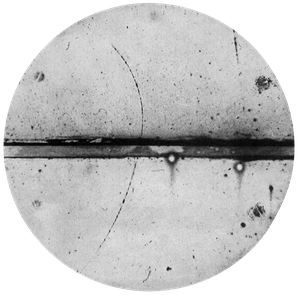
The discovery of positron
Caption: This historic photograph shows the track of a positron moving through a cloud chamber from bottom to top. When a charged particle moves through a cloud chamber it leaves behind a line of condensation, making its path visible. Cloud chambers are normally build with magnetic fields. This curves the path of the charged particle, with the curve of the path giving more information about the properties of the particle.
Here we see the first positron (the antiparticle of an electron). A thick horizontal band in the middle is a lead plate in the cloud chamber that slowed the particle down, causing the positron's path to curve more sharply after crossing the plate. This image, taken in 1932, provided the first clear visual evidence of the positron.
The discovery of the positron confirmed that antimatter exists and opened an important field of research in modern physics.
Credit: Carl D. Anderson
credit link
License: PD Public Domain icons