Termo do glossário: Antimatéria
Descrição: No início do século XX, os físicos teóricos perceberam que para cada tipo de partícula deveria existir um tipo correspondente de antipartícula – uma partícula com a mesma massa, mas com propriedades opostas, em particular carga elétrica oposta. Alguns anos depois, foi descoberta a antipartícula do elétron: o pósitron, que tem a mesma massa do elétron, mas carga elétrica oposta. Para algumas partículas neutras, como o fóton, a antipartícula é a mesma que a própria partícula. Quando uma partícula e a sua antipartícula correspondente se encontram, elas podem se aniquilar, formando fótons. Nosso universo parece ser composto principalmente de matéria, e não de antimatéria, formada por antipartículas. Os detalhes de como isso aconteceu são objeto de pesquisas em andamento.
Termos relacionados:
Ver este termo em outros idiomas
Status do termo e da definição: A definição original deste termo em inglês foi aprovada por um astrônomo(a) pesquisador(a) e um(a) professor(a) A tradução deste termo e de sua definição ainda aguarda aprovação
O Glossário Multilíngue da OAE é um projeto do Escritório da IAU de Astronomia para a Educação (OAE) em colaboração com o Escritório da IAU para Divulgação da Astronomia (OAO). Os termos e definições foram selecionados, escritos e revisados por meio de um esforço coletivo da OAE, dos Centros e Nós da OAE, dos Coordenadores Nacionais de Educação em Astronomia (NAECs) da OAE e de outros voluntários. Você pode encontrar uma lista completa dos créditos aqui. Todos os termos do glossário e suas definições são disponibilizados sob uma licença Creative Commons CC BY-4.0 e devem ser creditados à "IAU OAE".
Se você notar algum erro factual ou de tradução neste termo do glossário ou em sua definição, por favor entre em contato.
Em outros idiomas
- Árabe: المادة المضادة
- Bengali: প্রতিপদার্থ (Antimatter)
- Alemão: Antimaterie
- Inglês: Antimatter
- Espanhol: Antimateria
- Francês: Antimatière
- Hindi: अँटीमॅटर (प्रतिपदार्थ)
- Italiano: Antimateria
- Japonês: 反物質 (link externo)
- Marathi: अँटीमॅटर (प्रतिपदार्थ)
- Chinês Simplificado: 反物质
- Chinês Tradicional: 反物質
Mídia relacionada
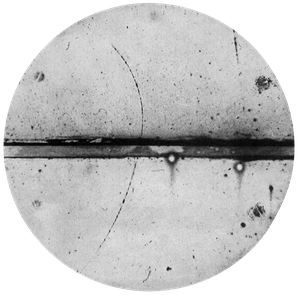
The discovery of positron
Legenda: This historic photograph shows the track of a positron moving through a cloud chamber from bottom to top. When a charged particle moves through a cloud chamber it leaves behind a line of condensation, making its path visible. Cloud chambers are normally build with magnetic fields. This curves the path of the charged particle, with the curve of the path giving more information about the properties of the particle.
Here we see the first positron (the antiparticle of an electron). A thick horizontal band in the middle is a lead plate in the cloud chamber that slowed the particle down, causing the positron's path to curve more sharply after crossing the plate. This image, taken in 1932, provided the first clear visual evidence of the positron.
The discovery of the positron confirmed that antimatter exists and opened an important field of research in modern physics.
Crédito: Carl D. Anderson
link do crédito
License: PD Domínio Público ícones