Glossar-Begriff: Antimaterie
Beschreibung: Zu Beginn des 20. Jahrhunderts erkannten theoretische Physiker, dass es für jede Art von Teilchen eine entsprechende Art von Antiteilchen geben muss: ein Teilchen mit der gleichen Masse, aber ansonsten völlig entgegengesetzten Eigenschaften, insbesondere einer entgegengesetzten elektrischen Ladung. Einige Jahre später wurde das Antiteilchen des Elektrons entdeckt: Das "Positron" hat die gleiche Masse wie ein Elektron, aber die entgegengesetzte elektrische Ladung. Bei einigen neutralen Teilchen, wie dem Photon, ist das Antiteilchen dasselbe wie das Teilchen. Wenn ein Teilchen und sein entsprechendes Antiteilchen aufeinandertreffen, können sie sich vernichten und Photonen erzeugen. Unser Universum scheint hauptsächlich aus Materie zu bestehen, nicht aus Antimaterie, die aus Antiteilchen besteht. Wie es dazu gekommen ist, ist Gegenstand laufender Forschungen.
Ähnliche Begriffe:
Dieser Begriff in anderen Sprachen
Begriffs- und Definitionsstatus Die Originaldefinition dieses Begriffes auf Englisch wurden von einem forschenden Astronom und einer Lehrkraft bestätigt Die Übersetzung dieses Begriffs und seiner Definition warten auf Prüfung und Bestätigung
The OAE Multilingual Glossary is a project of the IAU Office of Astronomy for Education (OAE) in collaboration with the IAU Office of Astronomy Outreach (OAO). The terms and definitions were chosen, written and reviewed by a collective effort from the OAE, the OAE Centers and Nodes, the OAE National Astronomy Education Coordinators (NAECs) and other volunteers. You can find a full list of credits here. All glossary terms and their definitions are released under a Creative Commons CC BY-4.0 license and should be credited to "IAU OAE".
Wenn dir ein inhaltlicher oder Übersetzungsfehler in diesem Glossarbegriff oder dieser Definition auffallen, bitte kontaktiere uns.
Auf anderen Sprachen
- Arabisch: المادة المضادة
- Bengali: প্রতিপদার্থ (Antimatter)
- Englisch: Antimatter
- Spanisch: Antimateria
- Französisch: Antimatière
- Hindi: अँटीमॅटर (प्रतिपदार्थ)
- Italienisch: Antimateria
- Japanisch: 反物質 (externer Link)
- Marathi: अँटीमॅटर (प्रतिपदार्थ)
- Brasilianisches Portugiesisch: Antimatéria
- Vereinfachtes Chinesisch: 反物质
- Traditionelles Chinesisch: 反物質
Ähnliche Medien
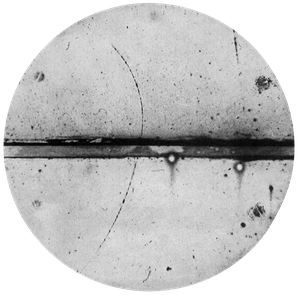
Die Entdeckung des Positrons
Unterschrift: Dieses historische Foto zeigt die Spur eines Positrons, das sich von unten nach oben durch eine Nebelkammer bewegt. Wenn sich ein geladenes Teilchen durch eine Nebelkammer bewegt, hinterlässt es eine Kondensationsspur, die seinen Weg sichtbar macht. Nebelkammern verfügen in der Regel über ein Magnetfeld. Diese krümmen die Bahn des geladenen Teilchens, wobei die Krümmung der Bahn weitere Informationen über die Eigenschaften des Teilchens liefert.
Hier sehen wir den ersten Nachweis eines Positrons (das Antiteilchen des Elektrons). Das breite horizontales Band in der Mitte ist eine Bleiplatte in der Nebelkammer, die das Teilchen abgebremst hat, wodurch sich die Bahn des Positrons nach dem Passieren der Platte stärker krümmt. Dieses 1932 aufgenommene Bild lieferte den ersten eindeutigen visuellen Beweis für die Existenz des Positrons.
Die Entdeckung des Positrons bestätigte die Existenz von Antimaterie und eröffnete damit ein wichtiges Forschungsgebiet der modernen Physik.
Bild: Carl D. Anderson
Quellenlink
License: PD Gemeinfrei Symbole